PPG Stress Detection Methods: Physiological Stress Measurement from PPG Features
**Stress detection is one of the most commercially visible applications of PPG technology, yet it remains one of the most scientifically challenging.*...
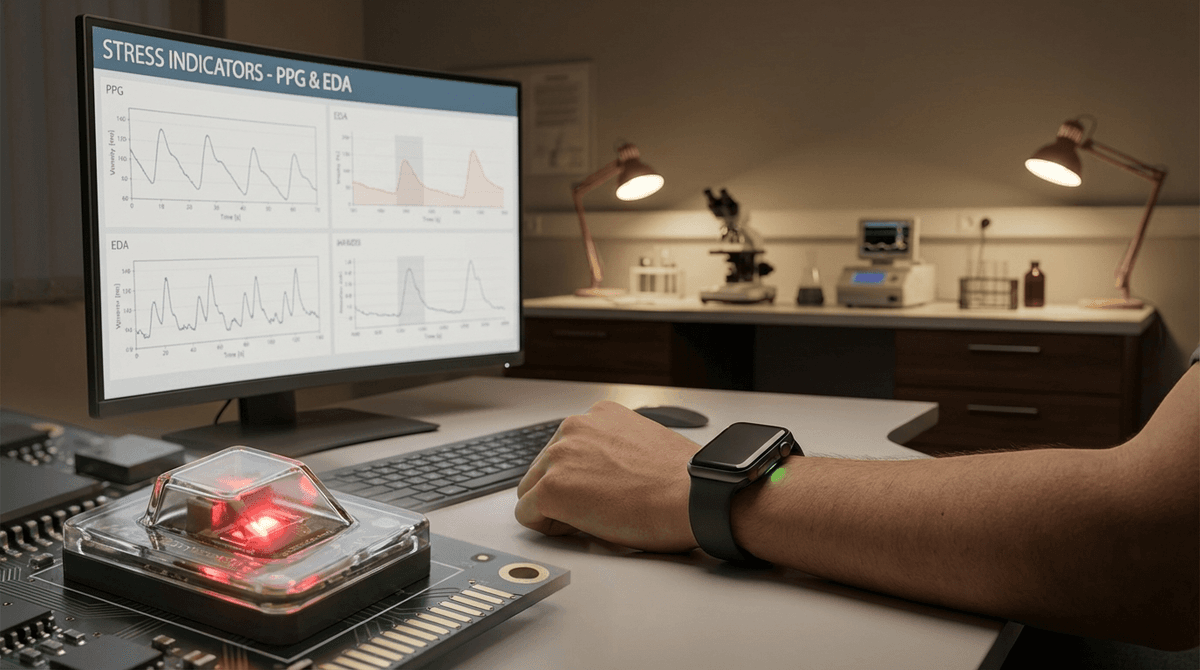
Stress detection is one of the most commercially visible applications of PPG technology, yet it remains one of the most scientifically challenging. Every major smartwatch and fitness tracker now offers some form of stress monitoring, typically based on PPG-derived heart rate variability. The underlying science is grounded in well-established autonomic physiology: psychological and physical stress activate the sympathetic nervous system and suppress parasympathetic activity, producing measurable changes in heart rate dynamics and peripheral vascular tone. However, the path from these physiological principles to a reliable, real-world stress detector involves navigating substantial technical and methodological challenges.
This article provides a rigorous technical examination of PPG-based stress detection, covering the physiological mechanisms that link stress to PPG signal changes, the specific features used for detection, machine learning classification approaches, validation methodology, and the current limitations of the technology. For foundational understanding of PPG signal acquisition, see our guide to PPG technology.
Physiological Basis of Stress-Induced PPG Changes
The Stress Response Pathway
The acute stress response begins with the perception of a threatening or demanding stimulus by the cerebral cortex and limbic system. This triggers two primary effector pathways:
The sympatho-adrenal-medullary (SAM) axis produces rapid (seconds) autonomic changes: increased heart rate, cardiac contractility, and peripheral vasoconstriction via norepinephrine release from sympathetic nerve terminals and epinephrine release from the adrenal medulla.
The hypothalamic-pituitary-adrenal (HPA) axis produces slower (minutes) hormonal changes: cortisol release from the adrenal cortex, which has widespread metabolic and immune effects.
PPG primarily captures the SAM axis response through its effects on cardiovascular dynamics. The HPA axis response is not directly measurable by PPG, though sustained cortisol elevation may produce secondary cardiovascular effects detectable over longer time scales.
Specific PPG Signal Changes During Stress
Sympathetic activation and parasympathetic withdrawal during stress produce the following measurable changes in the PPG signal:
Heart rate increase: Resting heart rate typically increases by 5-15 bpm during moderate psychological stress (Stroop test, mental arithmetic) and by 15-30 bpm during severe stress (public speaking, Trier Social Stress Test). The magnitude depends on baseline fitness, stress severity, and individual reactivity.
Reduced inter-beat interval variability: The most robust stress marker. RMSSD decreases by 20-40% during acute stress, and HF power decreases by 30-60%. This reflects parasympathetic withdrawal, as vagal modulation is the primary source of rapid beat-to-beat variability. The LF/HF ratio typically increases, though the magnitude and direction of LF power change alone is inconsistent across studies.
Decreased pulse wave amplitude (PWA): Sympathetic-mediated vasoconstriction in peripheral arterioles reduces the pulsatile blood volume at the measurement site, decreasing the AC amplitude of the PPG signal by 10-30%. This is one of the most specific PPG indicators of sympathetic activation but is also affected by skin temperature and sensor contact pressure.
Pulse waveform morphology changes: The PPG pulse contour steepens during stress, with faster systolic upstroke and altered diastolic decay. The dicrotic notch amplitude decreases, and the reflection index changes as arterial tone increases. These morphological changes can be quantified through second derivative analysis, as described in our article on PPG vascular assessment.
Decreased pulse transit time (PTT): The time delay between cardiac contraction and pulse arrival at the periphery decreases during stress due to increased blood pressure and arterial stiffness. PTT reduction of 5-15 ms is typical during moderate psychological stress.
Respiratory rate changes: Stress often increases respiratory rate and decreases respiratory depth. These changes are detectable in the PPG signal through respiratory-induced amplitude and baseline modulations.
PPG Feature Extraction for Stress Detection
HRV-Based Features
HRV features derived from PPG inter-beat intervals are the most widely used and best-validated features for stress detection. The standard feature set includes:
Time-domain features:
- Mean RR interval (inversely proportional to heart rate)
- SDNN (overall variability, decreases with stress)
- RMSSD (parasympathetic activity, decreases with stress)
- pNN50 (parasympathetic activity, decreases with stress)
- SDSD (standard deviation of successive differences)
Frequency-domain features:
- LF power (0.04-0.15 Hz, mixed sympathetic/parasympathetic)
- HF power (0.15-0.40 Hz, parasympathetic, decreases with stress)
- LF/HF ratio (sympathovagal balance index, increases with stress)
- Total power (overall autonomic modulation)
- Normalized LF and HF (LF and HF as percentages of total power)
Nonlinear features:
- Sample entropy (complexity, typically decreases with stress)
- SD1 and SD2 from Poincare plot (SD1 reflects parasympathetic, decreases with stress)
- DFA alpha-1 (short-term scaling, deviates from 1.0 during stress)
- Approximate entropy
- Correlation dimension
For detailed reference values and age-related changes in these metrics, see our HRV charts and our guide on how to improve HRV.
Pulse Waveform Features
Beyond inter-beat interval analysis, the morphology of individual PPG pulses carries stress-related information:
Amplitude features:
- AC amplitude (pulse wave amplitude, decreases with vasoconstriction)
- DC level (baseline absorption, changes with venous pooling)
- AC/DC ratio (perfusion index, decreases during stress)
- Pulse amplitude variability (PAV, changes reflect sympathetic vascular modulation)
Temporal features:
- Crest time (time to systolic peak, decreases during stress)
- Pulse width at 50% amplitude
- Systolic-to-diastolic area ratio
- Dicrotic notch time and amplitude
Derivative features:
- Maximum systolic upslope (first derivative peak, increases during stress)
- APG wave ratios (a, b, c, d, e wave amplitudes from second derivative)
- Pulse wave velocity indices
Spectral features:
- Harmonic content of the pulse waveform
- Spectral centroid shift
- Energy distribution across harmonics
Combined Feature Sets
The most effective stress detection models combine HRV and pulse waveform features. Gjoreski et al. (2017) (DOI: 10.3390/s17102369) systematically evaluated feature importance for binary stress classification using wrist PPG and found the following feature ranking by information gain:
- RMSSD (information gain = 0.42)
- HF power (0.38)
- Mean heart rate (0.35)
- LF/HF ratio (0.31)
- Pulse wave amplitude (0.28)
- SD1 (0.27)
- Sample entropy (0.24)
- pNN50 (0.22)
Combining the top 10 features yielded significantly better classification (accuracy 85.1%) than using any single feature (best individual: RMSSD at 73.4%).
Machine Learning Classifiers for Stress Detection
Traditional Machine Learning
The stress detection literature has extensively evaluated conventional classifiers on PPG-derived features:
Support Vector Machines (SVM): SVMs with radial basis function (RBF) kernels are among the most commonly used and best-performing classifiers for PPG-based stress detection. Healey and Picard (2005) (DOI: 10.1109/TITS.2005.848368) achieved 97% accuracy for three-level stress classification during driving using multimodal physiological signals including PPG. With PPG-only features, SVMs typically achieve 78-88% binary classification accuracy.
Random Forest: Random forests offer interpretable feature importance rankings and robust performance without extensive hyperparameter tuning. Typical binary stress classification accuracy from PPG features ranges from 80-90%. Random forests are particularly useful for identifying which features contribute most to stress discrimination.
Gradient Boosted Trees: XGBoost and LightGBM models have shown strong performance in recent studies, achieving 82-92% accuracy for binary stress detection with proper cross-validation. These models handle mixed feature types well and are less prone to overfitting than deep learning models given the typically small sample sizes in stress detection studies.
k-Nearest Neighbors (kNN): Simple but effective for stress detection, achieving 75-85% accuracy. kNN's performance is sensitive to feature scaling and the choice of k.
Deep Learning Approaches
Deep learning models have been increasingly applied to PPG-based stress detection, operating either on extracted features or directly on raw PPG waveforms:
1D Convolutional Neural Networks (CNN): Heo et al. (2021) trained a 1D CNN directly on 60-second raw PPG segments for binary stress classification, achieving 84.7% accuracy on the WESAD dataset (15 subjects, Stroop test and Trier Social Stress Test). The CNN learned to extract both HRV-related and morphological features without explicit feature engineering.
LSTM Networks: Schmidt et al. (2018) (DOI: 10.1145/3242969.3242985) used LSTM networks on the WESAD dataset to capture temporal dynamics in PPG-derived features, achieving 85.7% accuracy for three-class classification (baseline, stress, amusement) with PPG and electrodermal activity (EDA) combined, and 79.3% with PPG alone.
Transformer Models: Recent work by Can et al. (2023) applied attention-based transformer architectures to PPG stress detection, achieving 87.2% binary accuracy on a dataset of 45 subjects. The attention mechanism provided interpretability by highlighting which temporal segments of the PPG recording were most informative for stress classification.
Personalization and Transfer Learning
A fundamental challenge in PPG-based stress detection is individual variability. Autonomic stress responses vary substantially between individuals due to differences in baseline autonomic tone, cardiovascular fitness, stress reactivity, and habituation. Models trained on population-level data may perform poorly for specific individuals.
Personalized models address this by calibrating to individual baselines. Siirtola (2019) (DOI: 10.3390/s19204402) demonstrated that personalizing a random forest stress classifier with just 10 minutes of individual baseline data improved accuracy from 72.3% (population model) to 87.6% (personalized model) in a leave-one-subject-out evaluation of 20 subjects.
Transfer learning approaches pretrain on large datasets and fine-tune on individual data, achieving a balance between population-level patterns and individual specificity. This is particularly relevant for consumer wearable applications where individual calibration must be unobtrusive.
Validation Methodology and Datasets
Stress Induction Protocols
The validity of a stress detection study depends heavily on the stress induction protocol used:
Trier Social Stress Test (TSST): The gold standard for laboratory stress induction. Subjects prepare and deliver a speech and perform mental arithmetic before an evaluative audience. The TSST reliably produces large cortisol responses (200-400% increase from baseline) and significant autonomic activation. It provides robust ground truth for algorithm development.
Stroop Color-Word Test: A cognitive interference task that produces moderate psychological stress with significant autonomic activation but smaller cortisol responses than the TSST. Easily standardized and repeatable.
Mental Arithmetic: Serial subtraction tasks (e.g., counting backward from 1,000 by 7 or 13) under time pressure. Produces moderate stress with primarily cognitive demand.
Cold Pressor Test: Immersion of the hand in ice water (0-4 degrees Celsius) for 1-3 minutes. Produces strong sympathetic activation and pain-related stress but is not purely psychological.
Public Benchmark Datasets
WESAD (Wearable Stress and Affect Detection): The most widely used benchmark dataset for PPG-based stress detection. Contains data from 15 subjects wearing chest (RespiBAN) and wrist (Empatica E4) sensors during baseline, stress (TSST), amusement (funny video clips), and meditation conditions. Includes PPG, EDA, accelerometer, temperature, ECG, EMG, and respiration signals (Schmidt et al., 2018; DOI: 10.1145/3242969.3242985).
SWELL-KW: Office work stress dataset with 25 subjects performing typical office tasks under varying stress conditions (email interruptions, time pressure). Includes PPG, EDA, ECG, facial expression, and computer interaction data (Koldijk et al., 2014; DOI: 10.1145/2663204.2663257).
CLAS (Cognitive Load, Affect, and Stress): Dataset with 62 subjects performing cognitive tasks of varying difficulty while physiological signals including PPG are recorded (Markova et al., 2019).
Evaluation Pitfalls
Many published stress detection studies report inflated accuracy due to methodological flaws:
Within-subject data leakage: Training and testing on data from the same subjects without proper cross-validation. Leave-one-subject-out (LOSO) cross-validation should be the minimum standard, as within-subject splits inflate accuracy by 10-20%.
Class imbalance: Stress induction protocols typically produce much less stress data than baseline data. Accuracy on imbalanced datasets can be misleading; F1 score, balanced accuracy, and area under the ROC curve (AUC) are more informative metrics.
Short recording durations: Very short feature windows (less than 30 seconds) may not capture sufficient HRV information for reliable frequency-domain features. Most HRV standards recommend minimum 1-minute windows for time-domain and 2-minute windows for reliable LF estimation.
Ignoring activity confounds: Physical activity produces autonomic changes similar to psychological stress. Studies that do not control for or account for physical activity overestimate real-world stress detection accuracy.
Real-World Implementation Challenges
Motion Artifacts
Wrist-based PPG during daily life is heavily corrupted by motion artifacts, which are the primary source of false positive stress detections. Arm movements during normal activities produce autonomic-like changes in the PPG signal (increased heart rate estimation, decreased apparent HRV) that mimic stress responses. Robust stress detection requires either motion-free segments (detected via accelerometer) or artifact-resistant algorithms.
For detailed discussion of motion artifact handling, see our guide to PPG motion artifact removal.
Contextual Confounders
Numerous non-stress factors alter PPG-derived features in ways that resemble stress responses:
- Physical activity: Even mild activity (walking, climbing stairs) increases heart rate and decreases HRV
- Caffeine: Increases heart rate 3-10 bpm and decreases HRV for 2-4 hours after consumption
- Alcohol: Acutely decreases HRV and alters pulse waveform morphology
- Posture changes: Standing from sitting increases heart rate 10-20 bpm
- Thermal stress: Cold exposure causes vasoconstriction, mimicking sympathetic stress responses
- Meals: Postprandial blood flow redistribution affects PPG amplitude and HRV
- Circadian rhythm: HRV varies by 20-40% across the day independent of stress
Effective real-world stress detection systems must either control for these confounders (using accelerometer data, time of day, and activity recognition) or accept substantially reduced accuracy.
Individual Variability
Inter-individual differences in autonomic physiology create a fundamental challenge. A "normal" RMSSD for one person might be 45 ms, while for another it might be 25 ms. A population-level threshold for stress detection will misclassify individuals at both extremes. Personalization is not merely desirable but necessary for reliable individual stress monitoring.
Intra-individual variability adds additional complexity. The same person's stress response varies with sleep quality, menstrual cycle phase (in females), fitness level, medication status, and recent stress history (habituation). Effective systems must continuously update individual baselines.
Current State and Clinical Potential
Consumer Products
Major consumer wearables now offer stress monitoring features. These include the Garmin "Stress Score" (based on HRV analysis of wrist PPG), Samsung Galaxy Watch "Stress Level" (PPG-derived HRV), Fitbit "Stress Management Score" (PPG HRV combined with activity and sleep data), and Apple Watch "Mindfulness" features. These products generally provide relative stress trend information rather than validated absolute stress measurements.
Independent validation of consumer stress features is limited. Validation studies of the Garmin Stress Score show moderate correlations with salivary cortisol (r = 0.42) and the Perceived Stress Scale (r = 0.38) in controlled laboratory settings (de Looff et al., 2019). Real-world validation is more challenging and generally shows weaker correlations.
Clinical Applications
PPG-based stress detection has potential clinical applications in:
- Occupational health: Monitoring workplace stress in high-risk occupations (healthcare workers, first responders, military personnel)
- Mental health: Detecting stress-related autonomic changes that may precede anxiety or depression episodes
- Chronic disease management: Stress monitoring in patients with cardiovascular disease, diabetes, or autoimmune conditions where stress exacerbates disease progression
- Biofeedback therapy: Real-time stress feedback for cognitive behavioral therapy, mindfulness training, and stress management programs
For information on how stress impacts various health conditions and how PPG can help monitor them, see our conditions resource and learning center.
Future Directions
Multimodal Fusion
Combining PPG with other wearable sensors substantially improves stress detection accuracy. Electrodermal activity (EDA), skin temperature, and respiration each capture different aspects of the stress response. Schmidt et al. (2018) showed that combining PPG with EDA improved three-class stress classification from 79.3% to 85.7% accuracy. Future wearables integrating all these modalities could achieve robust stress detection approaching 90% accuracy in daily life.
Context-Aware Stress Detection
Machine learning models incorporating contextual features (time of day, location, calendar events, activity level, recent sleep quality) alongside physiological features can better distinguish true psychological stress from physiological confounders. This approach requires integration across the wearable sensor ecosystem and raises privacy considerations that must be carefully addressed.
Stress Biomarker Discovery
Large-scale PPG datasets combined with stress questionnaires and cortisol measurements may reveal novel PPG-derived stress biomarkers beyond traditional HRV metrics. Pulse waveform dynamics, multi-scale complexity measures, and inter-beat interval nonlinear dynamics may contain stress information that current feature sets fail to capture. Discovery of such biomarkers could substantially improve stress detection specificity from PPG signals processed by advanced signal processing algorithms.
Conclusion
PPG-based stress detection rests on solid physiological foundations: the autonomic nervous system changes that accompany stress produce measurable alterations in heart rate dynamics, pulse waveform morphology, and peripheral vascular tone. Machine learning classifiers can detect these changes with 80-92% accuracy under controlled laboratory conditions. However, the transition from laboratory to real-world remains the central challenge, with motion artifacts, contextual confounders, and individual variability substantially reducing practical accuracy. The most promising path forward combines personalized models, multimodal sensing, context-aware algorithms, and rigorous real-world validation, moving beyond the current state where consumer stress scores are approximate at best. For researchers and engineers working in this space, maintaining scientific rigor while pursuing commercial applicability is essential for building genuinely useful stress monitoring technology.