Temperature Effects on PPG Signals: How Cold, Heat, and Skin Temperature Alter Accuracy
**Temperature is one of the most impactful environmental confounders in photoplethysmography, capable of reducing PPG signal amplitude by over 90% in ...
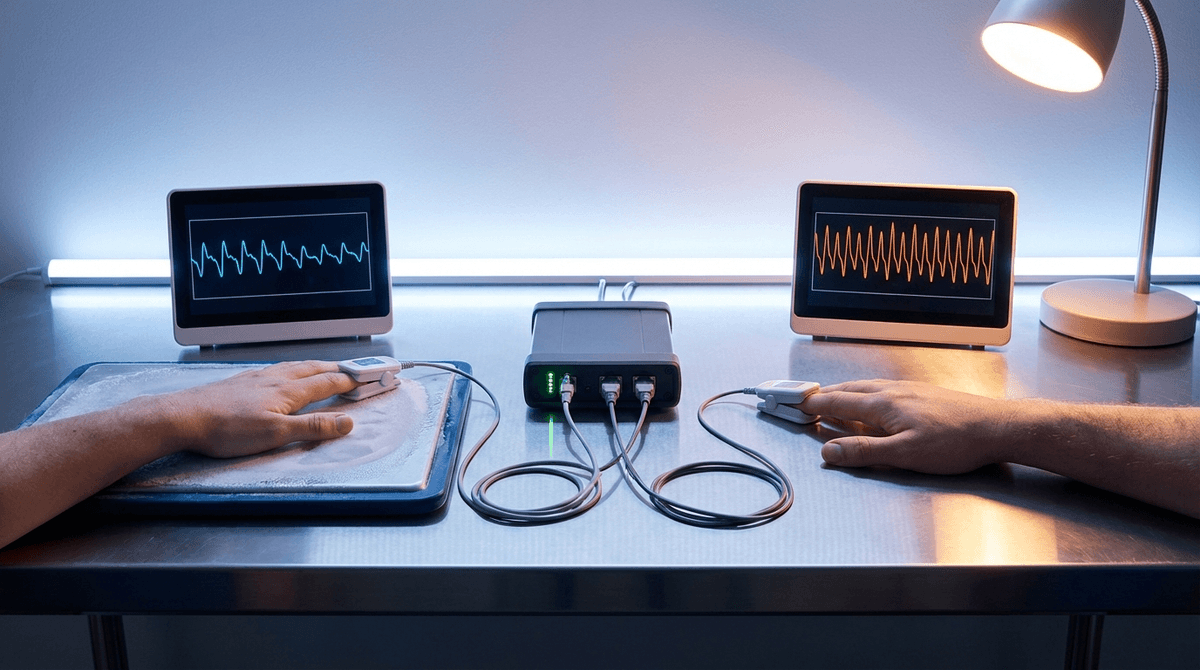
Temperature is one of the most impactful environmental confounders in photoplethysmography, capable of reducing PPG signal amplitude by over 90% in cold conditions through peripheral vasoconstriction, yet it is frequently overlooked in device specifications and validation studies. The human body's thermoregulatory response directly modulates peripheral blood flow, which is the very quantity that PPG measures. Understanding these effects is essential for designing robust PPG systems, interpreting data from wearable devices used in variable environments, and establishing measurement protocols that account for thermal conditions.
This article examines the physiology of temperature-mediated perfusion changes, quantifies their impact on PPG signal characteristics, reviews the evidence on temperature-dependent accuracy, and discusses engineering approaches for thermal compensation. For foundational context on PPG signal generation, see our introduction to PPG technology.
Thermoregulation and Peripheral Blood Flow
The human body maintains core temperature within a narrow range (36.5-37.5 degrees Celsius) through a sophisticated thermoregulatory system controlled by the hypothalamus. Peripheral blood flow, particularly to the skin of the extremities (fingers, toes, ears, nose), is a primary effector mechanism for both heat conservation and heat dissipation.
Cold Exposure and Vasoconstriction
When ambient temperature drops or core temperature is threatened, sympathetic nervous system activation causes vasoconstriction of cutaneous arterioles and arteriovenous anastomoses (AVAs) in the extremities. AVAs are direct connections between arterioles and venules that bypass capillary beds and are particularly dense in the fingertips, palms, ear lobes, and lips, all common PPG measurement sites.
Fingertip blood flow can decrease from approximately 20-50 mL/min per 100g of tissue at thermoneutral temperature to below 1 mL/min per 100g during strong vasoconstriction (Johnson and Kellogg, 2010). This represents a 20-50 fold reduction in the pulsatile blood volume change that generates the PPG signal.
The vasoconstrictor response is not instantaneous but develops over minutes. Typical time course after cold exposure: initial vasoconstriction within 30-60 seconds, progressive reduction in skin blood flow over 5-15 minutes reaching a minimum, and then potential cold-induced vasodilation (CIVD or Lewis hunting reaction) with periodic oscillations in flow occurring every 5-30 minutes as a protective mechanism against frostbite.
Heat Exposure and Vasodilation
In warm environments or during exercise, thermoregulatory vasodilation increases cutaneous blood flow to facilitate heat dissipation through convection and radiation. Skin blood flow can increase from the resting thermoneutral level of approximately 5-10 mL/min per 100g to 150-200 mL/min per 100g during severe heat stress (Charkoudian, 2010). This increases PPG signal amplitude substantially.
Active vasodilation is mediated by a combination of sympathetic withdrawal (reducing vasoconstrictor tone) and active vasodilatory mechanisms involving nitric oxide, vasoactive intestinal peptide, and other mediators. The vasodilatory response primarily affects the superficial vascular plexus where PPG measurements are concentrated, making heat-induced changes particularly impactful on signal quality.
Quantitative Effects on PPG Signal Characteristics
Signal Amplitude
The most direct temperature effect is on the AC (pulsatile) component amplitude. Multiple studies have quantified this relationship:
Budidha and Kyriacou (2015) (DOI: 10.1088/0967-3334/36/9/1911) systematically investigated temperature effects on finger PPG in 15 healthy volunteers during controlled cooling from 35 degrees Celsius to 15 degrees Celsius skin temperature. They reported that PPG AC amplitude decreased by 84% (range 71-95% across subjects) when fingertip skin temperature dropped from 35 to 20 degrees Celsius, and that the perfusion index (AC/DC ratio) fell below 0.4% (from a baseline of approximately 2-5%) in most subjects at skin temperatures below 22 degrees Celsius.
Grabovskis et al. (2013) measured bilateral finger PPG during unilateral hand cooling and found that AC amplitude at 530nm (green) decreased by 92% at the cooled hand while the control hand showed less than 5% change, confirming that the effect is mediated by local perfusion rather than systemic cardiovascular changes.
The DC (baseline) component also changes with temperature but by a smaller proportion. Cold reduces total tissue blood volume, decreasing light absorption and increasing the DC signal (more light reaches the detector). The pulsatile-to-baseline ratio change is therefore amplified: AC drops while DC increases, causing the perfusion index to decrease even more than the AC amplitude alone.
Signal Morphology
Temperature-mediated vascular tone changes alter not just the amplitude but the shape of the PPG waveform. In warm, vasodilated conditions, the dicrotic notch is typically well-defined, the reflected wave component is clearly visible, and the waveform exhibits a smooth, broad systolic peak. In cold, vasoconstricted conditions, the waveform becomes narrow and peaked with reduced diastolic component, the dicrotic notch disappears, and pulse wave velocity at the measurement site increases.
These morphological changes directly affect any analysis that depends on waveform features, including augmentation index estimation, blood pressure estimation from pulse transit time, and vascular age assessment from the second derivative (SDPPG). Allen and Murray (2002) (DOI: 10.1088/0967-3334/23/1/305) documented that the SDPPG aging index changed by approximately 0.3 units per degree Celsius of finger temperature change, demonstrating that temperature-induced morphological changes can mimic the effects of vascular aging.
Frequency Domain Effects
Cold-induced vasoconstriction introduces low-frequency vasomotor oscillations (0.05-0.15 Hz, also known as Traube-Hering-Mayer waves) into the PPG signal. These oscillations, caused by sympathetic nervous system fluctuations in vascular tone, can have amplitudes comparable to or exceeding the cardiac pulsatile signal in severely vasoconstricted states. They appear as baseline wander in the time domain and as spectral energy in the very-low-frequency band that can interfere with heart rate variability analysis.
Nitzan et al. (2002) characterized vasomotor oscillation patterns in finger PPG under varying thermal conditions and found that oscillation amplitude increased 3-5 fold during mild cold stress compared to thermoneutral baseline. These oscillations are distinct from respiratory modulation (0.15-0.4 Hz) and can cause false low-frequency HRV elevation if not properly filtered. For context on HRV measurement methodology, see our heart rate variability guide.
SpO2 Accuracy Under Temperature Stress
Cold-Induced SpO2 Errors
Pulse oximetry accuracy degrades in cold conditions through two mechanisms. First, the reduced signal amplitude lowers SNR, increasing measurement noise and variability. Second, vasoconstriction changes the pulsatile blood compartment (the "functional" blood volume that generates the AC signal) in ways that can alter the R-ratio.
Hynson et al. (1991) studied pulse oximeter performance during hypothermia and reported that the failure rate (inability to obtain a reading) increased from 2% at normal core temperature to 17% at a core temperature of 34 degrees Celsius and 43% at 32 degrees Celsius. When readings were obtained during hypothermia, mean bias increased from 0.5% to 2.8% and precision (standard deviation) worsened from 1.2% to 3.5%.
Khan et al. (2015) specifically investigated the relationship between fingertip skin temperature and pulse oximeter accuracy in 50 hospitalized patients. They found that SpO2 accuracy (compared to co-oximetry) was within acceptable limits (RMSE < 2%) when skin temperature exceeded 30 degrees Celsius but degraded significantly below this threshold (RMSE 3.8% at 25 degrees Celsius, 5.2% at 20 degrees Celsius). They proposed a skin temperature threshold of 28 degrees Celsius as the lower limit for reliable fingertip pulse oximetry.
High ambient temperature generally does not degrade SpO2 accuracy in healthy subjects at rest. The increased perfusion improves signal quality and the R-ratio calculation is not systematically biased by vasodilation. However, during exercise in hot environments, peripheral perfusion may paradoxically decrease due to sympathetically mediated redistribution of blood flow to active muscles, creating a transient cold-like effect on PPG signal quality despite high ambient temperature.
Perspiration is an indirect heat effect that degrades PPG in reflectance-mode wearable devices. Sweat on the skin surface changes the optical interface between the sensor and skin, creating variable light scattering and potential sensor lift-off. The effect is most pronounced at the wrist, where sweat can accumulate beneath a watch-style sensor and is a significant contributor to exercise-related signal degradation in addition to motion artifacts.
Measurement Site Vulnerability
Different PPG measurement sites show markedly different temperature sensitivity, primarily determined by the density of arteriovenous anastomoses and the degree of sympathetic vasoconstrictor innervation.
Fingertip
The fingertip is the most temperature-sensitive PPG site. Fingertip skin blood flow is almost entirely controlled by sympathetic vasoconstrictor tone through AVAs, which can be completely shut off during cold stress. This makes fingertip PPG highly reliable in warm conditions (strong signal, clear morphology) but highly vulnerable to cold. The temperature-perfusion relationship at the fingertip is steep: blood flow drops by approximately 50% per 5 degrees Celsius decrease in skin temperature below 32 degrees Celsius.
Wrist
Wrist PPG has moderate temperature sensitivity. The radial artery and its branches supply the tissue beneath wrist sensors, and while sympathetic vasoconstriction reduces superficial skin blood flow, the radial artery itself maintains flow for hand perfusion. Wrist PPG signal amplitude typically decreases by 40-70% during cold stress, less than the fingertip but still sufficient to impair heart rate and SpO2 estimation.
Ear
Ear lobe and ear canal PPG show intermediate temperature sensitivity. The ear has good resting perfusion and fewer AVAs than the fingertip, making it somewhat more resistant to cold-induced signal loss. However, the ear lobe is exposed and cools rapidly in cold environments, and the smaller tissue volume means that temperature changes affect blood flow quickly. Ear canal PPG is partially protected from ambient temperature by the insulating properties of the ear canal, making it a more thermally stable site than the earlobe. For a comprehensive comparison of measurement sites, see our sensor placement guide.
Forehead
The forehead is the least temperature-sensitive common PPG site. Forehead skin blood flow is maintained even during significant systemic vasoconstriction because the head requires continuous perfusion for thermoregulation of the brain. Reflectance-mode forehead PPG maintains usable signal quality at ambient temperatures where finger and wrist PPG fail entirely. Shelley et al. (2005) demonstrated that forehead pulse oximetry provided readings in 100% of cases during induced hypothermia where finger pulse oximetry failed in over 40% of cases.
Engineering Compensation Strategies
Skin Temperature Monitoring
The simplest and most effective hardware approach is integrating a skin temperature sensor adjacent to the PPG sensor. Skin temperature provides a direct indicator of local perfusion state and enables contextual interpretation of PPG signal quality. Most modern wrist wearables include skin temperature sensors (thermistors or infrared thermopiles), though few currently use the temperature data to adjust PPG processing parameters.
A temperature-aware PPG pipeline could adjust LED drive current based on skin temperature (increasing power in cold conditions to compensate for reduced signal), modify signal quality thresholds to avoid false rejection of valid but low-amplitude beats, switch to longer averaging windows when perfusion is low, and flag measurements taken below a minimum skin temperature threshold as potentially unreliable.
Adaptive LED Drive
Dynamic LED current control adjusts optical power in real-time based on the detected signal amplitude. When the ambient light photodetector registers low pulsatile amplitude (as occurs during vasoconstriction), the LED drive current increases to push more photons into the tissue. Most clinical pulse oximeters implement this, with LED current adjustable over a 10:1 or greater range.
The limitation is power consumption and thermal dissipation. Increasing LED power by 10x to compensate for a 90% signal reduction is thermally and energetically expensive, particularly in battery-powered wearables. Additionally, in severe vasoconstriction, even maximum LED power cannot generate adequate pulsatile signal because the physiological blood volume change is simply too small.
Multi-Site Measurement
Using PPG sensors at multiple body sites simultaneously allows selection of the site with the best signal quality at any given time. This approach is used in some clinical monitoring systems that can switch between finger, ear, and forehead sensors. For wearable applications, dual-site sensing (e.g., wrist plus ear via a connected earbud) could provide redundancy against temperature-induced signal loss.
Algorithmic Approaches
Several signal processing strategies improve PPG robustness under temperature stress. Ensemble averaging over more cardiac cycles reduces noise variance, trading temporal resolution for reliability. Typical clinical pulse oximeters average over 4-16 beats, but this can be extended to 20-30 beats in low-perfusion conditions, accepting a 15-30 second response time in exchange for stable readings.
Template matching algorithms that compare each detected pulse against a running average template can identify valid cardiac pulses even at very low amplitudes. The template provides prior information about expected waveform shape, enabling detection at SNR levels where simple peak detection fails. Correlation-based detection can reliably identify cardiac pulses at SNR as low as -3 to -6 dB when a good template is established.
Spectral analysis methods, particularly the Welch periodogram or autoregressive spectral estimation, can extract heart rate from PPG signals with poor time-domain waveform quality by identifying the fundamental cardiac frequency in the spectrum. These methods are inherently averaging operations and are more robust to intermittent signal dropout than beat-by-beat analysis.
Recommendations for Researchers and Device Designers
Temperature effects represent a fundamental challenge for PPG that cannot be fully solved by technology alone because the underlying limitation is physiological. The following recommendations address this reality.
For validation studies, always record and report the ambient temperature and, when possible, skin temperature at the measurement site. Conduct testing across a range of thermal conditions representative of intended use environments. Report accuracy metrics stratified by temperature range (cold: below 15 degrees Celsius ambient, cool: 15-22 degrees Celsius, comfortable: 22-28 degrees Celsius, warm: above 28 degrees Celsius).
For device design, include a skin temperature sensor and use it to qualify PPG measurements. Implement adaptive LED drive current with sufficient range (at least 5:1) to compensate for moderate perfusion changes. Design the sensor housing to minimize thermal bridging that would cool the skin surface beneath the sensor.
For clinical use, warm the measurement site before pulse oximetry when the patient has cold extremities. Consider forehead or ear sensors for patients in cold environments or with poor peripheral perfusion. Be aware that SpO2 readings from cold extremities may be unreliable even when the device displays a value.
Understanding temperature effects is part of the broader context of environmental factors that influence PPG accuracy. For additional factors affecting signal quality, see our resources on PPG signal processing algorithms and the broader conditions reference.
References
- Budidha and Kyriacou (2015) (DOI: 10.1088/0967-3334/36/9/1911) systematically investigated temperature effects on finger PPG in 15 healthy volunteers during controlled cooling from 35 degrees Celsius to 15 degrees Celsius skin temperature. They reported that PPG AC amplitude decreased by 84% (range 71-95% across subjects) when fingertip skin temperature dropped from 35 to 20 degrees Celsius, and that the perfusion index (AC/DC ratio) fell below 0.4% (from a baseline of approximately 2-5%) in most subjects at skin temperatures below 22 degrees Celsius.
- These morphological changes directly affect any analysis that depends on waveform features, including augmentation index estimation, blood pressure estimation from pulse transit time, and vascular age assessment from the second derivative (SDPPG). Allen and Murray (2002) (DOI: 10.1088/0967-3334/23/1/305) documented that the SDPPG aging index changed by approximately 0.3 units per degree Celsius of finger temperature change, demonstrating that temperature-induced morphological changes can mimic the effects of vascular aging.