Learn PPG
What Is Actigraphy?
Actigraphy is a movement record from an accelerometer on the wrist, ankle, or waist. Software turns that record into rest, activity, and an estimate of sleep versus wake. Clinical units use a piezoelectric sensor or a MEMS accelerometer, and they store activity counts in epochs or, on newer devices, the raw acceleration. Stage labels come from polysomnography. A PPG sensor in the same case times the pulse. The accelerometer still supplies the movement.
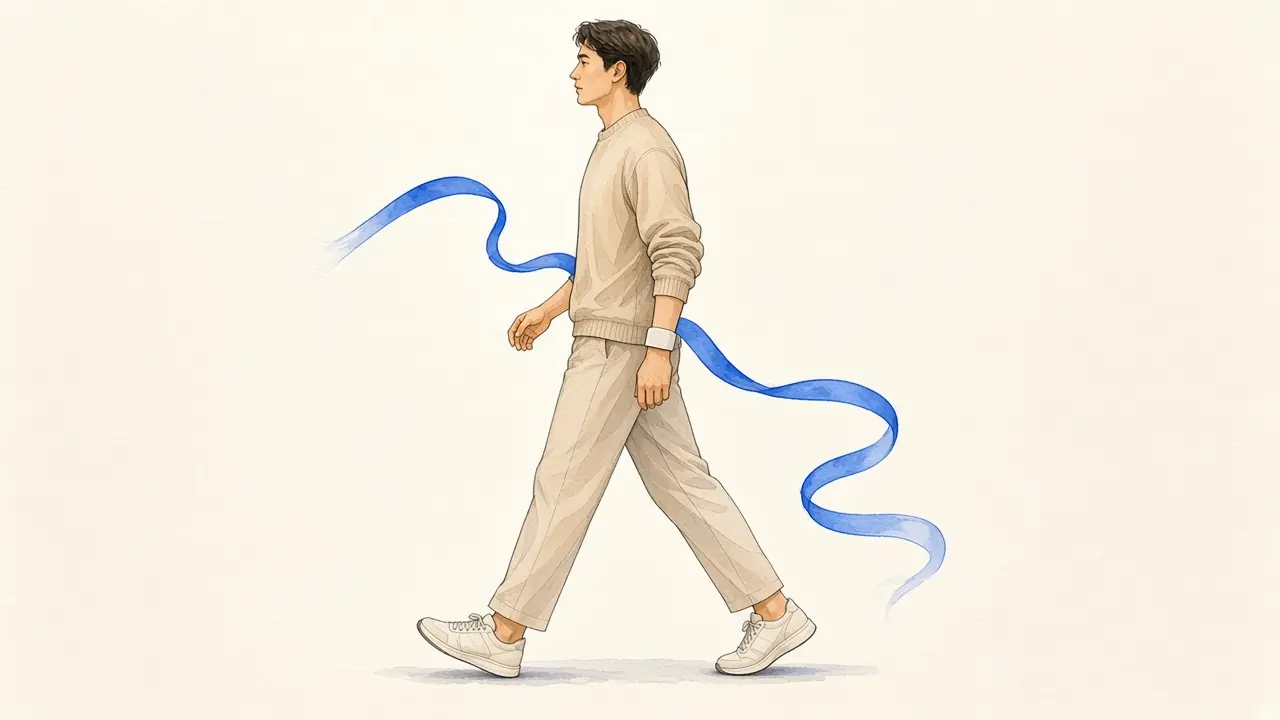
What actigraphy records
Actigraphy stores how much a limb moves. The monitor sits on the wrist, the ankle, or the waist, and sleep studies usually pick the wrist or the ankle. Software then estimates wake and sleep, plus the clock times a sleep log also asks for: time to fall asleep, total sleep time, wake after sleep onset, and sleep efficiency (total sleep time divided by time in bed). Ancoli-Israel and colleagues reviewed the method for the American Academy of Sleep Medicine (Sleep, 2003, 26(3):342–392, doi:10.1093/sleep/26.3.342). The device can run for days. The score rests on a plain observation: people move less in sleep than in wake. Polysomnography answers the same night with at least three signals, EEG, eye movements, and muscle tone. Actigraphy brings the movement.
Sensors and placement
The sensor difference is short. The 2018 AASM evidence review (Smith et al., Journal of Clinical Sleep Medicine, doi:10.5664/jcsm.7228) says clinical actigraphs generally include either a piezoelectric accelerometer or a MEMS accelerometer, the microelectromechanical kind. Axis count, sampling rate, where you place the device, and the scoring program all change the record. The same review says the data in hand were not enough to treat a consumer product as a stand-in for a clinical device that has a validated scoring path. This page does not add a head-to-head of named watches.
Epochs and what gets saved
Activity counts
What gets saved is a count, or the acceleration itself. Ancoli-Israel and colleagues describe the older reduction. Over an epoch the device accumulates an activity count. Three recipes they diagram are time spent above a threshold (they call 0.1 to 0.2 g a common threshold), the number of times the signal crosses zero, and digital integration of the area under the curve. The same movement did not yield the same count on every device, so a count is not a unit you can carry from one lab's file to another's. Comparisons in that review often had to line a 1-minute actigraphy epoch up with the 30-second polysomnography epoch.
Conceptual sketch
Time above a threshold
Often 0.1 to 0.2 g
Zero crossings
Each time the signal crosses zero
Area under the curve
Digital integration across the epoch
Raw acceleration
Patterson and colleagues, at ActiGraph (npj Digital Medicine, 2023, doi:10.1038/s41746-023-00802-1), give the practical reason counts lasted: early devices reduced the signal before storing it. They describe Cole–Kripke as a widely used sleep/wake formula that takes those counts as input. Later devices can keep the raw acceleration. The forearm-angle method they attribute to van Hees and colleagues (2015) starts from that raw signal. Their accuracy table is not reprinted here.
Wear time
Wear time is a separate decision from the sleep score. In physical-activity studies the monitor comes off to swim, shower, or sleep, and a run of zeros would otherwise look like sitting still. Migueles and colleagues, reviewing ActiGraph GT3X processing (Sports Medicine, 2017, doi:10.1007/s40279-017-0716-0), describe two published rules. The Troiano rule treats 60 minutes of zero counts per minute as non-wear and allows up to 2 minutes of interruption inside that hour. The Choi rule uses 90 minutes of zeros, with that same 2-minute allowance, placed between two 30-minute windows of zeros. Those rules keep time off the wrist out of a sedentary total. Sleep actigraphy expects the strap to stay on, and long stillness is part of what the sleep score is looking for. Sadeh's 2011 update says the limit in one sentence: actigraphy measures movement, not sleep itself (Sleep Medicine Reviews, 15(4):259–267, doi:10.1016/j.smrv.2010.10.001).
Sleep versus wake, not sleep stages
Conceptual sketch
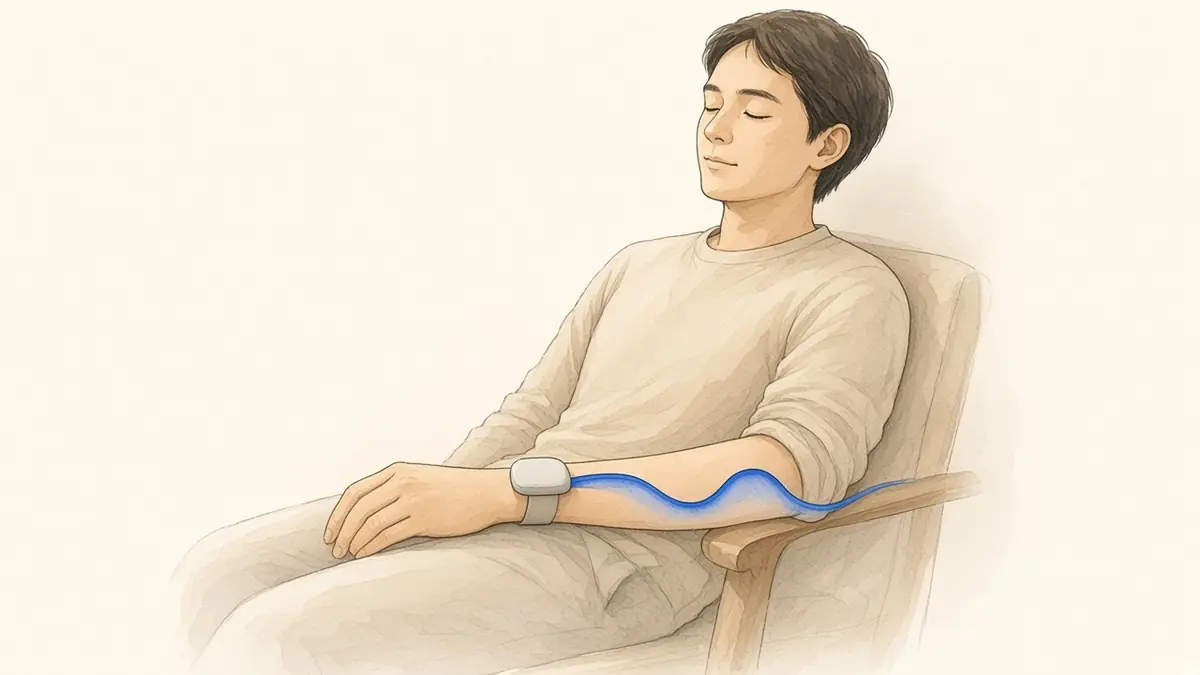
Wake
Sleep
Wake after sleep onset
Sleep
Stage names come from polysomnography. The AASM evidence review states that actigraphy does not supply sleep architecture, because NREM and REM staging needs EEG, electrooculography, and electromyography, and that it does not describe breathing. Sadeh's update finds reasonable validity in people with ordinary good sleep, and a weaker case when sleep is poor or the group is a special population. The miss he flags is wake inside a sleep period: certain devices and samples have low specificity for wakefulness. He also shows why a high agreement rate is easy to inflate on a night that is mostly sleep. Call every epoch sleep and you match most of the record while missing the wake. The 2018 AASM clinical practice guideline (Smith et al., doi:10.5664/jcsm.7230) is written for clinicians, and its suggestions apply to FDA-cleared actigraphs. Its strong recommendation is that clinicians not use actigraphy in place of EMG to diagnose periodic limb movement disorder. This page explains the method. It is not a diagnosis and not a care plan.
Conceptual sketch
Actigraphy
- Limb movement from an accelerometer
- Wrist, ankle, or waist
- Can run for days
- Sleep versus wake
Polysomnography
- EEG
- Eye movements
- Muscle tone
- Sleep stages
Actigraphy and PPG in the same case
A PPG LED often shares the case with the accelerometer. The optical channel times the pulse. The accelerometer still supplies the movement the sleep/wake score is built from. Papers that stage sleep from the optical waveform are a different method (/blog/ppg-sleep-tracking). Public sets that pair a wearable with polysomnography labels are listed at /research/topics/wearable-sleep-staging-datasets. The sleep regularity index (/blog/sleep-regularity-index) asks whether the same minute is asleep or awake a day later. Phillips and colleagues computed it from diaries. An actigraphy sleep/wake series can go into the same formula. This page does not cite a check of a named watch's index against that diary method. The gap between beats, which is not a movement score, is the interbeat interval (/learn/ibi).
Go deeper
Frequently Asked Questions
What is actigraphy?
A wearable accelerometer record of limb movement, usually from the wrist, ankle, or waist, scored into rest, activity, and sleep versus wake. Ancoli-Israel et al. 2003 (doi:10.1093/sleep/26.3.342) review it as a days-long movement method, held to a different standard than polysomnography.
Can actigraphy tell sleep stages apart?
Stage labels come from polysomnography: EEG, eye movements, and muscle tone. The 2018 AASM evidence review (doi:10.5664/jcsm.7228) says actigraphy does not provide that architecture, and does not describe breathing. Sadeh 2011 (doi:10.1016/j.smrv.2010.10.001) flags low specificity for wake inside a sleep period on some devices and samples.
What is the difference between activity counts and raw acceleration?
A count is movement summed inside an epoch, by a threshold, a zero-crossing tally, or integration. Ancoli-Israel et al. note that devices do not agree on the count for the same movement. Patterson et al. 2023 (doi:10.1038/s41746-023-00802-1) describe Cole–Kripke as a count-based score, and later devices as able to keep the raw acceleration.
What is non-wear time?
Time the monitor was off, which would otherwise look like stillness. Migueles et al. 2017 (doi:10.1007/s40279-017-0716-0) describe the Troiano rule as 60 minutes of zero counts per minute, allowing 2 minutes of interruption, and the Choi rule as 90 minutes of zeros with that allowance between two 30-minute zero windows. Those rules are for activity totals. A sleep score expects the strap to stay on.
How does PPG relate to actigraphy?
Many wrist devices carry both an accelerometer and an optical pulse sensor. The accelerometer supplies the movement. The PPG times the pulse. Staging from the optical wave is covered at /blog/ppg-sleep-tracking. Sleep timing across nights is the sleep regularity index at /blog/sleep-regularity-index.