rPPG FDA Regulatory Status
The gap between what rPPG technology can demonstrate in a research lab and what it's legally cleared to claim in a clinical or consumer health product...
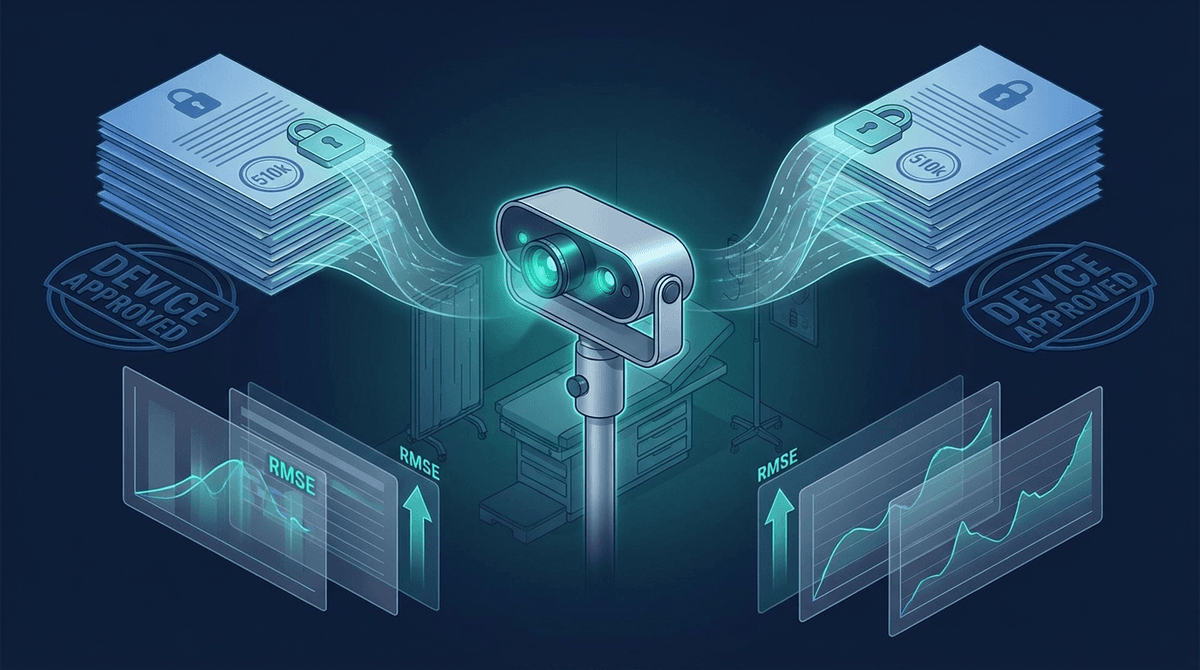
The gap between what rPPG technology can demonstrate in a research lab and what it's legally cleared to claim in a clinical or consumer health product is significant — and frequently misunderstood. Many apps and devices presenting contactless heart rate measurements are operating in a regulatory gray zone. A smaller number have pursued formal FDA clearance. Understanding the difference matters if you're building, deploying, or using these systems in any health-adjacent context.
How FDA Regulates Physiological Monitoring Software
The FDA classifies medical devices based on their intended use and risk level. For physiological monitoring via camera:
Class II Medical Device (substantial equivalence, 510(k)): A camera-based system claiming to measure heart rate for clinical purposes — to inform diagnosis, guide treatment, or monitor a medical condition — is generally a Class II medical device. Clearance requires demonstrating substantial equivalence to a legally marketed predicate device.
Class III Medical Device (premarket approval, PMA): Novel claims without a clear predicate (contactless SpO2 for clinical use, for example) would require full PMA with clinical data demonstrating safety and effectiveness.
Software as a Medical Device (SaMD): The FDA's Digital Health Center of Excellence specifically addresses software-based physiological monitoring. The FDA's SaMD framework, aligned with International Medical Device Regulators Forum (IMDRF) guidance, classifies SaMD by healthcare situation (critical, serious, non-serious) and significance of information provided (treat/diagnose, drive clinical management, inform clinical management).
A wellness app that shows heart rate as a general information feature ("inform clinical management" in a "non-serious" context) faces the lowest regulatory burden. A clinical monitoring app that alerts clinicians to bradycardia requiring intervention ("treat/diagnose" in a "critical" context) requires full device clearance.
What Has Actually Been FDA Cleared
As of early 2026, the landscape of FDA-cleared rPPG or camera-based vital sign products is limited:
Binah.ai markets camera-based heart-rate software and describes regulatory registrations outside the United States, but an FDA 510(k) clearance for its camera heart-rate product could not be verified in FDA's public device databases. It should not be described as FDA-cleared without a decision number and matching FDA record.
Nuralogix (Transdermal Optical Imaging / DeepAffex) has received Health Canada authorization in Canada and CE marking in Europe, but FDA clearance status for specific clinical claims remains more limited.
Lifelight (developed by Xim Ltd in the UK) received UKCA marking and CE marking, with UK MHRA engagement, but not FDA 510(k) clearance at time of writing.
The common pattern: non-US regulatory frameworks (CE marking under EU MDR, UKCA, Health Canada) have generally been more accessible for rPPG wellness monitoring clearances. FDA clearance for clinical claims remains an active but challenging goal for multiple companies.
Apple's Blood Oxygen app on the Apple Watch uses contact PPG (not rPPG). Apple describes it as a fitness-and-wellness feature not intended for medical use; it was not FDA-cleared as a medical pulse oximeter.
The FDA's Enforcement Discretion Policy
The FDA has historically exercised enforcement discretion for mobile medical apps that present "low risk" and function primarily as wellness tools. The key question is whether a product makes clinical claims.
A wellness app that says "your estimated heart rate is 72 bpm" and notes the measurement is for informational purposes only sits in a different regulatory position than one that says "your heart rate indicates elevated cardiovascular risk — consult a physician."
This enforcement discretion creates the gray zone where most consumer rPPG products operate. The FDA has been clear that enforcement discretion is not clearance, and that apps making clinical claims face regulatory action regardless of how they characterize their wellness intent.
The FDA's 2019 action against several EEG headbands that marketed "brainwave" measurements with clinical implications illustrates the boundary enforcement pattern. Similar scrutiny has been applied to some heart rate variability apps.
What 510(k) Clearance Actually Requires for rPPG
A company seeking 510(k) clearance for a camera-based heart rate monitor needs to demonstrate:
Substantial equivalence to a predicate: The predicate would typically be a cleared contact pulse oximeter or heart rate monitor. The comparison must show that the new device is at least as safe and effective for the same or comparable intended use.
Clinical accuracy data: The FDA expects accuracy data meeting or exceeding the predicate's performance specifications. For pulse oximeters, ISO 80601-2-61 specifies accuracy testing requirements including specific saturation ranges and statistical thresholds. An rPPG device claiming equivalent accuracy needs data in at least 10 subjects spanning at least 3 saturation levels, with root mean square error (ARMS) ≤ 3.5% against a validated co-oximeter.
Substantial equivalence argument for the contactless modality: This is the hard part. Moving from contact to contactless measurement is a design change that requires demonstrating the change doesn't raise new safety or effectiveness questions. The FDA has been cautious here.
Intended use precision: The cleared indication of use must be narrow enough to be defensible. "Estimates heart rate for general wellness purposes in healthy adults in controlled conditions" clears a different bar than "monitors heart rate for clinical cardiovascular monitoring."
Software documentation: The FDA's Software as a Medical Device guidance (and IEC 62304 if international) requires detailed documentation of the algorithm, validation testing, cybersecurity analysis, and change control processes.
EU MDR Status
In Europe, the Medical Device Regulation (EU MDR 2017/745, effective May 2021) replaced the older MDD framework. Under EU MDR, software qualifying as a medical device requires CE marking under the appropriate risk class.
Rule 11 of EU MDR classifies most diagnostic software as Class IIa or higher. An rPPG system used to inform clinical decisions would likely be Class IIa, requiring a Notified Body audit of the technical file.
Several companies have obtained CE marks under the older MDD framework for rPPG-adjacent products, but EU MDR re-certification is required. The transition deadline was extended to 2026-2027 for Class IIa devices due to Notified Body capacity constraints.
FDA's Digital Health Pre-Certification Program
The FDA's Digital Health Center of Excellence ran a Pre-Certification (Pre-Cert) pilot program from 2017-2022, designed to allow qualifying software developers to obtain "pre-certified" status that would streamline subsequent product reviews. Several mobile health companies participated.
The program was ultimately not formalized into regulation, but its concepts influenced the FDA's current PCCP (Predetermined Change Control Plan) pathway, which allows SaMD developers to define in advance how algorithm updates will be validated — reducing the need for full 510(k) amendments every time the underlying algorithm improves.
This is particularly relevant for rPPG, where algorithms improve rapidly through machine learning. Companies pursuing FDA clearance for rPPG should actively engage with PCCP to avoid the compliance burden of frequent 510(k) submissions.
Practical Implications for Developers
If you're building an rPPG product:
-
Define your intended use carefully. Wellness indication with explicit "not for clinical use" language avoids the 510(k) requirement. Clinical claims require clearance.
-
Don't let marketing override your regulatory position. If your app's marketing materials imply clinical accuracy or utility, the FDA may view the intended use as clinical regardless of what your user agreement says.
-
Document everything. FDA submissions require extensive design history file documentation. Start this documentation process at the beginning of development, not at submission time.
-
Consider the EU pathway first. CE marking under EU MDR (or UKCA) may be more accessible than FDA clearance for your first commercial milestone. This doesn't create a shortcut to US clearance, but can establish a commercial track record and clinical evidence base.
-
Engage FDA early (Pre-Submission meeting). The FDA's pre-submission program (formerly "Q-Sub") allows companies to get informal guidance on regulatory strategy before committing to a clearance pathway. This is especially valuable for novel modalities like rPPG.
- rPPG Telehealth Remote Monitoring — clinical deployment context
- rPPG vs Contact PPG Accuracy — accuracy standards context
- PPG IEEE ANSI Wearable Testing Standards — relevant testing standards
- PPG ISO Standards Overview — international regulatory frameworks
- rPPG Privacy Data Ethics — compliance considerations
Frequently Asked Questions
Is there an FDA-cleared app for camera-based heart rate measurement? FDA clearance for a camera-based heart-rate app should be verified by a specific FDA decision number and intended-use statement. The Binah.ai clearance previously asserted here could not be substantiated in FDA's public device databases.
What is the difference between FDA cleared and FDA approved for rPPG? FDA "clearance" (510(k)) means the device is substantially equivalent to a legally marketed predicate. FDA "approval" (PMA) requires demonstration of safety and effectiveness through clinical studies. Most medical devices, including contact pulse oximeters, are cleared rather than approved. rPPG systems would typically pursue clearance via 510(k).
Can an rPPG app make clinical claims without FDA clearance? No. Clinical claims — suggesting the measurement informs diagnosis, treatment, or clinical monitoring decisions — require FDA clearance in the US. Wellness claims with appropriate disclaimers can operate under enforcement discretion, but the line between wellness and clinical claims is actively patrolled by FDA.
What accuracy does the FDA require for heart rate monitoring clearance? The FDA typically benchmarks heart rate monitor accuracy against existing cleared predicates. For pulse oximeters measuring SpO2, ISO 80601-2-61 requires ARMS ≤ 3.5% against co-oximetry. Heart rate accuracy requirements are derived similarly from predicate device specifications, typically requiring mean absolute error below 3-5 bpm in clinical conditions.
How does EU CE marking for rPPG work? Under EU MDR 2017/745, rPPG software used for clinical purposes is classified as a medical device (typically Class IIa). CE marking requires a technical file, clinical evidence demonstrating safety and performance, a notified body audit, and quality management system certification (ISO 13485). The process is resource-intensive but several companies have achieved it.
Frequently Asked Questions
- Is there an FDA-cleared app for camera-based heart rate measurement?
- Yes, a small number of apps have received FDA clearance for camera-based heart rate monitoring for wellness purposes. Most consumer rPPG apps operate under FDA enforcement discretion rather than formal clearance. Clearances for clinical diagnostic use remain limited.
- Can an rPPG app make clinical claims without FDA clearance?
- No. Clinical claims — suggesting the measurement informs diagnosis, treatment, or clinical monitoring decisions — require FDA clearance in the US. Wellness claims with appropriate disclaimers can operate under enforcement discretion.
- What accuracy does the FDA require for heart rate monitoring clearance?
- The FDA benchmarks against existing cleared predicates. For heart rate monitors, accuracy requirements are typically derived from predicate device specifications, requiring mean absolute error below 3-5 bpm in clinical conditions, with testing across appropriate clinical populations.