Glucose monitor watch: what works today and what the research shows
No glucose monitor watch can read blood sugar through the skin yet. Here's what the FDA says, what research shows, and how to get glucose on your wrist.
Reviewed by Sameer Sontakey, Co-founder and Chief AI & Algorithms Officer at Sensor Bio. ChatPPG is independent and device-neutral; it is not a Sensor Bio product.
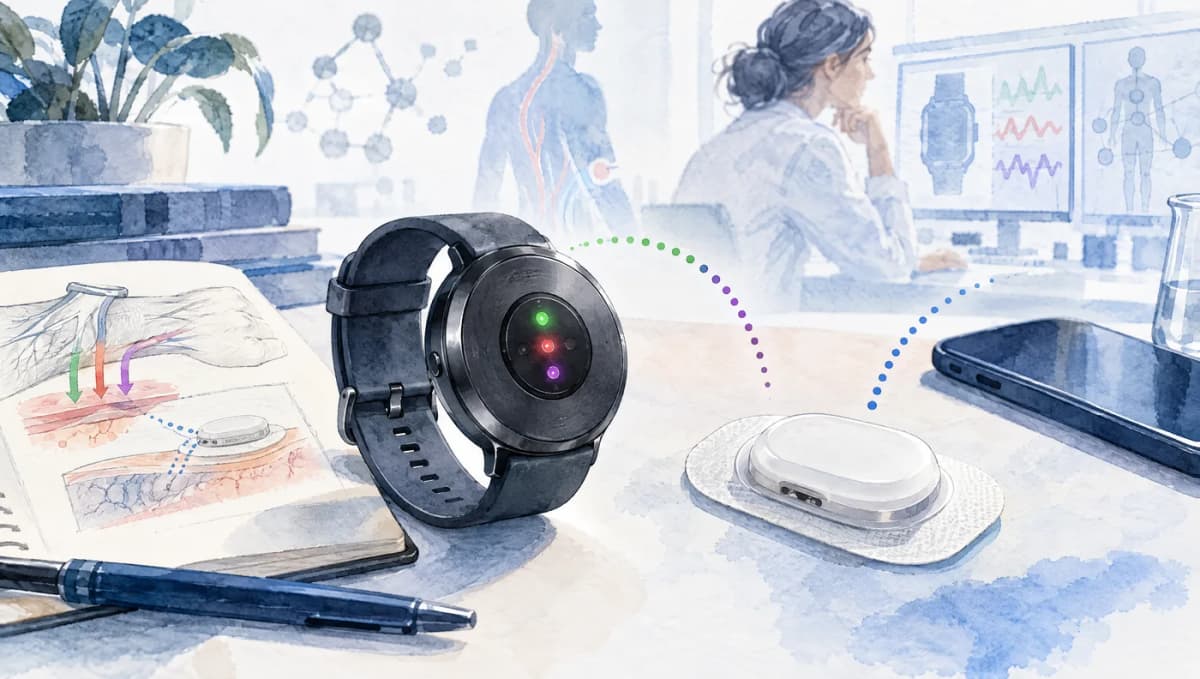
Short answer: A watch can show your glucose today only if a continuous glucose monitor (CGM) does the measuring. No smartwatch or smart ring can measure blood sugar through the skin on its own, and in February 2024 the U.S. Food and Drug Administration told people not to buy or use ones that claim to (FDA safety communication, Feb 21, 2024).
Research on estimating glucose from wrist sensors is real and moving, though. Here's what's on sale, what the FDA said, and what studies actually show.
What the FDA said
The FDA's 2024 warning is blunt. The agency "has not authorized, cleared, or approved any smartwatch or smart ring that is intended to measure or estimate blood glucose values on its own." It applies to any brand making that claim, and many of these devices are sold through online marketplaces.
The risk is specific. For someone with diabetes, a wrong reading can lead to a wrong dose of insulin or sulfonylureas. Too much can push blood sugar dangerously low within hours.
The FDA separates those gadgets from watch apps that display data from authorized CGMs, which measure glucose with a tiny filament under the skin. That second category is how most people get glucose on their wrist today.
What a smartwatch actually senses
A typical watch carries an optical PPG sensor (heart rate and its variability), an accelerometer, and sometimes skin temperature and electrodermal activity. None of these reads glucose directly. Glucose in the blood is a small optical signal buried under water, skin, and blood volume changes; our technical review of PPG glucose monitoring explains why that's hard.
What a watch can see are the body's responses around meals and glucose swings: changes in heart rate, sweating, temperature, and activity. Research models try to infer glucose from those patterns.
The Duke smartwatch study
The best-known open study is from Jessilyn Dunn's lab at Duke, published in npj Digital Medicine in 2021 (Bent et al., 2021, DOI 10.1038/s41746-021-00465-w).
- Participants: 16 adults aged 35 to 65 with elevated blood glucose (prediabetes range)
- Devices: Empatica E4 wristband (PPG, electrodermal activity, skin temperature, accelerometer) plus a Dexcom G6 CGM as the reference
- Data: more than 25,000 paired glucose readings and 5-minute wearable epochs over 8 to 10 days, with food logs
- Features: 69 engineered variables from the wristband, food diary, and demographics
The population model, tested on people it hadn't seen, had a mean absolute percent error of 14.33% and an average RMSE of 21.22 mg/dL. The abstract reports detecting personal glucose deviations with up to 84% accuracy.
Two cautions. The group was small, and the models leaned on food logs, not the watch alone. And a 14% average error is far from what insulin dosing needs. The study shows that wrist signals carry glucose-related information. It doesn't show a watch that replaces a CGM.
The dataset from this work is public as BIG IDEAS Glycemic; you can find it in the ChatPPG dataset directory, alongside the paper record.
Where research is heading
Much of the recent work flips the problem. Instead of estimating glucose from a watch, it builds models on top of CGM data and then uses wearables for context. One example in our hub is GlucoPRISM, a CGM model that tries to separate stable personal traits from day-to-day state and from differences between sensor brands. Work like this aims at better interpretation of CGM data, not needle-free measurement.
Wearables already help with a narrower task, too: spotting likely low-glucose episodes from heart and sweat responses. See wearable hypoglycemia detection with PPG.
How to get glucose on your wrist today
- Talk to a clinician about whether a CGM makes sense for you.
- Use an FDA-authorized CGM and its official app.
- Pair it with a compatible watch to see readings and alerts at a glance.
- Skip any watch or ring advertising needle-free blood sugar readings, however good the reviews look.
New PPG and glucose papers show up in the ChatPPG research hub as they're published.
This article is educational and is not medical advice. People with diabetes should make treatment decisions with their care team using authorized devices.
References
- U.S. Food and Drug Administration. Do Not Use Smartwatches or Smart Rings to Measure Blood Glucose Levels: FDA Safety Communication. February 21, 2024. https://www.fda.gov/medical-devices/safety-communications/do-not-use-smartwatches-or-smart-rings-measure-blood-glucose-levels-fda-safety-communication
- Bent B, Cho PJ, Henriquez M, Wittmann A, Thacker C, Feinglos M, Crowley MJ, Dunn JP. Engineering digital biomarkers of interstitial glucose from noninvasive smartwatches. npj Digital Medicine. 2021;4:89. DOI 10.1038/s41746-021-00465-w
Frequently Asked Questions
- Is there a watch that measures blood glucose without a needle?
- Not one you should rely on. In February 2024 the FDA said it has not authorized, cleared, or approved any smartwatch or smart ring that measures or estimates blood glucose on its own, and warned people not to buy or use them.
- Can Apple Watch monitor glucose?
- Apple Watch can display readings from a continuous glucose monitor (CGM), a small sensor worn on the body that measures glucose under the skin. The FDA distinguishes these apps, which show data from authorized CGMs, from watches that claim to measure glucose themselves.
- How close has research come to smartwatch glucose estimation?
- A 2021 Duke study in npj Digital Medicine (Bent et al.) used an Empatica E4 wristband plus food logs from 16 participants, with a Dexcom G6 CGM as the reference. Its population model had a mean absolute percent error of 14.33%. It is a feasibility result in a small group, not a validated device.
- Are non-invasive glucose watches safe for people with diabetes?
- The FDA warns that inaccurate readings can lead to wrong doses of insulin or other glucose-lowering drugs, which can cause dangerously low blood sugar. People with diabetes should use an FDA-authorized meter or CGM.
- What is the best way to see glucose on a smartwatch today?
- Wear an FDA-authorized CGM and use its companion app on a compatible smartwatch. The sensor does the measuring and the watch is a display. Ask a clinician which CGM suits you. This article is educational and not medical advice.
Related articles
Wearable Heart Rate Accuracy and Skin Tone: What the Research Shows
Does skin tone affect wearable heart rate accuracy? Research on PPG sensors and melanin absorption shows accuracy gaps across Fitzpatrick skin types. Here is what we know.
Wearable SpO2 Accuracy Comparison: What Studies Show for Consumer Devices
How accurate are consumer wearable SpO2 sensors? Comparing Apple Watch, Fitbit, Garmin, Samsung, and Oura Ring blood oxygen accuracy against clinical pulse oximeters.
Apple Watch hypertension notifications: how PPG spots possible high blood pressure
Apple Watch hypertension notifications read 30 days of PPG data. FDA filings show 41.2% sensitivity and 92.3% specificity. Here's what an alert means.
Ambulatory Blood Pressure Monitor vs Smartwatch: Accuracy, Use Cases, and Why They Are Not the Same
ABPM and smartwatch blood-pressure features are often discussed together, but they solve different problems. This guide compares clinical accuracy, use cases, and why ambulatory blood pressure monitoring still outperforms cuffless wearables for diagnosis.
Bilateral Ring PPG: What a 1,810-Person Study Shows About HR, BP, and Left–Right Differences
A large-scale bilateral ring PPG study measured both hands simultaneously in 1,810 participants. The results reveal where ring sensors excel (heart rate), where they show modest utility (age), and where limitations remain (blood pressure).
Devices in this article
Research records with the datasets, papers and published validation results for each device.