Does Oura Ring Measure Blood Pressure? What Ring BP Research Shows
Oura doesn't give you blood pressure numbers. Here's what its Blood Pressure Signals and Nighttime BP features track, and what ring BP studies show so far.
- Blood Pressure
- BP
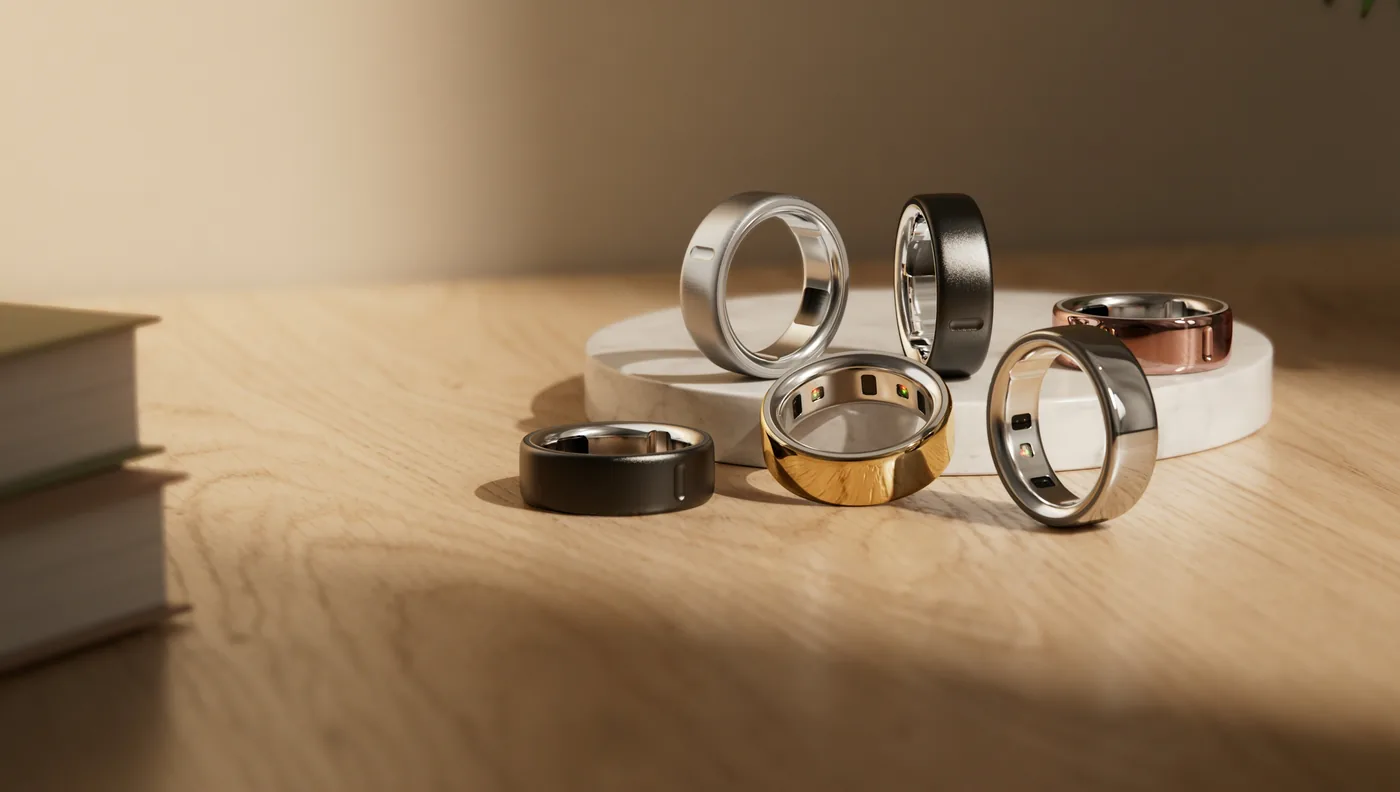
Short answer: No. The Oura Ring does not measure blood pressure and never shows a systolic or diastolic number. Its Blood Pressure Signals feature reads the optical pulse (PPG) from your finger while you sleep, looks for blood-pressure-related patterns across a 30-day window, and tells you only when it sees one worth discussing with a clinician. A second feature, Nighttime BP, tracks whether your overnight dipping pattern is changing (Oura support, Health Radar).
Ring hardware that produces real mmHg readings exists only as a research prototype so far. The rest of this page covers what Oura's features report, the accuracy numbers Oura has published (and why they are company-reported), and how far ring blood pressure research has actually come.
What Oura's blood pressure features do
Oura announced Health Radar in May 2026. It added Blood Pressure Signals and Nighttime Breathing to the existing Symptom Radar (Oura, May 28, 2026). The blood pressure side has three parts:
Scroll horizontally if needed
| Feature | What it shows | What it doesn't do |
|---|---|---|
| Blood Pressure Signals | A notice in the Today tab when 30 days of nighttime PPG show patterns that "may indicate cardiovascular strain." Otherwise it stays in a neutral "Monitoring for signals" state. | Measure or display blood pressure in mmHg |
| Nighttime BP | How your overnight blood-pressure-related dipping pattern changes over time | Give a nighttime pressure reading |
| Cuff Readings (Cuff Inputs) | A log of readings from your own cuff, typed in or imported from Apple Health or Health Connect, labeled Normal, Elevated or High using American Heart Association ranges | Feed Blood Pressure Signals, Nighttime BP or any Oura score |
A few details from Oura's support pages matter in practice (Health Radar, Heart Health Hub):
- You need an Oura Ring Gen3 or newer and an active membership. The Health Radar page currently lists iOS.
- Blood Pressure Signals needs at least 15 nights of data from the past 30 to build a baseline, so the first month is mostly silent.
- The feature is personalized with your height, weight and sex assigned at birth, so an out-of-date profile can affect it.
- It is switched off automatically if you use Pregnancy Insights.
- Oura says plainly that a result can differ from your doctor's assessment "as they're measuring different things in different ways."
Oura's May launch post said Health Radar would reach more than 30 additional markets from October 2026, including the EU, UK, Canada, Australia and South Korea (Oura).
How a ring can pick up blood pressure patterns from PPG
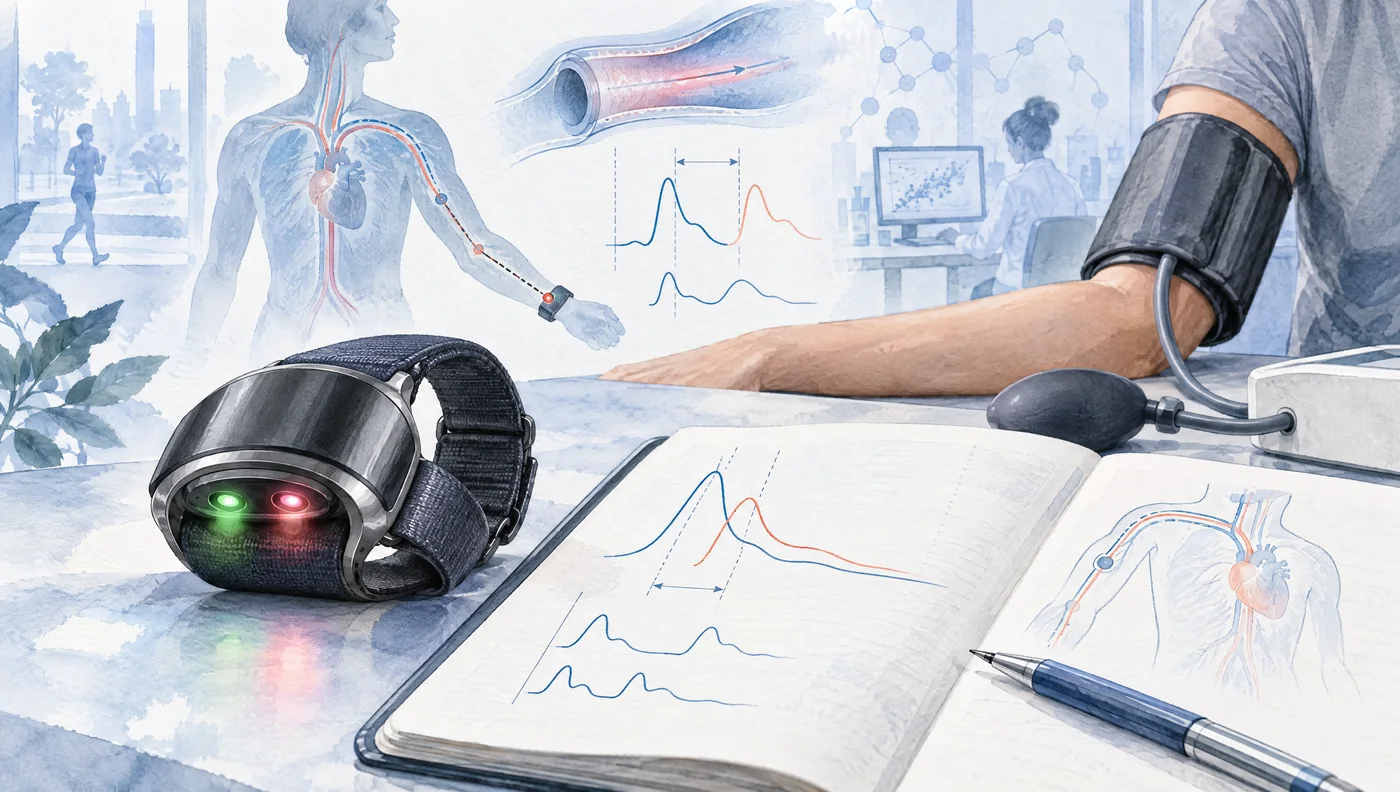
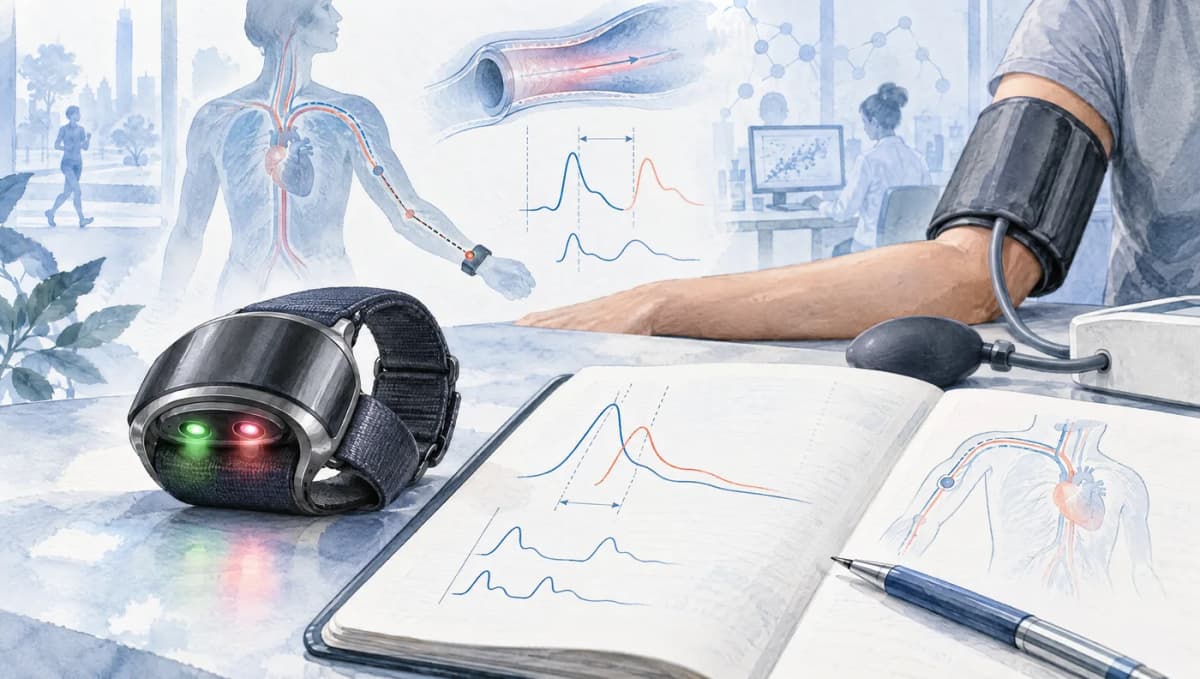
A PPG sensor shines light into the finger and records how much comes back as blood volume pulses with each heartbeat. The shape of that pulse wave changes with arterial stiffness, vascular tone and how fast the pressure wave travels (pulse wave velocity), and all of those move with blood pressure. Machine learning models trained on many people with and without hypertension can learn which waveform features tend to go with high pressure.
Models like this sort people into likely-high and likely-normal groups without producing a pressure value. In a MedTech Dive interview, Oura's chief medical officer Ricky Bloomfield said features like Oura's and Apple's "don't actually measure blood pressure at all," and that they find hypertension-linked features "in the PPG morphology, or shape of that waveform" (MedTech Dive).
Oura uses nighttime data because sleep removes a lot of the noise that confuses PPG, such as movement, posture changes and caffeine. Night is also when blood pressure normally dips. A blunted dip is linked to higher cardiovascular risk and is easy to miss with daytime cuff readings. We cover the physiology in PPG and nocturnal blood pressure dipping.
How accurate is it? Oura's numbers and what's missing
Oura published accuracy figures in a June 2026 blog post (Oura, "What PPG Can Reveal"). Treat them as company-reported. We found no peer-reviewed paper behind them as of November 10, 2026.
- Hypertension algorithm: 62% sensitivity and 91% specificity. It was built on data from Oura's Blood Pressure Profile Study, which had enrolled more than 300,000 members by June 2026. Hypertension was defined as a self-reported diagnosis plus cuff averages in the hypertensive range. The post doesn't give the size of the test set.
- Nighttime dipping algorithm: tested on Oura Ring 4 against 48-hour ambulatory blood pressure monitoring in 134 participants. It reached 84% sensitivity, 69% specificity and an AUC of 0.87.
In plain terms, the hypertension algorithm as reported would catch about 6 in 10 people who have hypertension and wrongly flag about 1 in 10 who don't. The dipping algorithm misclassified almost a third of people without dipping. Oura's own disclaimer on that post says the ring and app "are wellness products, not medical devices."
For context, the chart below puts Oura's figures next to two hypertension features with stronger evidence. One is Apple Watch hypertension notifications, from the FDA's 510(k) summary. The other is Google's smartwatch model, from a peer-reviewed Nature paper that also scored a single office cuff screen in the same people (Di Achille et al., 2026).
How often do passive blood pressure features catch the problem?
Up and to the left is better: more real cases caught, fewer false alarms. Marker shape shows the kind of evidence. Pick a feature to see what its numbers mean for 100 people.
Oura hypertension algorithm (research): out of 100 people who have hypertension, it would flag about 62 and miss about 38. Out of 100 people without hypertension, it would wrongly flag about 9. Reference: Self-reported diagnosis plus cuff averages. Source: Oura blog, June 16, 2026. Company-reported, not peer-reviewed.
100 people with hypertension
62 flagged, 38 missed
100 people without hypertension
9 false alarms, 91 correctly cleared
What it shows: the passive features catch somewhere between 4 and 7 of every 10 people with hypertension while wrongly flagging about 1 in 10 without it. That is close to a single office cuff screen in the Nature cohort, and far from a diagnosis. Each study used a different population and reference standard, so the points are not a head-to-head ranking. Oura's two points come from a company blog post, not a peer-reviewed paper.
Data table
| Feature | Task | Sensitivity | Specificity | Reference | Evidence |
|---|---|---|---|---|---|
| Google smartwatch AI (PPG + accelerometer) | Hypertension | 65.8% | 90% | 24-hour ambulatory BP monitoring; 196 adults, no known cardiovascular disease or BP medication, 7 days of wear | Peer-reviewed |
| Initial office BP screening (same cohort) | Hypertension | 55.3% | 90% | 24-hour ambulatory BP monitoring; Same 196 adults as the Google watch AI row | Peer-reviewed |
| Apple Watch hypertension notifications | Hypertension | 41.2% | 92.3% | FDA-cleared home BP monitor; 1,863 adults without a prior hypertension diagnosis, 30 days of wear | FDA 510(k) summary |
| Oura hypertension algorithm (research) | Hypertension | 62% | 91% | Self-reported diagnosis plus cuff averages; Oura Blood Pressure Profile Study members (enrollment over 300,000 as of June 2026) | Company-reported, not peer-reviewed |
| Oura nighttime dipping algorithm (Oura Ring 4) | Night dipping | 84% | 69% | 48-hour ambulatory BP monitoring; 134 participants | Company-reported, not peer-reviewed |
The points come from different studies, populations and reference standards, so this is not a ranking. Even so, passive PPG screening catches somewhere between 4 and 7 of every 10 people with hypertension while keeping false alarms near 1 in 10. In the Nature cohort, Google's watch model (65.8% sensitivity, 90.0% specificity against 24-hour ambulatory monitoring in 196 adults) beat a single office screen (55.3% and 90.0%). Apple's feature caught 41.2% with 92.3% specificity in the FDA summary (FDA K250507). If Oura's 62% and 91% hold up in peer review, it would sit in the same band.
Because even the best of these screens misses about a third of people with hypertension, not getting a notification is no reason to skip cuff checks.
Is it FDA cleared?
No. MedTech Dive reported that Oura offers Blood Pressure Signals as a wellness feature, which is not regulated as a medical device. That followed an FDA guidance change in January 2026 (MedTech Dive, May 28, 2026). Oura's VP of consumer software product, Jason Russell, told the outlet that the feature does not show systolic and diastolic readings.
A separate, regulated feature is in the pipeline. The Oura Blood Pressure Profile Study (NCT07267871) evaluated an algorithm for "identifying signs of hypertension" in US adults aged 22 and older with Gen3 or newer rings. It enrolled 382,200 people and completed on August 12, 2026 (ClinicalTrials.gov). Its primary outcome is sensitivity against participant-reported hypertension. Bloomfield has said Oura plans to submit that feature to the FDA (MedTech Dive). We have not seen a clearance as of this writing.
Can any ring measure real blood pressure?
Not yet as a product. The closest research is a 2026 prototype from Ramakrishna Mukkamala's group, published in IEEE Transactions on Biomedical Engineering (Momin et al., 2026). Instead of guessing from waveform shape, the ring copies the oscillometric method used by arm cuffs:
- A mechanical actuator tightens the ring around the finger. The user may also lower the hand, which changes the pressure in the finger arteries.
- A PPG sensor, a force sensor and an inertial measurement unit record the oscillations from the digital arteries as the pressure changes.
- An oscillometric algorithm computes blood pressure on demand, with no cuff calibration and no demographic inputs.
In 25 volunteers, the ring had root-mean-square errors of 7.1 mmHg systolic and 6.9 mmHg diastolic against a validated arm cuff. The authors call it a feasibility study. The ring was wired to a data-acquisition system and a display that guided the user. RMSE is also not the pass/fail statistic used in cuff validation standards. Cuffless devices are expected to go through protocols like the European Society of Hypertension recommendations, which test much larger and more varied groups.
A 2026 review in Pulse sums up where rings stand. Ring devices infer pressure from PPG and pulse-wave features rather than measuring it in the artery, their performance depends on calibration and on who is wearing them, and their accuracy and reliability are not yet good enough for routine clinical decisions (Sung, 2026). The same review sees value in tracking blood pressure dynamics, which matches how Oura frames its feature.
We have hub cards for the Momin ring prototype and the Sung review. Reported cuffless BP errors are compared on the cuffless BP leaderboard. For a different ring design, see our post on bilateral ring PPG for heart rate and blood pressure.
Oura vs other blood pressure wearables
What each one actually reports, based on the manufacturer's or regulator's own documents:
Scroll horizontally if needed
| Device or system | What you get | Cuff needed? | Status |
|---|---|---|---|
| Oura Ring (Gen3 and newer) | Pattern notice from 30 days of nighttime PPG, plus a dipping trend. No mmHg. | No (optional cuff log) | Wellness feature (Oura) |
| Apple Watch hypertension notifications | A "possible hypertension" notification after 30-day windows. No mmHg. | No | FDA 510(k) K250507 (FDA); see our explainer |
| Samsung Galaxy Watch (Samsung Health Monitor) | Systolic, diastolic and pulse estimates | Yes, recalibrate every 28 days | "For wellness only" in the US (Samsung); see our Galaxy Watch BP post |
| WHOOP MG (Blood Pressure Insights, WHOOP Life) | Daily estimated systolic and diastolic range from overnight PPG | Yes, 3 readings to start, then every 30 days | Wellness feature; FDA closed its warning letter in June 2026 (FDA); see does WHOOP measure blood pressure? |
| Google smartwatch model (AI-PPG-ACC-HTN) | Hypertension yes/no from PPG plus accelerometer over 7 days | No | Peer-reviewed study (Nature); model card. Google's shipping feature for Pixel Watch and Fitbit is covered in does Fitbit measure blood pressure? |
| Momin oscillometric ring | On-demand systolic and diastolic | No | Wired research prototype (IEEE TBME) |
If you want a number on a screen today, a wearable won't replace an upper-arm cuff. Our blood pressure watch guide and cuffless blood pressure timeline cover the wider market.
What to do if your ring flags a pattern
Oura's support page says to follow your healthcare provider's guidance and recommends a validated upper-arm cuff for the readings you log (Oura). A practical sequence:
- Take cuff readings on several days. Sit quietly first and use the same arm each time. A single reading is a snapshot, and Oura says the same.
- Compare them with a blood pressure chart so you know which range you are in.
- Bring the readings to a clinician. They may suggest ambulatory monitoring, which is how non-dipping and masked hypertension are usually confirmed.
- Don't read "no signal" as normal. The best published passive screens miss a third or more of people with hypertension.
This article is educational and not medical advice. Don't change any medication based on a ring or watch notification.
For more on the ring itself, see how accurate the Oura Ring is for heart rate, HRV, sleep and SpO2, the Oura Ring sensor page, the Oura Ring 4 device card, and Oura Ring 3 vs 4. For the condition, see hypertension.
References
- Momin MA, Wang S, Jazini M, Freithaler M, Hashemkhani S, Hoover GE, Li Y, Lee I, Xiong F, Mukkamala R. A finger worn ring for on-demand measurement of absolute blood pressure. IEEE Transactions on Biomedical Engineering. 2026. Online ahead of print. doi:10.1109/TBME.2026.3748379
- Sung K-C. An unfinished but necessary path: ring-based cuffless blood pressure monitoring at the crossroads of innovation and clinical reality. Pulse. 2026;14:192-197. Published October 5, 2026. doi:10.1159/pls/aeoag005
- Di Achille P, Cai L, Wu J, et al., Poh M-Z. Opportunistically detecting signs of hypertension on a consumer smartwatch. Nature. Published November 5, 2026. doi:10.1038/s41586-026-11336-3
- US Food and Drug Administration. 510(k) summary K250507, Hypertension Notification Feature (Apple Inc.). 2025. accessdata.fda.gov
- Ouraring Inc. Oura Blood Pressure Profile Study. ClinicalTrials.gov NCT07267871. clinicaltrials.gov
- Oura. From early signals to early intervention: introducing Health Radar. May 28, 2026. ouraring.com
- Oura. What PPG can reveal: new cardiovascular and respiratory research findings. June 16, 2026. Company-reported, not peer reviewed. ouraring.com
- Oura Member Care. Health Radar. support.ouraring.com
- Oura Member Care. Heart Health Hub. support.ouraring.com
- Reuter E. Ōura to add blood pressure feature following FDA policy change. MedTech Dive. May 28, 2026. medtechdive.com
- MedTech Dive. Ōura's Ricky Bloomfield proposes new regulatory pathway for wearable health features. medtechdive.com
- Samsung US. Samsung Health Monitor. samsung.com
Frequently Asked Questions
- Does the Oura Ring measure blood pressure?
- No. Oura's support pages say Blood Pressure Signals does not measure or display blood pressure in mmHg. It looks for blood-pressure-related patterns in your nighttime PPG (optical pulse) data over 30-day periods and only shows a result if it finds a pattern worth your attention.
- Which Oura rings support Blood Pressure Signals?
- Oura says Health Radar, which includes Blood Pressure Signals, needs Oura Ring Gen3 or newer and an active membership. Its support page lists iOS and availability in the US, Canada, the UK, the EU, Australia, New Zealand, Mexico, South Korea, Saudi Arabia, India and the United Arab Emirates. Check the app for your own region.
- Does Oura show systolic and diastolic numbers?
- No. The ring never shows a systolic or diastolic reading. You can log readings from your own cuff in Cuff Readings (typed in or imported from Apple Health or Health Connect), and Oura labels them with American Heart Association ranges, but those cuff entries do not feed Blood Pressure Signals or Nighttime BP.
- How accurate is Oura's blood pressure feature?
- There is no peer-reviewed validation yet. In a June 2026 blog post Oura reported 62% sensitivity and 91% specificity for a hypertension algorithm, and 84% sensitivity and 69% specificity (AUC 0.87) for a nighttime dipping algorithm tested on Oura Ring 4 in 134 people against 48-hour ambulatory monitoring. These are company-reported figures, not independently reviewed results.
- Is there a smart ring that measures real blood pressure?
- Not as a consumer product that we could find. A 2026 IEEE Transactions on Biomedical Engineering study built a prototype ring that squeezes the finger and reads oscillations like a cuff. In 25 volunteers it had root-mean-square errors of 7.1 mmHg systolic and 6.9 mmHg diastolic against a validated arm cuff, but it was wired to a data-acquisition system and is not for sale.
- Is Oura's blood pressure feature FDA cleared?
- No. Oura calls Blood Pressure Signals a wellness feature and says its features are not medical devices. A separate hypertension feature was studied in the Oura Blood Pressure Profile Study (NCT07267871, 382,200 participants, completed August 2026), which Oura has said it plans to take to the FDA.
- Can Oura detect high blood pressure at night (dipping)?
- Nighttime BP shows how your overnight blood-pressure-related dipping pattern changes over time. It does not measure nighttime pressure. Oura's own dipping algorithm correctly identified 84% of dippers and 69% of non-dippers in a company study, so it will mislabel some people. Ambulatory blood pressure monitoring is still how clinicians confirm non-dipping. This article is educational and not medical advice.
Related articles
Does WHOOP Measure Blood Pressure? Accuracy, Calibration and the FDA
WHOOP estimates your blood pressure each morning after a cuff calibration. How Blood Pressure Insights works, how accurate it is, and why the FDA stepped in.
Does Fitbit Measure Blood Pressure? Google's Nature Study Explained
Fitbit and Pixel Watch don't show blood pressure numbers. Google's Blood pressure trends flags a monthly High trend. Here's what its Nature study found.
How Accurate Is Apple Watch Blood Oxygen? What Studies Show
Apple Watch blood oxygen tracks a clinical oximeter at rest but often gives no reading during exercise. What 2026 study data show, including skin tone.
Does Galaxy Watch measure blood pressure? Yes, with a cuff
Galaxy Watch4 and later estimate blood pressure after three cuff readings, redone every 28 days. In 1,714 users, each recalibration moved readings about 6 mmHg.
Bilateral Ring PPG: What a 1,810-Person Study Shows About HR, BP, and Left–Right Differences
A large-scale bilateral ring PPG study measured both hands simultaneously in 1,810 participants. The results reveal where ring sensors excel (heart rate), where they show modest utility (age), and where limitations remain (blood pressure).
Venous Pulsation Effects on PPG Signals: Sources, Mechanisms, and Mitigation
**Venous blood pulsations are an underappreciated source of error in photoplethysmography that can reduce SpO2 accuracy by 2-8 percentage points and d...
Related Comparisons
Whoop vs Oura Ring: Which Tracks Sleep and HRV Better?
WHOOP is a screenless band worn on the wrist or body; Oura is a ring worn on the finger. Two peer-reviewed studies tested both on the same people. Miller et al. (2022; 53 adults, one night with polysomnography and ECG) found WHOOP 3.0 and Oura Gen 2 close for sleep staging (60% vs 61% epoch agreement) and WHOOP closer for overnight HRV (ICC 0.99 vs 0.63); WHOOP supplied its raw data and funds the lab's research. Dial et al. (2025; 13 adults, 536 nights at home against ECG, no competing interests) tested the newer hardware and found the opposite for HRV: overnight RMSSD error was 5.96% for Oura Ring 4 and 7.15% for Oura Gen3 versus 8.17% for WHOOP 4.0. Resting heart rate error was 1.94%, 1.67% and 3.00%.
Compare devices →Oura Ring Gen 3 vs Gen 4: Is the PPG Sensor Upgrade Worth It?
Oura Ring 4 replaced Gen3 in 2024 with what Oura calls Smart Sensing: an 18-path PPG layout using green and infrared light for heart rate and red and infrared for SpO2. Oura quotes up to 7 days of battery for Gen3 and typically 5–8 days for Ring 4. Both are water resistant to 100 m. No independent study has compared Gen3 and Ring 4 accuracy, so this page does not claim one.
Compare devices →Ultrahuman Ring vs Oura Ring: Specs and Published Evidence
Ultrahuman Ring and Oura Ring are both screenless rings that track sleep, heart rate and HRV from the finger. The difference that matters for accuracy is evidence. Oura rings have been tested against polysomnography and ECG in many peer-reviewed studies, several of them independent. We found no peer-reviewed study that tested an Ultrahuman Ring against a clinical reference. The only Ultrahuman validation is a 2026 medRxiv preprint written by Ultrahuman staff on its VO2max estimate, and no study has tested both rings together. So this page does not rank them on accuracy.
Compare devices →Devices in this article
Research records with the datasets, papers and published validation results for each device.