Apple Watch hypertension notifications: how PPG spots possible high blood pressure
Apple Watch hypertension notifications read 30 days of PPG data. FDA filings show 41.2% sensitivity and 92.3% specificity. Here's what an alert means.
Reviewed by Sameer Sontakey, Co-founder and Chief AI & Algorithms Officer at Sensor Bio. ChatPPG is independent and device-neutral; it is not a Sensor Bio product.
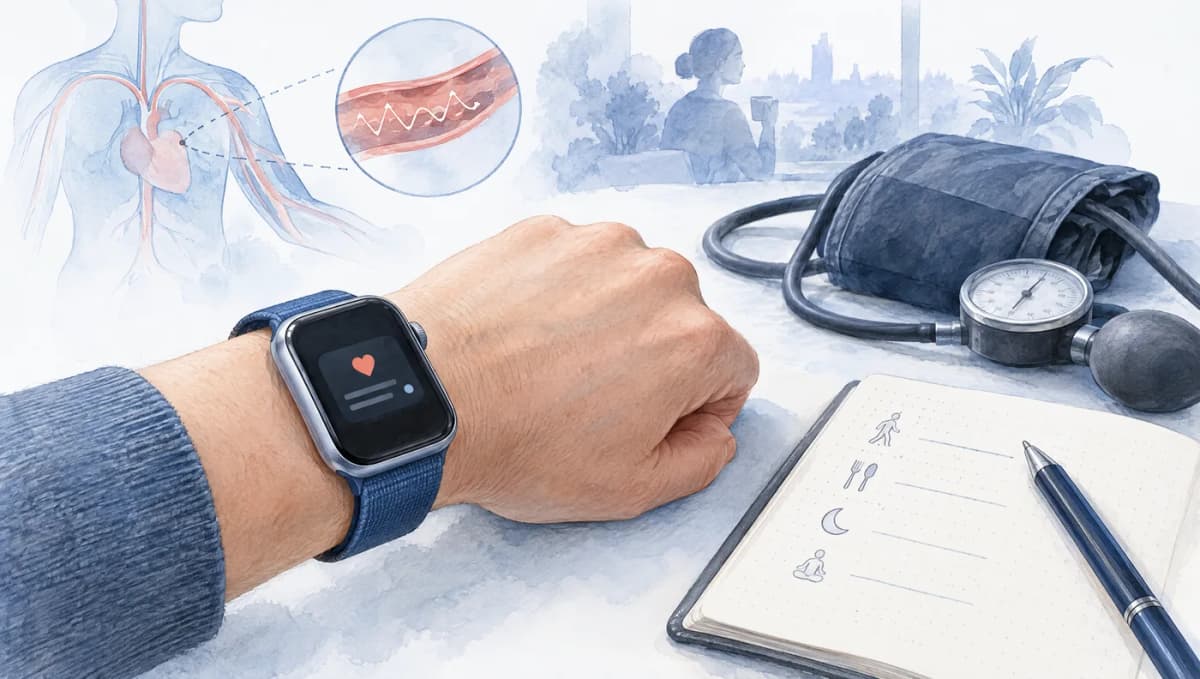
Short answer: Apple Watch hypertension notifications don't measure blood pressure. The watch reads its optical heart sensor (PPG) in the background for 30 days and, if the pulse data looks like what it learned from people with high blood pressure, it sends a "possible hypertension" alert. In the FDA-reviewed validation study, the feature caught 41.2% of people with hypertension and correctly cleared 92.3% of people without it (FDA 510(k) K250507).
So an alert is worth acting on, and silence tells you little. The rest of this page explains how the feature works, what the numbers mean, and why a pulse waveform carries blood pressure information at all.
How the feature works
Apple's validation paper describes a passive feature. It runs during waking hours, needs no calibration, and evaluates data in separate 30-day windows (Apple, Hypertension Notifications Validation Paper, Sept 2025). There is no number on screen. You either get a notification or you don't.
According to the same paper, the feature is available on Apple Watch Series 9 or later and Apple Watch Ultra 2 or later, not Apple Watch SE. It is meant for people 22 and older who have not been diagnosed with hypertension, and it is not intended for use during pregnancy.
The FDA cleared it on September 11, 2025 under a new device type, "Hypertension Machine Learning-Based Notification Software" (FDA 510(k) database, K250507).
What the validation study found
The FDA summary describes the pivotal study:
| Item | Result |
|---|---|
| Enrolled adults (no prior hypertension diagnosis) | 2,229 |
| Analyzed (at least 15 days of usable data) | 1,863 |
| Reference | FDA-cleared home blood pressure monitor over 30 days |
| Hypertension definition | Average ≥130 systolic or ≥80 diastolic mmHg (AHA) |
| Overall sensitivity | 41.2% (95% CI 37.2–45.3) |
| Overall specificity | 92.3% (95% CI 90.6–93.7) |
| Sensitivity, stage 2 hypertension | 53.7% (95% CI 47.7–59.7) |
| Specificity, normal blood pressure | 95.3% (95% CI 93.7–96.5) |
Source: FDA 510(k) summary K250507.
Apple tuned the feature to avoid false alarms. If you have normal blood pressure, there is about a 1-in-20 chance of a notification over a 30-day window. If you have hypertension, the odds of being flagged are a bit worse than a coin flip, a little better if it is stage 2.
That trade-off fits a consumer screening tool worn by millions of people who never asked to be screened. It also means the feature can't rule anything out.
Why a pulse waveform says anything about blood pressure
Each heartbeat sends a pressure wave down the arteries. A PPG sensor sees that wave as a change in light absorption at the wrist. Stiffer, higher-pressure arteries change the shape of the wave: how fast it rises, where the reflected wave lands, and where the small dip called the dicrotic notch sits. Our PPG blood pressure estimation methods guide covers these features in depth.
Apple hasn't published its model in detail, but academic work shows the same idea can screen for hypertension without estimating a number. A 2026 study in European Heart Journal – Digital Health by Hong, Nandi, Zheng and Alastruey tested a simple hypothesis: people with normal blood pressure show bigger changes in their PPG between waking and sleep than people with unmanaged hypertension (Hong et al., 2026, DOI 10.1093/ehjdh/ztag131).
They extracted 20 PPG indices from the Aurora-BP dataset (180 people: 138 normotensive, 42 hypertensive) and compared each person's awake and sleep periods. A support vector machine reached 81.1% accuracy on the internal test set. On an independent dataset of 26 people (CUHK-BP), a version using only timing-based indices reached 84.6% accuracy. Timing features tied to the dicrotic notch held up best across datasets.
That study is small, and it measures something different from Apple's feature, which runs during waking hours. It does show why a month of passive PPG data can carry a hypertension signal. The nightly dip in blood pressure is itself a clinical marker; see our piece on nocturnal blood pressure dipping. You can browse the paper's record in the ChatPPG research hub.
What a notification means, and what it doesn't
If you get an alert:
- Treat it as a reason to measure. Use a validated upper-arm cuff, take readings on several days, and bring them to a clinician.
- Don't start or change medication based on the watch.
- Remember that specificity of 92.3% still leaves some false alerts across a large population.
If you never get one:
- That isn't a clean bill of health. In the study, most people with hypertension were not flagged.
- Masked hypertension, where office readings look fine but daily readings run high, is common. Our guides on masked hypertension detection with wearables and white-coat vs masked hypertension explain why home readings matter.
How it compares with cuffless blood pressure watches
Some wearables try to show an actual blood pressure number from PPG, usually after calibration with a cuff. Those devices face a stricter validation question, which we cover in cuffless blood pressure validation and the blood pressure watch guide. Apple's approach avoids that problem by answering a narrower yes-or-no question over a month.
For the wider research picture, see PPG hypertension monitoring and the ChatPPG research hub, which tracks new PPG blood pressure papers, datasets and models as they come out.
This article is educational and is not medical advice. Talk to a clinician about blood pressure readings or symptoms.
References
- U.S. Food and Drug Administration. 510(k) summary K250507, Hypertension Notification Feature (Apple Inc.), decision date September 11, 2025. https://www.accessdata.fda.gov/cdrh_docs/pdf25/K250507.pdf
- Apple Inc. Hypertension Notifications Validation Paper, September 2025. https://www.apple.com/health/pdf/Hypertension_Notifications_Validation_Paper_September_2025.pdf
- Hong J, Nandi M, Zheng Y, Alastruey J. Hypertension screening via awake–sleep differences in photoplethysmogram signals. European Heart Journal – Digital Health. 2026. DOI 10.1093/ehjdh/ztag131
Frequently Asked Questions
- Does Apple Watch measure blood pressure?
- No. Apple's hypertension notification feature does not measure blood pressure and never shows a reading. It analyzes optical heart sensor (PPG) data over 30-day windows and sends a 'possible hypertension' notification if it finds signs of high blood pressure.
- How accurate are Apple Watch hypertension notifications?
- In the pivotal study summarized in FDA 510(k) K250507, 1,863 adults with usable data wore an Apple Watch for 30 days. Overall sensitivity was 41.2% and specificity was 92.3%. Sensitivity for stage 2 hypertension was 53.7%, and specificity among people with normal blood pressure was 95.3%.
- Which Apple Watch models support hypertension notifications?
- Apple's September 2025 validation paper lists Apple Watch Series 9 or later and Apple Watch Ultra 2 or later, excluding Apple Watch SE. The feature is intended for adults 22 or older without a prior hypertension diagnosis, and not for use during pregnancy.
- If my Apple Watch never sends an alert, is my blood pressure normal?
- Not necessarily. With 41.2% sensitivity, the feature missed more than half of the people in the validation study who had hypertension. A cuff measurement is still the way to know your blood pressure.
- What should I do after a possible hypertension notification?
- Measure your blood pressure with a validated upper-arm cuff over several days and share the readings with a clinician. The notification is a prompt to check, not a diagnosis. This article is educational and not medical advice.
Related articles
Ambulatory Blood Pressure Monitor vs Smartwatch: Accuracy, Use Cases, and Why They Are Not the Same
ABPM and smartwatch blood-pressure features are often discussed together, but they solve different problems. This guide compares clinical accuracy, use cases, and why ambulatory blood pressure monitoring still outperforms cuffless wearables for diagnosis.
Masked Hypertension and Wearable Detection: Why Clinic Blood Pressure Can Miss Risk
Masked hypertension is easy to miss because clinic blood pressure can look normal while out-of-office readings stay high. This guide explains where wearables may help with screening and support, and why diagnosis still depends on validated cuff-based out-of-office measurement.
Wearable SpO2 Accuracy Comparison: What Studies Show for Consumer Devices
How accurate are consumer wearable SpO2 sensors? Comparing Apple Watch, Fitbit, Garmin, Samsung, and Oura Ring blood oxygen accuracy against clinical pulse oximeters.
Can Wearables Detect AFib? Clinical Evidence & FDA-Cleared Devices
A comprehensive review of wearable atrial fibrillation detection covering PPG-based irregular rhythm detection, ECG-enabled smartwatches, the Apple Heart Study, Fitbit Heart Study, FDA clearances, sensitivity and specificity data, and clinical guidelines for screening versus diagnosis.
Cuffless Blood Pressure Validation: The ESH Tests Explained
The ESH 2023 framework introduced six validation tests for cuffless BP devices. Learn what passing static, position, treatment, awake/asleep, exercise, and recalibration tests means — and what 2026 studies reveal about real-world accuracy.
Related Comparisons
Whoop vs Apple Watch: What the Sleep-Lab Studies Found
Two independent sleep-lab studies tested WHOOP and Apple Watch on the same people on the same night, against polysomnography (PSG) for sleep and ECG for heart rate. Miller and colleagues (2022) tested WHOOP 3.0 and Apple Watch Series 6 in 53 adults; Schyvens and colleagues (2025) tested WHOOP 4.0 and Apple Watch Series 8 in 62 adults. Overnight heart rate was close to ECG for both. WHOOP 3.0 tracked overnight HRV more closely than Apple Watch S6. For sleep stages the two studies point in different directions, so neither device clearly wins there.
Compare devices →Garmin vs Apple Watch: PPG, ECG & Battery Compared
Apple Watch Series 10 has an ECG app, irregular rhythm notifications and Blood Oxygen; Garmin's Fenix 8 adds the ECG app in eligible regions and multi-week battery. In the independent studies that tested both brands, Apple Watch agreed more closely with ECG during exercise (Gillinov 2017) and for overnight heart rate (Miller 2022), while sleep staging was similar. No study has tested Series 10 against Fenix 8 or Forerunner 965.
Compare devices →Apple Watch Ultra 2 vs Garmin Fenix 8: Specs Guide
Choose the Garmin Fenix 8 if battery life, built-in mapping, and training tools come first. Choose the Apple Watch Ultra 2 if you use an iPhone and value tighter Apple integration, cellular connectivity, and a brighter specified display. Both offer optical heart-rate sensing, multi-band positioning, ECG support in eligible regions, and a 40 m recreational dive rating. This comparison uses the 49 mm Ultra 2 and 47 mm Fenix 8 AMOLED as the clearest like-for-like models.
Compare devices →Devices in this article
Research records with the datasets, papers and published validation results for each device.