How Accurate Is Apple Watch Blood Oxygen? What Studies Show
Apple Watch blood oxygen tracks a clinical oximeter at rest but often gives no reading during exercise. What 2026 study data show, including skin tone.
- Wearable Accuracy
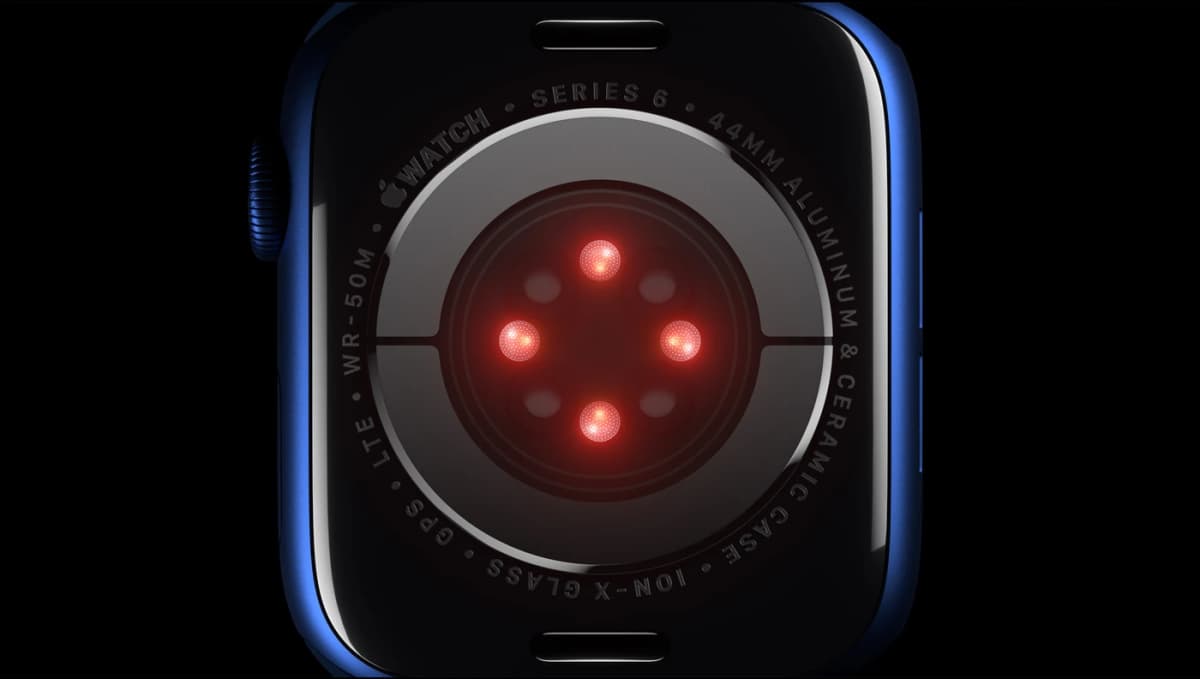
Short answer: How accurate is Apple Watch blood oxygen? When you sit still, the Apple Watch reads close to a clinical pulse oximeter. Studies of the Series 6 put the average difference under 1 percentage point, with 95% of single readings within about 3 to 4 points either way. When you move, it often gives no reading at all. In a 2026 Lehigh University study, the watch produced 1 of 245 scheduled readings while people walked on a treadmill.
So the watch is a reasonable wellness check at rest. It is not a medical oximeter, and Apple doesn't claim it is: the company describes the Blood Oxygen app as a general fitness and wellness feature that is "not intended for medical use".
This article is educational and is not medical advice. If you have symptoms such as shortness of breath, or a lung or heart condition such as COPD, use a pulse oximeter cleared for medical use and follow your clinician's advice.
For how wrist SpO2 compares across brands, see our wearable SpO2 accuracy comparison. This post stays with Apple Watch.
How Apple Watch measures blood oxygen
The Blood Oxygen app runs on Apple Watch Series 6 or later and every Apple Watch Ultra. It is not supported on Apple Watch SE, and Apple says it is for adults 18 and over (Apple Support: Blood Oxygen app).
The method is ordinary pulse oximetry, moved to the back of the wrist. According to Apple's 2022 white paper, the watch shines red and near-infrared light into the skin, records the reflected light as two photoplethysmography (PPG) signals that pulse with each heartbeat, works out the ratio of the red pulse to the infrared pulse, and converts that ratio to a percentage. The red, infrared and green LEDs run at about 660, 850 and 525 nm. Emitters and detectors sit on the same surface, which makes this a reflectance sensor rather than the light-through-the-finger design of a fingertip clip (Apple, Blood Oxygen app on Apple Watch, October 2022).
Apple notes in the same paper that pulse signals are smaller at the wrist than at the fingers, which is why the app asks you to stay still. There are two modes. You can start an on-demand reading, which takes 15 seconds with your arm resting flat and palm down. The watch also takes occasional background readings when it senses you are still, including during sleep if sleep tracking is on. Apple points out that these background readings are not the continuous second-by-second monitoring a bedside oximeter provides. The physics of why wrist readings are harder is covered in PPG SpO2 accuracy limitations, and our Apple Watch sensor page lists the hardware.
What the 2026 Lehigh activity study found
The newest independent test is Miller and colleagues at Lehigh University, published on October 30, 2026 in Frontiers in Digital Health (Miller et al., 2026, doi:10.3389/fdgth.2026.1909802). Forty-nine healthy adults (26 women, 23 men, mean age 25.5) wore four consumer devices in two rounds. The Apple Watch Series 6, running watchOS 11.5, was tested alongside a Zacurate fingertip oximeter against a Welch Allyn hospital monitor. A Garmin Fenix 7 and a Wellue O2Ring were tested in the other round against a GE Dash 3000.
Each round had three five-minute phases: seated rest, walking on a treadmill at 2.5 mph, and seated recovery. Participants read every device aloud once a minute, so each device had 245 scheduled readings per phase. The study summary card is on our research hub.
Results for the Apple Watch, from Tables 3 and 8 of the paper:
- Seated rest: 244 of 245 readings recorded (99.6%). Mean difference from the Welch Allyn was +0.20 percentage points, with 95% limits of agreement from −3.84 to +4.24.
- Treadmill walk: 1 of 245 readings recorded (0.4%). Forty-eight of 49 people got no reading at all, so accuracy during walking could not be estimated.
- Seated recovery: 245 of 245 recorded. Mean difference −0.27 points, with limits from −4.39 to +3.85.
Neither seated bias was statistically significant after correction for multiple comparisons. The authors are clear that the treadmill gap is about whether a reading appears, not about readings being wrong: the Series 6 requires the wearer to stay still during an on-demand measurement, which walking doesn't allow.
The interactive chart below shows every scheduled reading as a square. Guess first, then reveal.
Did the Apple Watch give a reading, and how close was it?
In the 2026 Lehigh study, 49 adults sat, walked on a treadmill at 2.5 mph, then sat again, reading each device once a minute for five minutes per phase. That is 245 scheduled readings per device per phase.
Your guess: the Apple Watch produced 150 of 245 scheduled treadmill readings. Reveal the study to compare.
Apple Watch reading recorded Other device reading recorded No reading (hollow square)Each square is one scheduled reading; missing ones are grouped at the end, not shown by person.
What it shows: the Apple Watch read almost every time people sat still, and almost never while they walked. The app asks you to hold still for a 15-second on-demand reading, so the gap is about getting a reading at all, not about readings being wrong during movement.
Data table
| Device | Seated rest | Treadmill walk | Seated recovery |
|---|---|---|---|
| Apple Watch Series 6 | 244 (99.6%) | 1 (0.4%) | 245 (100%) |
| Garmin Fenix 7 | 245 (100%) | 202 (82.4%) | 241 (98.4%) |
| Wellue O2Ring | 245 (100%) | 245 (100%) | 245 (100%) |
| Zacurate 500BL | 245 (100%) | 245 (100%) | 245 (100%) |
| Device | Phase | Compared with | Pairs | Bias [limits] |
|---|---|---|---|---|
| Apple Watch Series 6 | Seated rest | Welch Allyn | 244 | +0.2 [−3.84, +4.24] |
| Apple Watch Series 6 | Treadmill walk | Welch Allyn | 1 | Not estimable |
| Apple Watch Series 6 | Seated recovery | Welch Allyn | 245 | −0.27 [−4.39, +3.85] |
| Zacurate 500BL | Seated rest | Welch Allyn | 245 | +0.38 [−2.62, +3.38] |
| Zacurate 500BL | Treadmill walk | Welch Allyn | 245 | −0.35 [−6.05, +5.35] |
| Zacurate 500BL | Seated recovery | Welch Allyn | 245 | +0.09 [−3.5, +3.67] |
| Garmin Fenix 7 | Seated rest | GE Dash 3000 | 245 | −0.17 [−10.29, +9.95] |
| Garmin Fenix 7 | Treadmill walk | GE Dash 3000 | 202 | −0.4 [−4.9, +4.1] |
| Garmin Fenix 7 | Seated recovery | GE Dash 3000 | 241 | −0.7 [−5.33, +3.92] |
| Wellue O2Ring | Seated rest | GE Dash 3000 | 245 | +0.78 [−8.91, +10.46] |
| Wellue O2Ring | Treadmill walk | GE Dash 3000 | 245 | −1.03 [−6.26, +4.21] |
| Wellue O2Ring | Seated recovery | GE Dash 3000 | 245 | +0.35 [−3.53, +4.23] |
| Study | Reference | People | Bias [limits] |
|---|---|---|---|
| Miller 2026 | Clinical pulse oximeter (Welch Allyn) | 49 healthy adults | +0.2 [−3.84, +4.24] |
| Spaccarotella 2022 | Fingertip oximeter (Nellcor PM10N) | 257 people, incl. lung and heart disease | −0.23 [−3.49, +3.04] |
| Pipek 2021 | Two fingertip oximeters | 100 people, 84 with COPD or ILD | +0.8 [−2.7, +4.1] |
| Apple 2022 | Arterial blood (SaO2) | 50 healthy adults, induced hypoxia, SaO2 70 to 100% | +0.21 [−3.61, +4.02] |
The references were hospital pulse oximeters, not arterial blood, so this is agreement with another oximeter rather than true accuracy. The participants were also young and healthy, with readings mostly in the normal range, so the study says nothing about how the watch performs when oxygen is genuinely low. The authors make both points themselves and caution against extrapolating to missed low-oxygen events.
Earlier Apple Watch SpO2 studies agree at rest
Two independent studies from 2021 and 2022 tested the same Series 6 at rest, both in people with lung disease as well as healthy volunteers.
Pipek et al. (2021). In a Brazilian outpatient clinic, 100 people (23 with COPD, 61 with interstitial lung disease and 16 healthy volunteers) had readings taken seated, with the left arm resting on a table, against two fingertip oximeters (Pipek et al., 2021, doi:10.1038/s41598-021-98453-3). SpO2 correlated at r = 0.81. The bias was 0.8 percentage points, with limits of agreement from −2.7 to +4.1, and the watch tended to read slightly higher than the finger devices. The authors found no difference by skin color, wrist circumference, wrist hair or nail polish, and stressed that all measurements were taken at one sitting with a researcher's help.
Spaccarotella et al. (2022). An Italian team screened 265 people and analysed 257: 56 healthy, 60 with lung disease and 141 with cardiovascular disease (Spaccarotella et al., 2022, doi:10.3390/jcm11061467). Against a Nellcor fingertip oximeter, SpO2 correlated at r = 0.89. The bias was −0.23 points, with limits of −3.49 to +3.04. Even with trained staff and arms resting flat, the watch failed to give a reading in eight people. All participants were white, few had saturations below 90%, and there was no arterial blood comparison.
Apple's own validation. Apple's 2022 white paper reports a lab study in which 50 healthy adults breathed lower-oxygen air while blood was drawn from an artery, the reference method for pulse oximeter testing. Across saturations of 70 to 100%, the root-mean-square error was 1.97 percentage points and the mean difference was 0.21, with limits of −3.61 to +4.02. Readings were available in 94.7% of eligible periods. Apple computed these values offline from raw watch signals, not from the app on a wrist in daily use. This is the only Apple Watch dataset here that goes down to 70% and uses arterial blood. It is also manufacturer data: Apple says the processing and analysis "were conducted solely by Apple", and it was not peer reviewed.
Across all four datasets, average bias sits within a point of zero at rest, and a single reading can be about 3 to 4 points off.
Why readings drop out when you move
Pulse oximetry depends on a small pulsing part of the light signal. Arm swing and footfalls move the sensor against the skin and add noise that can swamp it, a problem described in PPG motion artifact removal. Apple's white paper says the app "withholds readings" when it judges the signal or position unsuitable, rather than showing a doubtful number.
Apple's support page lists the usual reasons a reading fails:
- moving, or holding the arm by your side or with a clenched fist
- a loose band, or the back of the watch not flush with the wrist (Apple suggests moving it 1 to 2 inches up from the wrist bone)
- low skin perfusion, for example when you are cold
- some tattoos, whose ink can block the light
- a resting heart rate above 150 bpm
The Lehigh result is the clearest example yet. The same people who got a reading almost every minute while seated got almost none while walking. Background readings work the same way: Apple says they usually happen when you are not moving, and the number per day depends on how active you are, so don't expect SpO2 during a workout.
Does skin tone affect Apple Watch SpO2?
The evidence does not show a clear effect, and it is not strong enough to rule one out.
The 2026 study measured skin tone two ways, with a colorimeter (Individual Typology Angle) and by eye (Fitzpatrick type). No device-specific link between skin pigmentation and error stayed significant after correcting for multiple comparisons. But the Fitzpatrick analysis of Apple Watch absolute error came close (p = 0.054), and the authors treated it as exploratory. They also note that no sample size was calculated in advance, the study may have been underpowered for smaller effects, and only 11 people were in the Fitzpatrick V or VI group. With 49 participants, "no significant effect" is not the same as "no effect".
Pipek (2021) also found no difference by skin color. Spaccarotella (2022) enrolled only white participants, so it cannot speak to the question. Apple's arterial study reported similar error for light and dark skin, but its dark-skin group was eight people. Apple says the sensor adjusts LED brightness, detector gain and sampling rate to cope with melanin, which absorbs strongly at the red and green wavelengths the watch uses.
Hospital fingertip oximeters have been reported to overestimate oxygen in people with darker skin, and the FDA has issued draft guidance in response; that story is covered in pulse oximeter accuracy and dark skin. Wrist sensors use the same red and infrared principle, so the open question deserves larger studies.
Apple Watch vs a fingertip pulse oximeter
Scroll horizontally if needed
| Apple Watch (Series 6 studies) | Fingertip pulse oximeter | |
|---|---|---|
| Sensor | Reflectance, back of wrist | Light passes through the fingertip |
| Seated, 95% limits vs reference | About −4 to +4 points | Zacurate in the same 2026 round: −2.62 to +3.38 |
| While walking (2026 study) | 1 of 245 readings | Zacurate recorded all 245 |
| Intended use | General fitness and wellness | Depends on the model; some are cleared for medical use |
The Zacurate is one consumer fingertip model, compared against the same Welch Allyn monitor in the same round as the watch. During walking its limits widened to −6.05 to +5.35, so fingertip devices also get noisier with motion, though they kept producing numbers. For a broader look at what to buy and how to read one, see our wearable pulse oximeter guide and pulse oximeter readings chart.
Is the Blood Oxygen feature available on my watch?
As of November 2026, Apple's feature availability page lists the United States among the countries where the Blood Oxygen app is available, but how it works depends on when and where you bought the watch.
On August 14, 2025, Apple announced a redesigned Blood Oxygen feature for some US users of the Series 9, Series 10 and Ultra 2 who did not have the feature, enabled by a US Customs ruling. After updating to iOS 18.6.1 and watchOS 11.6.1, sensor data from the watch is measured and calculated on the paired iPhone, and results appear in the Respiratory section of the Health app (Apple Newsroom, August 14, 2025). Apple said watches bought earlier with the original feature, and watches bought outside the US, were not affected.
Apple's current support page puts it this way: for Apple Watch models bought in the US on or after January 18, 2024 with part numbers ending in LW/A or LS/A, the analysis is done on the iPhone and you view results in the Health app. The analysis needs the paired iPhone; a secondary iPhone that isn't paired cannot do it. To take a reading, open Blood Oxygen on the watch, rest your arm flat, tap Start and keep still for 15 seconds.
When to use a medical oximeter instead
Use a pulse oximeter cleared for medical use, and your clinician's guidance, when:
- you have COPD, interstitial lung disease, heart failure or another condition where oxygen levels guide treatment (see pulse oximeter for COPD)
- you are unwell with an infection such as COVID-19 and have been told to monitor your oxygen
- you use supplemental oxygen and adjust it to a target
- you have symptoms such as breathlessness, chest pain, confusion or bluish lips, in which case seek urgent care rather than another reading
Apple's own page says Blood Oxygen readings are "not intended for medical use, including self-diagnosis or consultation with a doctor". The watch can still be useful for spotting your usual resting range or watching readings change at altitude; our SpO2 at altitude tool shows the expected drop. Studies of continuous SpO2 monitoring with wearables explain why overnight and activity tracking is harder than a seated spot check.
For normal ranges, see the blood oxygen level chart. For device-by-device evidence beyond Apple, see the SpO2 accuracy hub.
References
- Miller K, Whitney H, Chavez N, Seshadri DR. Agreement of consumer wearable pulse oximeters across activity conditions and skin pigmentation. Frontiers in Digital Health. 2026;8:1909802. CC BY 4.0. doi:10.3389/fdgth.2026.1909802
- Pipek LZ, Nascimento RFV, Acencio MMP, Teixeira LR. Comparison of SpO2 and heart rate values on Apple Watch and conventional commercial oximeters devices in patients with lung disease. Scientific Reports. 2021;11:18901. doi:10.1038/s41598-021-98453-3
- Spaccarotella C, Polimeni A, Mancuso C, Pelaia G, Esposito G, Indolfi C. Assessment of non-invasive measurements of oxygen saturation and heart rate with an Apple smartwatch: comparison with a standard pulse oximeter. Journal of Clinical Medicine. 2022;11(6):1467. doi:10.3390/jcm11061467
- Apple. Blood Oxygen app on Apple Watch. White paper, October 2022. Manufacturer analysis, not peer reviewed. apple.com/healthcare
- Apple Support. How to use the Blood Oxygen app on Apple Watch. Published September 14, 2026. support.apple.com/en-us/120358
- Apple Newsroom. An update on Blood Oxygen for Apple Watch in the U.S. August 14, 2025. apple.com/newsroom
- Apple. watchOS feature availability: Health, Blood Oxygen app. Accessed November 5, 2026. apple.com/watchos/feature-availability
Frequently Asked Questions
- Is Apple Watch blood oxygen accurate?
- At rest, mostly yes for a wellness feature. In four studies of the Apple Watch Series 6, the average difference from a reference was under 1 percentage point, and 95% of single readings fell within roughly 3 to 4 points either way. The catch is movement: in a 2026 treadmill study the watch produced 1 of 245 scheduled readings while people walked. Apple says the Blood Oxygen app is for general fitness and wellness, not medical use.
- Why does my Apple Watch blood oxygen reading fail or say unsuccessful?
- Usually because of movement, fit, or low blood flow in the skin. Apple's support page lists motion, arms hanging by your side or a clenched fist, a loose band or a watch sitting on the wrist bone, cold skin with low perfusion, some tattoos, and a resting heart rate above 150 bpm. Apple's white paper says the app withholds a reading when the signal or position is unsuitable. Rest your arm flat on a table, palm down, keep still for the 15-second measurement, and wear the band snug.
- Is Apple Watch SpO2 as accurate as a finger pulse oximeter?
- Not quite, and it is not tested the same way. At rest the Apple Watch agreed with fingertip and clinical oximeters within about ±4 percentage points for 95% of readings. In the 2026 study a fingertip oximeter tested in the same round had somewhat tighter limits at rest and kept reading during walking, when the watch did not. A fingertip oximeter cleared for medical use is the better tool when a number will guide a health decision.
- Does skin tone affect Apple Watch blood oxygen?
- The studies so far have not found a clear effect, but they were too small to rule one out. A 2026 study of 49 adults found no significant skin-tone effect for the Apple Watch after correcting for multiple comparisons, while one Fitzpatrick analysis came close (p = 0.054) and the authors called it exploratory. A 2021 study of 100 people found no difference by skin color, and Apple's own arterial-blood study included only eight people with Fitzpatrick V or VI skin. Clinical pulse oximeters have a documented skin-tone problem, so the question is still open.
- What is a normal blood oxygen reading on Apple Watch?
- Apple's support page says most people have a blood oxygen level of 95 to 100%, that some people live normally below 95%, and that slightly lower values during sleep are expected. Our blood oxygen level chart explains the ranges clinicians use. A low reading with symptoms such as breathlessness or chest pain needs a medical oximeter and prompt medical advice, not another watch reading.
- Can Apple Watch detect low oxygen during sleep?
- It takes occasional background readings during sleep if sleep tracking is on, and the Health app labels them. None of the studies in this article tested whether those readings catch low-oxygen episodes at night. Apple lists Sleep Apnea Notifications as a separate feature. If you are worried about breathing at night, ask a clinician about a sleep study.
Related articles
Wearable SpO2 Accuracy: What Studies Show
How accurate are smartwatch and ring SpO2 readings? Apple Watch, Fitbit, Garmin, Samsung and Oura compared with clinical pulse oximeters in studies.
Does WHOOP Measure Blood Pressure? Accuracy, Calibration and the FDA
WHOOP estimates your blood pressure each morning after a cuff calibration. How Blood Pressure Insights works, how accurate it is, and why the FDA stepped in.
How accurate are Apple Watch calories? Usually 15–25% off
Apple Watch calorie counts usually miss lab measurements by about 15–25%. What six validation studies found, and why body fat changed the error.
Does Galaxy Watch measure blood pressure? Yes, with a cuff
Galaxy Watch4 and later estimate blood pressure after three cuff readings, redone every 28 days. In 1,714 users, each recalibration moved readings about 6 mmHg.
Garmin and Apple Watch Validation Studies
What independent studies show for Garmin and Apple Watch heart rate, SpO2 and AFib detection, how validation studies work, and where each falls short.
Related Comparisons
Whoop vs Apple Watch: What the Sleep-Lab Studies Found
Two sleep-lab studies tested WHOOP and Apple Watch on the same people on the same night, against polysomnography (PSG) for sleep and ECG for heart rate. Miller and colleagues (2022) tested WHOOP 3.0 and Apple Watch Series 6 in 53 adults; Schyvens and colleagues (2025) tested WHOOP 4.0 and Apple Watch Series 8 in 62 adults. Overnight heart rate was close to ECG for both. WHOOP 3.0 tracked overnight HRV more closely than Apple Watch S6. For sleep stages the two studies point in different directions, so neither device clearly wins there.
Compare devices →Garmin vs Apple Watch: Heart Rate Accuracy from Published Studies
In the studies that tested both brands, Apple Watch agreed more closely with ECG for exercise heart rate and overnight heart rate. Series 10 and Fenix 8 were not the models tested.
Compare devices →Apple Watch Ultra 2 vs Garmin Fenix 8: Specs Guide
Choose the Garmin Fenix 8 if battery life, built-in mapping, and training tools come first. Choose the Apple Watch Ultra 2 if you use an iPhone and value tighter Apple integration, cellular connectivity, and a brighter specified display. Both offer optical heart-rate sensing, multi-band positioning, ECG support in eligible regions, and a 40 m recreational dive rating. This comparison uses the 49 mm Ultra 2 and 47 mm Fenix 8 AMOLED as the clearest like-for-like models.
Compare devices →Devices in this article
Research records with the datasets, papers and published validation results for each device.