Does Fitbit Measure Blood Pressure? Google's Nature Study Explained
Fitbit and Pixel Watch don't show blood pressure numbers. Google's Blood pressure trends flags a monthly High trend. Here's what its Nature study found.
- Blood Pressure
- BP
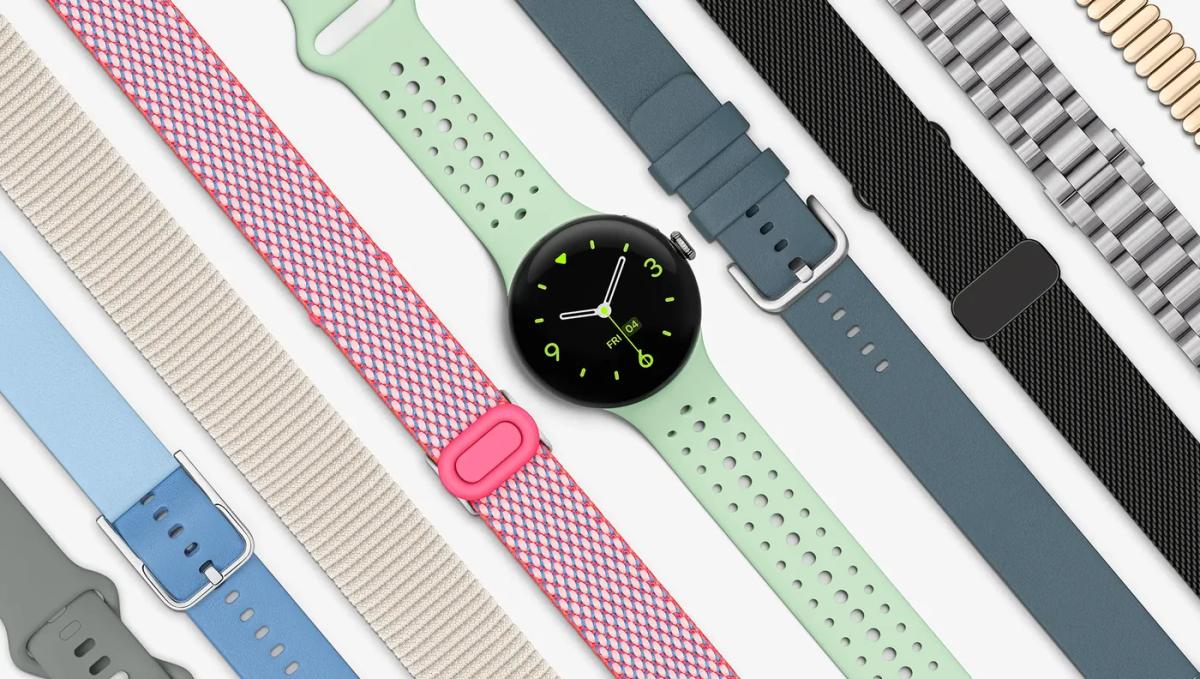
Short answer: No Fitbit or Pixel Watch measures blood pressure or shows you a systolic and diastolic number. Since September 2026, some of Google's newer wearables run a feature called Blood pressure trends. It reads your pulse and motion patterns for about a month and then gives the month one of three labels: High, Not high, or Not enough data. Google's own help page puts it plainly: the feature "doesn't measure your blood pressure, and it doesn't give you numbers" (Google Health Help).
The science behind it got a big public test on November 5, 2026, when Google researchers published a study in Nature (Di Achille et al., 2026). A Pixel Watch 3 and an AI model caught about two in three people with hypertension, a little better than a single office cuff check in the same group. This post covers what the feature does, which devices get it, and what the study does and doesn't show.
What Blood pressure trends does
Google added Blood pressure trends to a set of background tools it calls Health Guardian. The features went live in the Google Health app the week of September 24, 2026, with the first monthly trend reports arriving in early October (Google blog). According to Google's help pages (feature page, Health Guardian page):
Scroll horizontally if needed
| What you get | Details from Google |
|---|---|
| Result | A monthly trend: High, Not high or Not enough data. No mmHg values. |
| Inputs | Optical (PPG) and motion sensors plus AI, which look at "the complex shape and speed of your pulse." Keep your height and weight current in the app. |
| Wear time | At least 5 continuous days a month, with at least 8 hours a day of good signal. Sleeping with the watch on is recommended. |
| Cuff | Not needed for calibration. You can log cuff readings by hand, by asking the Coach, or through Health Connect or Apple Health. |
| When results arrive | Trend insights are delivered on the first of each month. |
| Who it's not for | People who are pregnant, and people already diagnosed with high blood pressure or kidney disease. |
Two lines from Google's page are worth repeating. A Not high result "doesn't promise that your blood pressure is normal." And a cuff reading "always matters more than a High or Not high trend." The help page also notes that medicines that change heart rate or blood pressure, such as beta-blockers, decongestants and some pain relievers, can change the pulse patterns the trend relies on.
The feature is called Vascular Stress in Japan and Mexico, and availability varies by country and device.
Which Fitbit and Pixel devices support it
Google's Health Guardian table lists these devices for Blood pressure trends (Google Health Help):
Scroll horizontally if needed
| Device | Blood pressure trends | Subscription |
|---|---|---|
| Google Pixel Watch 3, 4 and 5 | Yes | Free |
| Google Fitbit Edge | Yes | Google Health Premium required |
| Google Fitbit Air | Yes | Google Health Premium required |
| Fitbit Charge 6, Sense 2, Versa 4, Inspire 3 and older Fitbits | Not listed | n/a |
So if you own a Fitbit Charge 6, the answer is no. The Charge 6 does appear in the same table for ECG, irregular rhythm notifications and high or low heart rate notifications, which are different features. Third-party wearables aren't supported. For how Fitbit's optical sensor performs on the basics, see our Fitbit heart rate accuracy review and the Fitbit sensor page.
How a watch can spot hypertension without a cuff
The research model in the Nature paper is called AI-PPG-ACC-HTN. Google's research blog explains that it doesn't try to estimate a reading at one moment, because single-moment values are easily thrown off by noise. Instead it looks for a persistent hypertensive state across several days (Google Research).
It uses two sensors that are already in the watch:
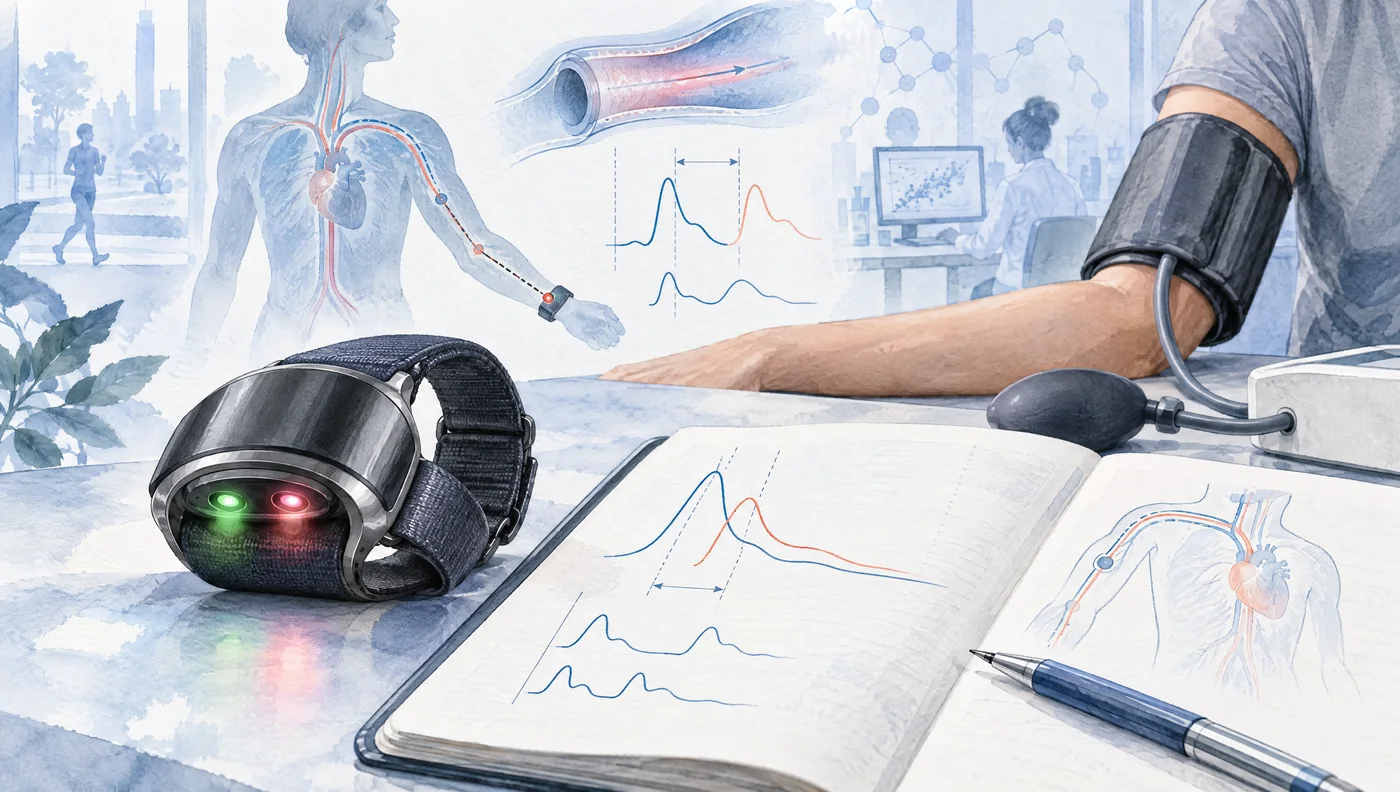
- PPG (photoplethysmography): the optical sensor that tracks blood volume changes under the skin. The shape of each pulse changes with arterial stiffness and wave reflection, which is the physiology behind pulse wave velocity and PPG morphology.
- Accelerometer: it finds still periods, and it also picks up the ballistocardiogram, the tiny wrist vibrations caused by the heart ejecting blood into the aorta.
According to the preprint version of the paper, the team first trained a waveform encoder without labels on 492,347 hours of smartwatch data from 2,109 people. It then trained a simple classifier on embeddings averaged across each person's wear time, plus the person's height as a stand-in for arterial path length. That classifier was developed with 663 participants from 44 US states who also wore a 24-hour ambulatory monitor (Di Achille et al., medRxiv preprint). No cuff calibration is needed at any point.
When the researchers looked at what the model responded to, people with higher scores had slightly narrower pulses, a slower systolic upstroke and differences in the ballistocardiogram waves. Those fit with stiffer arteries (Google Research). For the broader family of methods, see pulse wave analysis for blood pressure and pulse transit time.
What the Nature study found
The validation study ran at five US sites. Participants wore a Pixel Watch 3 at home, including during sleep, and also did office readings, home cuff readings and 24-hour ambulatory blood pressure monitoring (ABPM). ABPM was the reference, with hypertension defined as a 24-hour average of 130/80 mmHg or higher. Of 296 people enrolled, 196 had complete data. Most exclusions came from missing or incomplete ABPM files, often because people didn't wear the cuff to bed (preprint).
The final group averaged 41.9 years old, 55.6% were female and 34.2% were non-Hispanic Black. Skin tones spanned light to dark on a colorimeter scale, and 38.8% had hypertension on ABPM.
Initial screening (196 people). Over about seven days, the watch model had a sensitivity of 65.8% (95% CI 54.0 to 76.3), specificity of 90.0% (83.2 to 94.7) and a positive predictive value of 80.6% (68.6 to 89.6). An initial office cuff screen in the same people reached 55.3% sensitivity, 90.0% specificity and 77.8% PPV (Nature abstract). The preprint also tested age, sex and BMI alone, which caught only 34.2%.
Confirmatory testing (48 people whose first office reading was high). Here the watch had 78.4% sensitivity, 90.9% specificity and 96.7% PPV. A return office visit scored 67.6%, 63.6% and 86.2%. Multi-day home cuff monitoring scored 89.2%, 81.8% and 94.3% (preprint abstract; the same figures appear on the Google Research blog).
Toggle between the two scenarios below.
Pixel Watch 3 vs a blood pressure cuff at spotting hypertension
Every bar is scored against 24-hour ambulatory monitoring (average 130/80 mmHg or higher). Whiskers are 95% confidence intervals. Switch between the first screen and the follow-up step.
196 adults with no known cardiovascular disease and no blood pressure medication. Watch: about 7 days of Pixel Watch 3 data. Office: a single initial office screen (140/90 mmHg or higher).
What it shows: Initial screening, 196 people: the watch flagged 65.8% of people with hypertension on 24-hour monitoring, against 55.3% for a single office cuff screen. Both cleared 90% of people without it. The confidence intervals overlap, so the watch was at least as good as the office screen here, not clearly better. Age, sex and BMI alone caught 34.2%.
Sensitivity: share of people with hypertension who were flagged. Specificity: share of people without hypertension who were cleared. PPV (positive predictive value): share of flags that turned out to be real hypertension; it depends on how common hypertension was in the group (38.8% in the full cohort). Bar labels are rounded; exact values are in the table.
Data table
| Scenario | Method | Sensitivity (95% CI) | Specificity (95% CI) | PPV (95% CI) | Source |
|---|---|---|---|---|---|
| Initial screening (n=196) | Smartwatch AI (PPG + accelerometer) | 65.8% (54-76.3) | 90% (83.2-94.7) | 80.6% (68.6-89.6) | Nature abstract; preprint Table 2 |
| Initial screening (n=196) | Initial office BP screen | 55.3% (43.4-66.7) | 90% (83.2-94.7) | 77.8% (64.4-88) | Nature abstract; preprint Table 2 |
| Initial screening (n=196) | Demographics only (age, sex, BMI) | 34.2% (23.7-46) | 90% (83.2-94.7) | 68.4% (51.3-82.5) | Preprint results, Table 2 |
| Confirmatory testing (n=48) | Smartwatch AI (PPG + accelerometer) | 78.4% (61.8-90.2) | 90.9% (58.7-99.8) | 96.7% (82.8-99.9) | Preprint abstract, Table 3; Google Research blog |
| Confirmatory testing (n=48) | Return office BP | 67.6% (50.2-82) | 63.6% (30.8-89.1) | 86.2% (68.3-96.1) | Preprint abstract, Table 3; Google Research blog |
| Confirmatory testing (n=48) | Multi-day home BP monitoring | 89.2% (74.6-97) | 81.8% (48.2-97.7) | 94.3% (80.8-99.3) | Preprint abstract, Table 3; Google Research blog |
In the initial screen the watch's confidence interval overlaps the office cuff's, so the fair reading is that the watch did about as well as a single office check, possibly a bit better. Home cuff monitoring still had the highest sensitivity in the confirmatory step. The authors frame the watch as a prompt to get a proper cuff-based workup, not a diagnosis.
What it misses
- About one in three people with hypertension. With 65.8% sensitivity in the initial screen, roughly a third of people who had hypertension on ABPM were not flagged. In the preprint's error analysis, 17 of the 26 people the watch missed were also missed by the office screen.
- People on blood pressure medication, or with heart disease. They were excluded by design. The authors say the model's use for monitoring treatment or established hypertension still needs study, and Google's feature isn't designed for people with a diagnosis.
- Small numbers. 196 people in the main analysis and 48 in the confirmatory subset leave wide confidence intervals, especially for specificity in the subset.
- False positives aren't all false alarms. Nine of the watch's 12 false positives met some criteria for hypertension, mostly at night, according to the preprint.
Research model vs the feature on your wrist
Don't treat the Nature numbers as the accuracy of Blood pressure trends. Google's research blog says the findings "helped inform" the Health Guardian feature. The same post calls the work early feasibility research that is "not indicative of any existing or upcoming commercial product feature" (Google Research). Google's product posts say Blood pressure trends is built on WavesFM, a foundation model for long PPG and accelerometer recordings, and was validated in a Fitbit Hypertension Labs study (Google blog). The WavesFM paper is an arXiv preprint. Its stage-one encoder was pretrained on more than 6.8 million hours of recordings from 324,000 people (Cao et al., 2026). Google hasn't published sensitivity or specificity for the shipping feature that we could find as of November 11, 2026.
The product also has a different job. The study tested a hypertension screen. Google says Blood pressure trends "is not intended to screen for hypertension" and is a general wellness feature (Google Health Help). That's the same trends-not-numbers approach Oura took. For more detail, see our hub card for the Nature paper, the AI-PPG-ACC-HTN model card and the WavesFM model card.
How Google's approach compares
Scroll horizontally if needed
| Device | What you get | Cuff needed? | Evidence |
|---|---|---|---|
| Pixel Watch 3/4/5, Fitbit Edge, Fitbit Air | Monthly High / Not high trend, no mmHg | No | Wellness feature; research model in Nature |
| Oura Ring | Pattern notice from 30 nights of PPG plus a dipping trend, no mmHg | No | Wellness feature; company-reported accuracy |
| Apple Watch | Possible-hypertension notification, no mmHg | No | FDA 510(k) cleared |
| Samsung Galaxy Watch | Systolic and diastolic estimates | Yes, every 28 days | Wellness only in the US |
| WHOOP MG | Daily estimated systolic and diastolic range | Yes, 3 readings to start, then every 30 days | Wellness feature; FDA closed its warning letter in June 2026 |
None of these replaces an upper-arm cuff. Our blood pressure watch guide, ambulatory monitor vs smartwatch comparison and the cuffless BP leaderboard cover the wider field. Office readings can miss high pressure that only shows up at work or at night, a pattern we cover in masked hypertension and wearables and white-coat vs masked hypertension.
If your trend says High
Google's help page lays out the next steps (Google Health Help):
- Measure with an upper-arm cuff, twice a day (morning and evening, two readings a minute apart) for 7 days. Use a validated cuff that fits your arm.
- Share the readings with your doctor. Ask whether a 24-hour monitor makes sense. That's the test the research model was checked against.
- Check your numbers against a blood pressure chart so you know which range you're in.
- Get help right away for chest pain, shortness of breath, weakness on one side, trouble speaking or seeing, or a sudden severe headache. Don't wait for a trend.
If your trend is Not high but your cuff readings are high, go with the cuff. Don't start, stop or change any medication based on a watch. This article is educational and not medical advice. For background on the condition, see hypertension. For the devices themselves, see the Pixel Watch sensor page, the Pixel Watch 3 device card and Fitbit vs Apple Watch.
References
- Di Achille P, Cai L, Wu J, et al., Poh M-Z. Opportunistically detecting signs of hypertension on a consumer smartwatch. Nature. Published November 5, 2026. doi:10.1038/s41586-026-11336-3
- Di Achille P, et al. Opportunistically detecting signs of hypertension on a consumer smartwatch. medRxiv preprint (not peer reviewed; earlier version of reference 1). Posted December 2025. doi:10.64898/2025.12.10.25341972
- Cao P, Yang Z, Liu T, et al., Di Achille P, Poh M-Z. WavesFM: hierarchical representation learning for longitudinal wearable sensor waveforms. arXiv preprint 2605.09173. 2026. doi:10.48550/arXiv.2605.09173
- Di Achille P, Poh M-Z. Detecting signs of hypertension using wearable sensors. Google Research blog. November 5, 2026. research.google
- Google Health Help Center. Track your Blood pressure trends with the Google Health app. support.google.com
- Google Health Help Center. Learn about Health Guardian features. support.google.com
- Thng F. Track subtle changes in your body with Health Guardian features on Pixel and Fitbit. Google blog. August 12, 2026. blog.google
- Sridharan Weaver S. Health Guardian features go live in Google Health. Google blog. September 24, 2026. blog.google
Frequently Asked Questions
- Does Fitbit measure blood pressure?
- No. No Fitbit or Pixel Watch shows a systolic or diastolic number. On supported devices, Google's Blood pressure trends feature looks at about a month of pulse and motion patterns and labels the month High, Not high or Not enough data. Google's help page says it 'doesn't measure your blood pressure, and it doesn't give you numbers.'
- Does Fitbit Charge 6 track blood pressure?
- No. Google's Health Guardian device table lists Blood pressure trends only for Pixel Watch 3, 4 and 5, Fitbit Edge and Fitbit Air. The Charge 6 gets other Health Guardian features, such as irregular rhythm notifications, ECG and high or low heart rate notifications, but not blood pressure trends.
- Does Pixel Watch measure blood pressure?
- Pixel Watch 3, 4 and 5 can run Blood pressure trends for free in the Google Health app (version 5.09 or later). It still doesn't give a reading in mmHg. You need at least 5 continuous days of wear in a month with at least 8 hours a day of good signal, and Google recommends wearing the watch to sleep.
- What does a High blood pressure trend mean?
- Google says a High trend means your heart may have been working harder than it should to pump blood over the month. It recommends taking upper-arm cuff readings twice a day, morning and evening, for 7 days and sharing them with your doctor. If you have chest pain, shortness of breath or other warning signs, seek care right away. A Not high trend does not mean your blood pressure is normal.
- How accurate is Google's smartwatch hypertension detection?
- In Google's Nature study of 196 adults wearing a Pixel Watch 3 for about a week, the research model caught 65.8% of people who had hypertension on 24-hour ambulatory monitoring, with 90.0% specificity. A single office cuff screen in the same people caught 55.3% with the same specificity. That is the research model. Google says the work helped inform the shipping feature but has not published accuracy figures for Blood pressure trends itself.
- Do I need a blood pressure cuff with Blood pressure trends?
- Yes. The feature doesn't need cuff calibration, but Google says it does not replace a cuff and that a cuff reading always matters more than a High or Not high trend. Google recommends a validated upper-arm cuff and lists validatebp.org in the US and stridebp.org elsewhere.
- Is Google's blood pressure feature FDA cleared?
- Google describes Blood pressure trends as a general wellness feature. Its help pages say it is not intended to diagnose any disease, is not a prescreener for hypertension, doesn't give real-time readings and should not be used to adjust medication. It is also not designed for people who are pregnant or who already have a hypertension or kidney disease diagnosis.
Related articles
Does Galaxy Watch measure blood pressure? Yes, with a cuff
Galaxy Watch4 and later estimate blood pressure after three cuff readings, redone every 28 days. In 1,714 users, each recalibration moved readings about 6 mmHg.
Does WHOOP Measure Blood Pressure? Accuracy, Calibration and the FDA
WHOOP estimates your blood pressure each morning after a cuff calibration. How Blood Pressure Insights works, how accurate it is, and why the FDA stepped in.
Does Oura Ring Measure Blood Pressure? What Ring BP Research Shows
Oura doesn't give you blood pressure numbers. Here's what its Blood Pressure Signals and Nighttime BP features track, and what ring BP studies show so far.
Apple Watch hypertension notifications: how PPG spots possible high blood pressure
Apple Watch hypertension notifications read 30 days of PPG data. FDA filings show 41.2% sensitivity and 92.3% specificity. Here's what an alert means.
How accurate are Apple Watch calories? Usually 15–25% off
Apple Watch calorie counts usually miss lab measurements by about 15–25%. What six validation studies found, and why body fat changed the error.
PPG Second Derivative (SDPPG/APG) Explained
The PPG second derivative (SDPPG or APG) and its a to e waves: what each wave means, the aging index, and how to compute it from a raw PPG signal.
Related Comparisons
Fitbit vs Apple Watch: Heart Rate and Sleep Accuracy from Published Studies
Independent studies favor Apple Watch for exercise heart rate (concordance with ECG 0.92 vs 0.67 for Fitbit Blaze in Gillinov 2017). For sleep staging, Fitbit Sense (κ 0.42) and Charge 5 (κ 0.41) came close to Apple Watch Series 8 (κ 0.53) in Schyvens 2025. Both brands ran large AFib studies, but with different definitions, so their headline numbers are not directly comparable.
Compare devices →Fitbit vs Garmin: Heart Rate Accuracy from Published Studies
Older-model studies give mixed results. During exercise, the Garmin Forerunner 235 agreed more closely with ECG than the Fitbit Blaze (concordance 0.81 vs 0.67; Gillinov 2017). For sleep, Fitbit Alta HR performed as well as or better than actigraphy while Garmin Fenix 5S and Vivosmart 3 did worse (Chinoy 2021), and Fitbit Sense and Charge 5 (κ 0.42/0.41) beat Garmin Vivosmart 4 (κ 0.21) in Schyvens 2025.
Compare devices →Devices in this article
Research records with the datasets, papers and published validation results for each device.