Bilateral Ring PPG: What a 1,810-Person Study Shows About HR, BP, and Left–Right Differences
A large-scale bilateral ring PPG study measured both hands simultaneously in 1,810 participants. The results reveal where ring sensors excel (heart rate), where they show modest utility (age), and where limitations remain (blood pressure).
Reviewed by Sameer Sontakey, Co-founder and Chief AI & Algorithms Officer at Sensor Bio. ChatPPG is independent and device-neutral; it is not a Sensor Bio product.
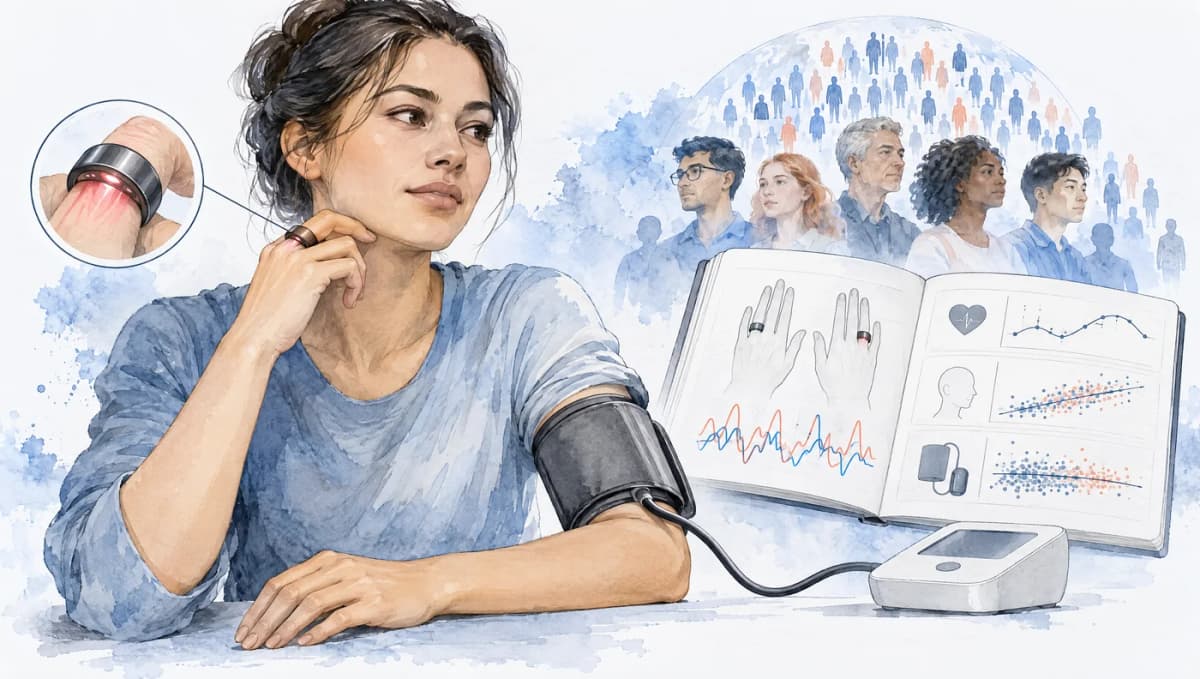
Most wearable ring studies measure one hand, typically assuming that a single finger provides representative cardiovascular information. But what happens when you measure both hands simultaneously? A large-scale bilateral ring PPG study by Chen et al. (2026, npj Digital Medicine) measured synchronized PPG signals from both hands in 1,810 participants to answer this question — and the results reveal where bilateral averaging helps most, where it helps modestly, and where even bilateral data doesn't solve fundamental measurement challenges.
The headline findings: bilateral ring PPG shows strong utility for heart rate (MAE 3.21 bpm), cautious utility for age estimation (MAE 9.46 years), and limited, transparently quantified performance for blood pressure (MAE 12.36 mmHg systolic, 8.21 mmHg diastolic). Understanding where each measurement stands helps set realistic expectations for what wearable ring PPG can reliably deliver.
The Bilateral Ring PPG Benchmark: 97,559 Synchronized Samples
Study Design
The Chen et al. study built the first large-scale bilateral ring-PPG benchmark, collecting 97,559 valid synchronized samples from 1,810 participants. Each participant wore wearable rings on both hands simultaneously, capturing PPG waveforms, heart rate, and associated physiological parameters under controlled conditions.
The research team tested predictions for four cardiovascular and physiological targets:
- Heart rate (HR) in beats per minute
- Systolic blood pressure (SBP) in mmHg
- Diastolic blood pressure (DBP) in mmHg
- Age in years
The bilateral setup allowed the researchers to compare single-hand measurements against bilateral averaged measurements (combining data from both hands) and to examine whether left–right signal differences correlate with prediction accuracy.
Heart Rate: The Clear Winner for Bilateral Ring PPG
Performance vs. Baseline
For heart rate estimation, bilateral ring PPG achieved a mean absolute error (MAE) of 3.21 bpm. This represents a substantial improvement over a cohort-mean baseline (predicting the average HR for the entire cohort), which produced MAE of 10.65 bpm. The reduction from 10.65 to 3.21 bpm indicates that the ring PPG signal carries meaningful, individualized heart rate information.
Clinical Interpretation
An MAE of 3.21 bpm falls within the range of acceptable accuracy for many consumer health and wellness applications. For comparison:
- Clinical pulse oximeters typically achieve HR MAE < 2 bpm at rest (see our PPG heart rate accuracy review)
- Wrist-worn PPG devices show MAE of 2–5 bpm at rest in most validation studies
- During exercise, wrist PPG MAE increases to 5–15 bpm or more depending on activity type
At 3.21 bpm, bilateral ring PPG performs comparably to wrist-worn devices at rest and likely outperforms wrist sensors during many activities due to the finger's superior perfusion index and lower motion artifact during ambulation. For a detailed comparison of finger vs. wrist PPG signal quality, see our ring vs. wrist sensor comparison.
Why Bilateral Averaging Helps Heart Rate
The bilateral improvement for heart rate reflects several mechanisms:
- Noise averaging: Random measurement noise in each hand's sensor averages out when combining signals
- Perfusion variability: Momentary perfusion differences between hands (due to positioning, compression, or local vasomotion) are mitigated
- Robustness to unilateral artifacts: If one hand experiences transient motion or contact loss, the other hand's signal provides continuity
Chen et al. found that samples with smaller bilateral differences (more similar PPG signals between left and right hands) reduced HR MAE by an additional 19.3%. This suggests that bilateral signal quality concordance is a useful indicator: when both hands produce similar signals, the averaged prediction is more reliable.
Age Estimation: Modest Improvement, Modest Utility
Performance Numbers
For age prediction, bilateral ring PPG achieved MAE of 9.46 years, compared to the cohort-mean baseline of 11.08 years. The improvement from 11.08 to 9.46 years is statistically significant but modest in absolute terms — a reduction of only 1.62 years.
What Age Estimation Measures
Age estimation from PPG waveforms reflects cumulative vascular aging: arterial stiffening, reduced vascular compliance, altered wave reflection patterns, and changes in autonomic modulation. These aging-related changes manifest in PPG waveform morphology features such as:
- Pulse wave velocity (faster in stiffer arteries)
- Dicrotic notch position and prominence (altered by wave reflection timing)
- Systolic upstroke slope (reduced in older adults)
- Pulse pressure amplitude variability
The 9.46-year MAE suggests that while PPG waveforms contain age-related signal, the relationship is noisy — many other factors (fitness level, cardiovascular health, medications, autonomic tone) also affect waveform morphology and introduce variance that is orthogonal to chronological age.
Clinical Relevance
A 9.46-year MAE means that age predictions from bilateral ring PPG are more informative than random guessing but not precise enough for applications requiring accurate chronological age. The potential utility lies in vascular age assessment — estimating physiological aging of the cardiovascular system rather than chronological age. For individuals whose vascular health diverges meaningfully from their chronological age, PPG-derived metrics may provide useful trending information over time.
Blood Pressure: Limited Performance Despite Bilateral Data
The Numbers and What They Mean
For blood pressure estimation, bilateral ring PPG achieved:
- SBP MAE: 12.36 mmHg (baseline 13.81 mmHg)
- DBP MAE: 8.21 mmHg (baseline 9.27 mmHg)
The improvements over baseline are modest: 1.45 mmHg for SBP and 1.06 mmHg for DBP. More concerning, the authors report that error dispersions remained close to target variability — meaning the spread of prediction errors is nearly as large as the natural variability in blood pressure across the population.
Why This Matters: Comparing to Clinical Standards
The ANSI/AAMI SP10 standard and the IEEE 1708 standard for cuffless blood pressure devices specify maximum allowed errors:
- Grade A: Mean error ≤ 5 mmHg and standard deviation ≤ 8 mmHg
- Grade B: Mean error ≤ 10 mmHg and standard deviation ≤ 12 mmHg
At 12.36 mmHg SBP MAE and 8.21 mmHg DBP MAE, the bilateral ring PPG falls outside even Grade B thresholds for SBP. (The Chen et al. paper reports MAE rather than mean error plus standard deviation, but the error dispersion comment suggests the SD is substantial.)
For clinical context:
- A 12.36 mmHg error in systolic BP could misclassify a borderline hypertensive patient (SBP 130–139 mmHg) as either normal or Stage 1 hypertensive
- An 8.21 mmHg error in diastolic BP is similarly large relative to the clinical classification thresholds (DBP 80–89 mmHg for elevated)
Why Cuffless BP from PPG Remains Challenging
The limited BP performance is not specific to bilateral ring PPG. Single-site wearable PPG faces the same fundamental challenges:
Individual calibration requirement: The PPG-BP relationship varies between individuals due to differences in arterial compliance, vascular tone, autonomic regulation, and body habitus. Without individual calibration against a reference cuff measurement, population-level models produce large errors. For more on the state of cuffless BP technology, see our cuffless blood pressure guide.
Calibration drift: Even with individual calibration, the PPG-BP relationship changes over hours to days due to hydration status, posture, temperature, stress, and other physiological factors. Frequent recalibration (every 1–4 weeks) is typically needed, which limits practical utility.
Lack of pulse transit time in single-site PPG: The most validated approach to cuffless BP estimation uses pulse transit time (PTT) — the delay between two spatially separated PPG measurements. Single-site ring PPG (or even bilateral finger PPG) does not capture PTT because the arterial path length between fingers is minimal. For PTT-based BP estimation, a finger-to-toe or finger-to-ear measurement is needed. See our multi-site PPG guide for details on PTT measurement.
Waveform features are indirect BP surrogates: Without PTT, cuffless BP algorithms rely on PPG waveform morphology features (pulse width, area under the curve, dicrotic notch timing, etc.). These features correlate weakly with BP across populations, producing the limited accuracy seen in this and many other studies.
The Honest Takeaway on Ring PPG for Blood Pressure
The Chen et al. findings confirm what the broader literature shows: wearable ring PPG should not be relied upon for clinical blood pressure measurement. The 12.36 mmHg SBP and 8.21 mmHg DBP errors are too large for diagnosis, treatment decisions, or hypertension management.
Ring PPG may have utility for relative BP trending within an individual over time (detecting large changes rather than absolute values), but even this requires validation with frequent reference measurements.
What About Left vs. Right Hand Differences?
Bilateral Signal Concordance
One of the study's key findings was that samples with smaller bilateral differences (where the PPG signals from left and right hands were more similar) produced more accurate heart rate predictions — a 19.3% improvement in HR MAE.
This result has practical implications:
- Quality gating: Devices measuring both hands could use bilateral concordance as a signal quality metric, flagging or rejecting measurements when left–right differences exceed a threshold
- Sensor placement feedback: Bilateral differences may indicate suboptimal sensor fit or contact pressure on one hand
- Pathological asymmetry: In research or clinical settings, large left–right PPG asymmetry can indicate peripheral vascular disease, thoracic outlet syndrome, or other vascular pathologies
No Consistent Left-Hand or Right-Hand Advantage
The study did not report a systematic difference in accuracy between left-hand-only and right-hand-only measurements, suggesting that neither hand is inherently superior for cardiovascular PPG monitoring. The benefit comes from averaging rather than hand selection.
Pattern Held Across 12 Neural Network Backbones
Chen et al. tested 12 different neural network architectures (backbones) for the prediction models, ranging from standard convolutional networks to more complex architectures. The key finding: the performance pattern (HR strong, age modest, BP limited) was consistent across all 12 backbones.
This architecture-agnostic result is important because it suggests the limitations are data-driven, not algorithm-driven. In other words:
- The strong HR performance reflects genuine physiological signal in bilateral ring PPG data
- The limited BP performance reflects fundamental challenges in extracting BP information from single-site PPG waveforms, not a failure of model sophistication
Throwing more complex models at the problem does not overcome the underlying signal limitations for blood pressure.
Practical Implications for Ring PPG Wearables
What Ring PPG Does Well
Based on this study and the broader validation literature:
Heart rate monitoring: Ring PPG is highly accurate for resting and low-motion heart rate. Bilateral averaging can improve accuracy further and provides robustness against unilateral artifacts. For heart rate tracking during sleep, daily activities, and moderate exercise, ring sensors outperform wrist sensors in most contexts. See our Oura Ring accuracy review for device-specific validation data.
HRV and autonomic monitoring: The high perfusion index at the finger produces clean inter-beat interval detection, which is the foundation for heart rate variability (HRV) analysis. Ring sensors are well-suited for overnight HRV tracking and recovery monitoring.
SpO2 monitoring: Fingertip transmission or reflection PPG provides the strongest signal for SpO2 estimation. Ring sensors consistently outperform wrist sensors for oxygen saturation measurement.
What Ring PPG Should Not Be Used For (Yet)
Clinical blood pressure measurement: The 12.36 mmHg SBP and 8.21 mmHg DBP errors from bilateral ring PPG are too large for diagnosis or management of hypertension. Until cuffless BP technology achieves Grade A or B clinical accuracy in diverse populations, traditional cuff measurements remain the standard.
Absolute age determination: An MAE of 9.46 years is not useful for applications requiring accurate chronological age.
Where Bilateral Ring PPG Research Goes Next
Combining Bilateral PPG with Multi-Site PTT
The logical next step is to combine bilateral ring PPG (which provides redundancy and noise reduction) with multi-site PPG (which provides pulse transit time for BP estimation). A system measuring:
- Bilateral finger rings (for robust HR and waveform morphology)
- An ear sensor or wrist sensor (for PTT-based BP estimation)
could potentially achieve clinically meaningful BP accuracy. The challenge is designing a wearable form factor that users will actually wear continuously.
Bilateral Signal Quality Metrics
The 19.3% HR improvement in concordant bilateral samples suggests that bilateral PPG systems should implement real-time quality gating based on left–right similarity. Future algorithms could:
- Weight the more reliable hand more heavily when signals differ
- Flag measurements for user review when bilateral concordance is poor
- Use bilateral asymmetry trends to screen for vascular pathology
Extending to Clinical Populations
The Chen et al. benchmark was collected in a general population sample. Extending bilateral ring PPG validation to clinical populations (hypertensive patients, heart failure patients, patients with peripheral vascular disease) would clarify whether the technology's utility differs in disease contexts.
Frequently Asked Questions
Is bilateral ring PPG more accurate than single-hand ring PPG for heart rate?
Yes, the Chen et al. study showed that bilateral averaging improved heart rate MAE from a baseline of 10.65 bpm to 3.21 bpm. While this comparison includes the benefit of using the PPG signal at all (vs. cohort-mean baseline), bilateral data provides noise reduction and robustness that single-hand measurements lack. The additional 19.3% improvement in concordant bilateral samples further supports the value of measuring both hands.
Can wearable rings accurately measure blood pressure?
Not at clinically useful accuracy based on current evidence. The bilateral ring PPG study achieved SBP MAE of 12.36 mmHg and DBP MAE of 8.21 mmHg, which exceeds clinical accuracy thresholds. Cuffless BP from wearable rings remains a research challenge, not a validated clinical tool. Traditional cuff measurements are still required for diagnosis and treatment.
Do I need to wear rings on both hands to get accurate heart rate?
No. A single high-quality ring sensor provides accurate heart rate (typically within 2–5 bpm at rest). Bilateral ring PPG provides incremental improvement, but the benefit is modest for most consumer applications. The bilateral approach is more valuable for research studies and for quality gating (using bilateral concordance to flag unreliable measurements).
What is the best hand to wear a PPG ring on?
The Chen et al. study found no systematic difference between left and right hands for cardiovascular monitoring accuracy. Either hand works well. Practical considerations (dominant vs. non-dominant hand comfort, daily activities that might dislodge the ring) matter more than physiological differences between hands.
Can PPG rings detect differences in left and right hand blood flow?
Yes. Large bilateral asymmetry in PPG waveform amplitude or timing can indicate peripheral vascular disease, thoracic outlet syndrome, subclavian steal syndrome, or other vascular pathologies. However, clinical diagnosis requires confirmation with Doppler ultrasound or angiography. Bilateral ring PPG asymmetry is a screening tool, not a diagnostic test.
How does ring PPG compare to wrist PPG for heart rate accuracy?
Ring PPG generally outperforms wrist PPG for resting heart rate and sleep monitoring due to the finger's higher perfusion index (2–8% vs. 0.2–2% at wrist). The bilateral ring PPG study's 3.21 bpm HR MAE is comparable to or better than most wrist-worn devices at rest. For detailed comparison, see our ring vs. wrist sensor guide.
References
-
Chen, J., Liu, B., Shi, W., Wang, M., Gao, R., Wang, G., & Chen, C. (2026). Large-scale bilateral cardiovascular monitoring via wearable rings. npj Digital Medicine, 9, Article number not yet assigned. https://doi.org/10.1038/s41746-026-03036-z
-
ANSI/AAMI/ISO 81060-2:2018. Non-invasive sphygmomanometers — Part 2: Clinical investigation of intermittent automated measurement type. Association for the Advancement of Medical Instrumentation.
-
IEEE Standard 1708-2014. IEEE Standard for Wearable Cuffless Blood Pressure Measuring Devices. Institute of Electrical and Electronics Engineers.
Frequently Asked Questions
- Is bilateral ring PPG more accurate than single-hand ring PPG for heart rate?
- Yes, bilateral averaging improved heart rate accuracy in the Chen et al. study. Bilateral data provides noise reduction and robustness beyond single-hand measurements, with an additional 19.3% improvement when bilateral signals were concordant.
- Can wearable rings accurately measure blood pressure?
- Not at clinically useful accuracy. The bilateral ring PPG study achieved SBP MAE of 12.36 mmHg and DBP MAE of 8.21 mmHg, exceeding clinical accuracy thresholds. Traditional cuff measurements remain required for diagnosis and treatment.
- Do I need to wear rings on both hands to get accurate heart rate?
- No. A single high-quality ring sensor provides accurate heart rate (typically within 2–5 bpm at rest). Bilateral ring PPG provides incremental improvement, but the benefit is modest for most consumer applications.
- What is the best hand to wear a PPG ring on?
- The Chen et al. study found no systematic difference between left and right hands for cardiovascular monitoring accuracy. Either hand works well. Practical considerations matter more than physiological differences.
- How does ring PPG compare to wrist PPG for heart rate accuracy?
- Ring PPG generally outperforms wrist PPG for resting heart rate and sleep monitoring due to the finger's higher perfusion index (2–8% vs. 0.2–2% at wrist). The bilateral ring study's 3.21 bpm HR MAE is comparable to or better than most wrist devices at rest.
Related articles
Glucose monitor watch: what works today and what the research shows
No glucose monitor watch can read blood sugar through the skin yet. Here's what the FDA says, what research shows, and how to get glucose on your wrist.
Smartwatch AF detection vs Holter: what a 150-person wrist-worn study found
A 150-person npj Digital Medicine study compared wrist PPG + single-lead ECG to 24-h Holter for AF detection and burden, then tracked 28 days of wear.
Overnight Oximetry vs Sleep Study: What Oximetry Can Show, What It Misses, and Why False Reassurance Happens
Overnight oximetry can be useful for screening and triage, but it is not a full sleep study. This guide explains what oximetry measures, where it fits clinically, and why normal results can still miss meaningful sleep apnea.
Wearable Heart Rate Accuracy and Skin Tone: What the Research Shows
Does skin tone affect wearable heart rate accuracy? Research on PPG sensors and melanin absorption shows accuracy gaps across Fitzpatrick skin types. Here is what we know.
Can a Smartwatch Detect Stress? PPG, HRV, and What Science Shows
Evidence-based look at whether smartwatches can reliably detect stress using PPG-derived HRV, including accuracy data from Garmin, Apple Watch, and Samsung studies.