Samsung Galaxy Watch blood pressure: how it works and drifts
Galaxy Watch blood pressure needs a cuff every 28 days. Data from 1,714 users show readings shift about 6 mmHg per recalibration, more with age.
- Blood Pressure
- BP
Short answer: Yes, a Samsung Galaxy Watch can measure blood pressure, but only after you calibrate it against an upper-arm cuff, and you have to do that again every 28 days. Between calibrations the watch tracks how your pulse wave changes and turns that into systolic and diastolic numbers. The newest evidence, a 2026 preprint covering 1,714 Galaxy Watch users, found that each recalibration moved the weekly average systolic reading by 5.95 mmHg on average, with bigger jumps in older users and people with higher blood pressure.
So the Galaxy Watch blood pressure feature is best used to watch trends between cuff checks. A single number on your wrist is a weaker basis for decisions than a validated cuff.
This article is educational and is not medical advice. It cannot diagnose or rule out high blood pressure. If you have or suspect hypertension, confirm readings with a validated cuff and talk with a clinician.
Can a Samsung watch measure blood pressure?
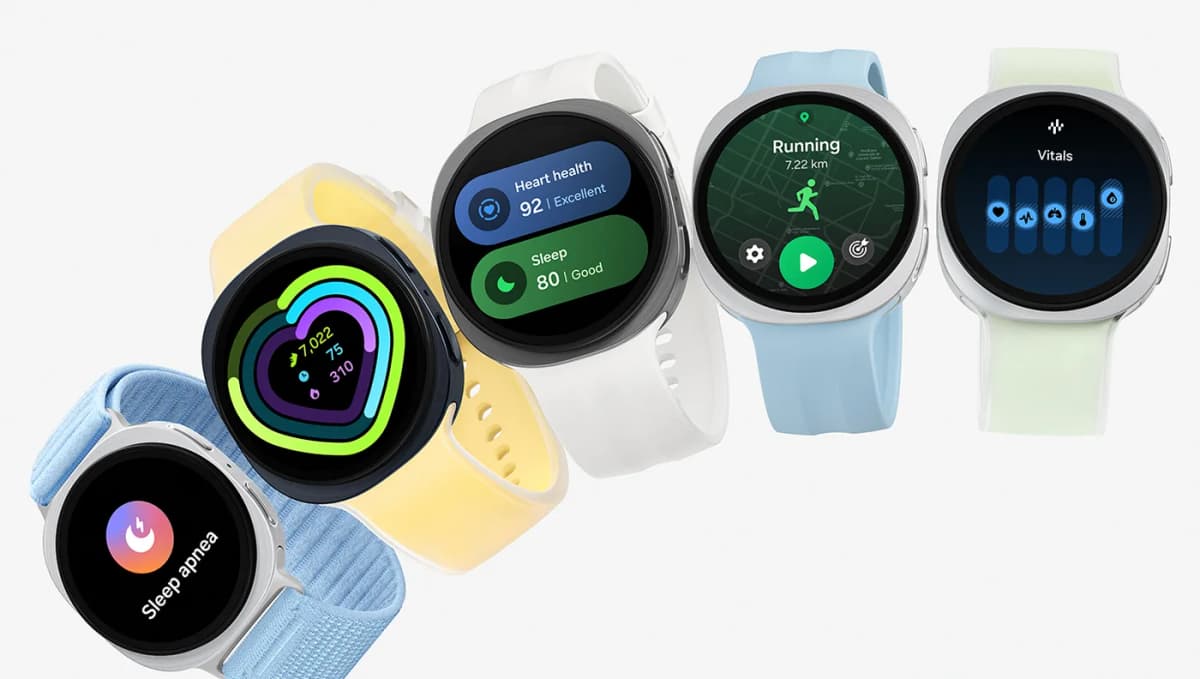
It can, through the Samsung Health Monitor app. On its US site Samsung lists blood pressure among the app's features for the Galaxy Watch4 and later, and says the setup needs a Galaxy phone paired with the watch (Samsung US: Samsung Health Monitor). Samsung's US support page adds that the feature requires "initial and periodic calibrations every 28 days using a third-party upper-arm blood pressure cuff, sold separately", a phone on Android 12 or later, and a watch on Wear OS 4.0 or later (Samsung US support: Check your blood pressure using a Galaxy smartwatch).
The same Samsung pages are clear about what the feature is for. "Blood pressure monitoring is for wellness only. It's not for the diagnosis and treatment of any medical condition." The US support page also says the function is not intended for diagnosing, curing, mitigating, treating or preventing disease. Samsung Health Monitor shows only the features available in your region, so what you see depends on where you live and which phone you use.
How Galaxy Watch blood pressure works
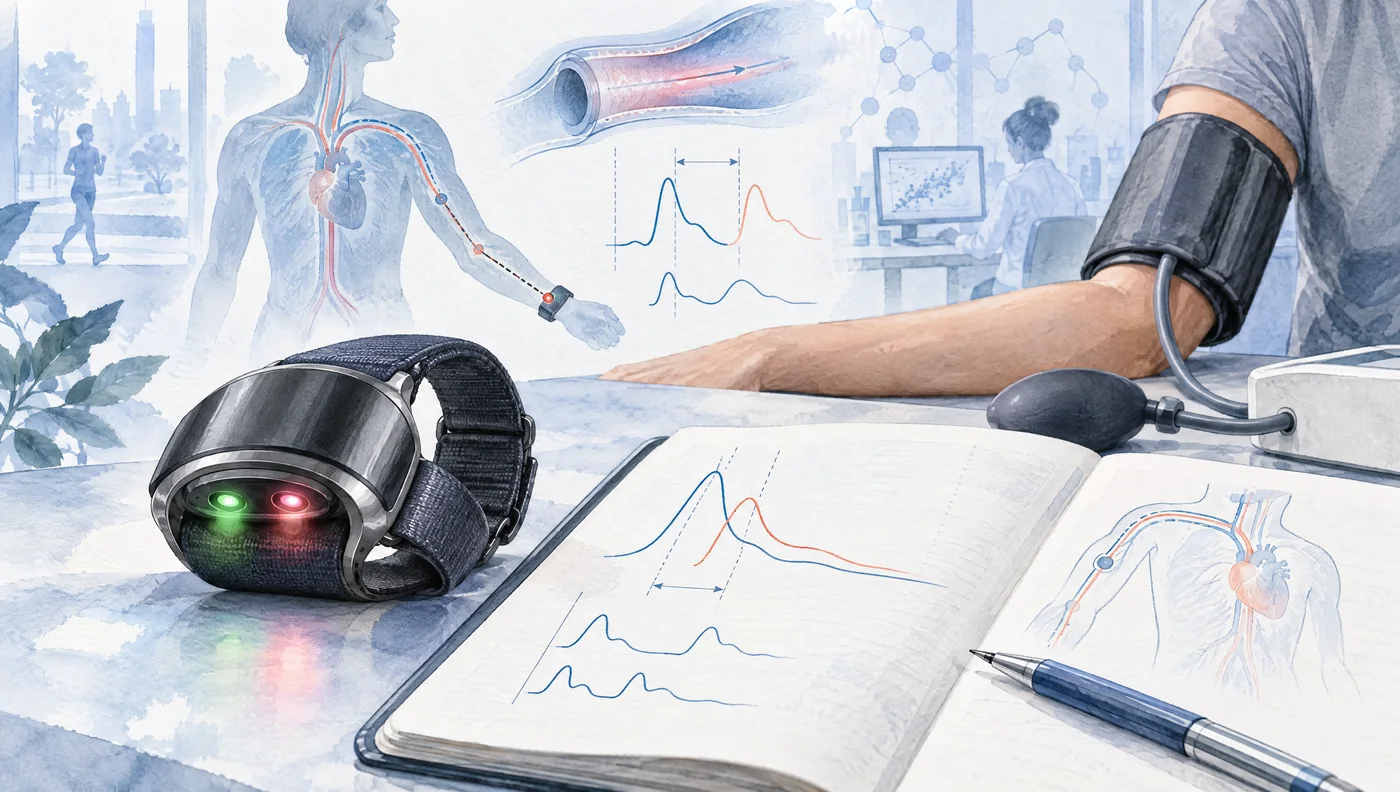
The watch has no cuff, so it cannot squeeze an artery the way a home monitor does. It relies on the same optical sensor that measures heart rate. That sensor uses photoplethysmography (PPG): it shines light into the wrist and records how much comes back as blood volume rises and falls with each beat. The result is a pulse waveform, and its shape, the PPG morphology, changes as the arteries stiffen or relax and as pressure moves.
When Samsung announced the feature in 2020, it said the watch "measures blood pressure through pulse wave analysis", then "analyzes the relationship between the calibration value and the blood pressure change to determine the blood pressure" (Samsung Global Newsroom, 2020). In plain terms, the cuff readings anchor the scale and the watch estimates how far you have moved from that anchor. Our page on pulse wave analysis for blood pressure covers the general method, and PPG blood pressure estimation methods compares it with other approaches such as pulse transit time.
Samsung's US page notes that the app "needs a good-quality signal in order to calculate blood pressure", and that signal quality can depend on how clean the sensor is and on the optical properties of the skin being measured.
The calibration routine
Samsung's instructions for calibration are close to the rules for any good cuff reading (Samsung US: Samsung Health Monitor):
- No alcohol, caffeine, smoking, exercise or bathing for 30 minutes beforehand.
- Sit in a quiet room with your back supported, legs uncrossed, feet flat and forearms resting on a table, and rest for at least 5 minutes.
- Put the cuff on one upper arm and the watch on the other wrist, snug but not tight.
- Take three cuff readings within 30 minutes and enter them in the app. Stay still and don't talk during each one.
- Wear the watch on the same wrist for later measurements, and follow the same preparation each time.
The 28-day limit is enforced. Samsung's support pages say measurements "cannot be made" once 28 days have passed since the last calibration, that this is "enforced by the certificating authority for measurement accuracy", and that you can recalibrate earlier at any time (Samsung Australia support; Samsung Singapore support).
Regulatory status, as stated by the sources
South Korea's Ministry of Food and Drug Safety (MFDS) approved Samsung's blood pressure app as software as a medical device on April 20, 2020, calling it the world's first blood pressure measurement mobile app approved as a medical device (MFDS press release, 2020). The ministry said the app met the same accuracy standard used for automatic cuff monitors: an average difference of ±5 mmHg or less with a standard deviation of 8 mmHg or less. Samsung's own announcement described it as government-cleared, over-the-counter and cuffless, first on the Galaxy Watch Active2.
That test checks readings taken shortly after calibration, under controlled conditions. It does not show how well the readings hold up over the following four weeks of daily life. Falter and colleagues called the watch a "recently CE-cleared smartwatch" in their 2022 study. On the US pages we checked, Samsung describes the feature as wellness-only and does not describe it as FDA-cleared.
What happens between calibrations: the 1,714-user preprint
The newest and largest analysis is a 2026 preprint by Joowon Lee and colleagues, posted on JMIR Preprints (Lee J et al., 2026, doi:10.2196/preprints.106980). It is a preprint and has not been peer reviewed.
The problem it tackles is simple to state. In daily life nobody wears a cuff alongside the watch, so there is no reference to check each reading against. The authors instead measured stability. For each recalibration they took the user's average cuffless systolic reading in the week before and the week after, and called the absolute gap the "calibration difference". If the watch were perfectly stable, that gap would be no bigger than ordinary day-to-day blood pressure change.
They pooled data from 3 nationwide campaigns run between 2021 and 2023: 1,714 participants and 5,728 calibration differences, all from Samsung Galaxy Watch measurements. Their findings:
- The mean calibration difference was 5.95 mmHg (SD 4.73).
- Assuming 3 measurements per averaging week, the overall population and younger or lower-pressure groups were broadly in line with what day-to-day blood pressure variability would predict. Older users and users with higher average systolic pressure consistently showed larger gaps.
- Age, average systolic pressure and the minimum number of measurements were each independently linked to the size of the gap (all P<.01).
- A machine-learning analysis showed the effect of age rising more steeply beyond about 55 years, and the effect of systolic pressure beyond about 125 mmHg.
- Gaps were also elevated in younger people with hypertension and in older people without it.
- More measurements shrank the gap, following an exponential decay, with diminishing returns beyond 3. Older and higher-pressure users kept benefiting from extra readings.
The authors are careful about what this shows. They propose calibration difference as a scalable way to study stability "rather than as a substitute for regulatory accuracy assessment".
How much does a Galaxy Watch reading move after you recalibrate?
Researchers compared each user's average systolic reading in the week before a cuff recalibration with the week after. In a perfectly stable system, the gap would be no bigger than normal day-to-day blood pressure change.
Drag the slider to guess how much a Galaxy Watch's weekly average systolic reading moves when you recalibrate it with a cuff, then reveal the published numbers.
What it shows: each recalibration nudged the weekly average by several mmHg on average, and the spread was wide. This is a stability measure. It does not say how close the watch was to a cuff, because there was no cuff reading to compare against between calibrations.
Data table
| Study | Data | Mean ± SD, mmHg | Sample |
|---|---|---|---|
| Han 2023 | 2021 campaign, Hypertension Research | 6.8 ± 5.6 | 760 people |
| Lee 2024 | 2021 + 2022 campaigns, same time of day | 7.95 ± 6.6 | 2,730 recalibrations |
| Lee 2026 (preprint) | 3 campaigns 2021 to 2023, JMIR Preprints | 5.95 ± 4.73 | 5,728 recalibrations, 1,714 people |
| Shift larger than | Above 135 systolic or 85 diastolic (n = 750) | Everyone else (n = 1,980) |
|---|---|---|
| 5 mmHg | 66% | 57% |
| 10 mmHg | 39% | 27% |
| 15 mmHg | 20% | 12% |
| 20 mmHg | 8.4% | 5% |
Earlier real-world studies found the same pattern
The 2026 preprint builds on two peer-reviewed analyses of overlapping Korean Society of Hypertension campaign data, so the three are not independent. They still help, because they report more detail.
Han et al., 2023. In the 2021 campaign, 760 Galaxy Watch users (mean age 43.7, 80.3% men) uploaded 35,797 readings from up to 4 weeks after calibration, an average of 22 ± 4 days of monitoring (Han et al., 2023, doi:10.1038/s41440-023-01215-z). Participants averaged 1.5 readings a day. The average pre-post calibration error for systolic pressure was 6.8 ± 5.6 mmHg, and it grew with higher systolic pressure before calibration. Readings were lowest between midnight and 4 a.m. and highest between noon and 4 p.m. The authors wrote that stability after calibration and the best interval for recalibration needed more study.
Lee Y et al., 2024. This analysis combined the 2021 and 2022 campaigns, 2,730 calibration differences, and compared averages only within the same 4-hour time-of-day window (Lee Y et al., 2024, doi:10.1109/ojemb.2024.3384488). The average absolute gap was 7.95 mmHg (SD 6.6). From home-monitoring data in another cohort, the authors estimated that day-to-day variability alone would give a standard deviation of roughly 2.83 to 6.79 mmHg for this kind of gap. The observed signed spread was 10.27 mmHg, which they read as instability from calibration or the device itself, beyond normal day-to-day change.
The 2024 paper also split users by their watch average before calibration. When that average was above 135 systolic or 85 diastolic, 39% of recalibrations moved the weekly systolic average by more than 10 mmHg, against 27% for everyone else. In that higher group the average after recalibration came out lower than before, by 6.11 mmHg on average. Other factors linked to bigger gaps were age (0.61 mmHg more per 10 years) and female sex (0.937 mmHg more). The 2022 campaign, which had stricter measurement rules, showed smaller gaps than 2021.
Calibration stability is not clinical accuracy
A stable reading can still be wrong, and these campaign studies had no cuff to compare against between calibrations. For accuracy against a reference you need a different kind of study.
The clearest independent test we found is Falter et al. (2022) in Frontiers in Cardiovascular Medicine (doi:10.3389/fcvm.2022.958212). Forty patients booked for 24-hour ambulatory blood pressure monitoring wore a Galaxy Watch Active2 on the other arm after calibrating it. The watch showed a proportional bias: it overestimated low systolic pressures and underestimated high ones, and all diastolic readings were overestimated. For spotting systolic and/or diastolic hypertension, sensitivity was 83% and specificity 41%. The area under the curve was 0.78 for systolic and 0.93 for diastolic hypertension. Blood pressure variability was systematically higher on the ambulatory monitor than on the watch. The authors described "a systematic bias toward a calibration point" and concluded the watch was "not yet ready for clinical usage". They also noted that standards for cuff monitors don't fully fit cuffless devices.
That gap in standards is real. In 2023 the European Society of Hypertension published recommendations for validating cuffless devices, noting that no generally accepted protocols existed for validating them (Stergiou et al., 2023, doi:10.1097/hjh.0000000000003483). It defines six tests: static, device position, treatment, awake and asleep, exercise, and a recalibration test that checks how well cuff calibration holds over time. Our explainer on cuffless blood pressure validation walks through them, and when cuffless blood pressure is useful covers where the evidence stands across devices.
How to get steadier Galaxy Watch readings
These tips come from Samsung's instructions and from the stability studies above. They help consistency. They don't turn the watch into a diagnostic device.
- Calibrate carefully. Use a validated upper-arm cuff, follow the seated, rested routine, and take all three cuff readings properly. Every reading after that is anchored to this one.
- Take several readings and average them. Both Lee studies found smaller gaps when averages were built from more measurements. The 2026 preprint saw diminishing returns past about 3 per period for most people, while older and higher-pressure users kept gaining from more.
- Compare like with like. Measure at a similar time of day and in the same position. The 2024 study found smaller calibration gaps for night-time measurements (8 p.m. to 8 a.m.) than for morning ones (8 a.m. to noon). Readings also vary through the day, so mixing morning and evening numbers can look like a change that isn't there.
- Recalibrate before the deadline if something changes. Samsung allows recalibration at any time. The 2024 authors suggested more frequent recalibration and, for higher-risk users, calibration under clinical supervision.
- Expect a jump after recalibrating. A shift of several mmHg is common. Look at the trend over weeks, not one reading before and one after.
- Check unusual readings with a cuff. If the watch shows a sustained rise, or readings in the high or crisis ranges on a blood pressure chart, confirm with a validated cuff and see a clinician.
If you are over about 55, already have hypertension, or your readings sit above about 125 mmHg systolic, the 2026 preprint found larger calibration gaps in groups like yours. The authors wrote that "uniform usage protocols may not be sufficient", so more readings per average and regular cuff checks matter most for you.
Trends are the realistic use
All of this points the same way. A Galaxy Watch can show you whether your readings drift up or down over weeks, especially if you measure consistently and average several readings. It cannot match a validated cuff on a single reading, and it needs that cuff every 28 days anyway. That is also why research on wrist PPG is moving toward patterns such as night-time dipping and longer trends rather than one-off numbers.
For other angles, see our blood pressure watch guide, how accurate wrist blood pressure monitors are, Galaxy Watch heart rate accuracy, the Samsung Galaxy Watch sensor page, and the Samsung vs Apple Watch comparison. The research hub has a summary card for the 2026 calibration preprint.
References
- Lee J, Lee Y, Lee T, Seo J, Lee H-Y. Feasibility of watch-based blood pressure monitoring in real-world settings: a retrospective analysis of multiyear observational data. JMIR Preprints. Posted July 14, 2026. Preprint, not peer reviewed. doi:10.2196/preprints.106980
- Han M, Lee YR, Park T, et al. Feasibility and measurement stability of smartwatch-based cuffless blood pressure monitoring: a real-world prospective observational study. Hypertension Research. 2023;46(4):922-931. doi:10.1038/s41440-023-01215-z
- Lee Y, Park J, Park S, Seo J, Lee H-Y. Stability of watch-based blood pressure measurements analyzed by pre-post calibration differences. IEEE Open Journal of Engineering in Medicine and Biology. 2024;5:828-836. doi:10.1109/ojemb.2024.3384488
- Falter M, Scherrenberg M, Driesen K, et al. Smartwatch-based blood pressure measurement demonstrates insufficient accuracy. Frontiers in Cardiovascular Medicine. 2022;9:958212. doi:10.3389/fcvm.2022.958212
- Stergiou GS, Avolio AP, Palatini P, et al. European Society of Hypertension recommendations for the validation of cuffless blood pressure measuring devices. Journal of Hypertension. 2023;41(12):2074-2087. doi:10.1097/hjh.0000000000003483
- Samsung Global Newsroom. Samsung announces blood pressure monitoring application for Galaxy Watch devices. April 21, 2020. news.samsung.com
- Ministry of Food and Drug Safety (Korea). The world's first blood pressure measurement mobile app approved as medical device. Press release, April 21, 2020. mfds.go.kr
- Samsung US. Samsung Health Monitor. samsung.com/us/apps/samsung-health-monitor
- Samsung US support. Check your blood pressure using a Galaxy smartwatch. samsung.com/us/support/answer/ANS10010530
- Samsung Australia support. Recalibrating your Samsung Galaxy Watch. samsung.com/au/support
- Samsung Singapore support. Frequency to calibrate Samsung Health Monitor. samsung.com/sg/support
Frequently Asked Questions
- Can a Samsung watch measure blood pressure without a cuff?
- Only after you calibrate it with one. Samsung Health Monitor asks you to take three readings with a separate upper-arm cuff within 30 minutes and enter them in the app. After that the watch estimates systolic and diastolic pressure from its optical heart-rate sensor, with no cuff on your arm, until the next calibration is due.
- How often do you need to calibrate Galaxy Watch blood pressure?
- Every 28 days. Samsung's support pages say the watch stops taking blood pressure readings once 28 days have passed since the last calibration, and that you can recalibrate earlier at any time from the app menu. You can turn on a reminder that arrives three days before calibration is due.
- Is Samsung Galaxy Watch blood pressure accurate?
- It passed the accuracy test South Korea's regulator uses for cuff monitors when it was cleared in 2020, but independent studies are less reassuring. In a 2022 study of 40 patients wearing a 24-hour ambulatory monitor, the Galaxy Watch Active2 read low pressures too high and high pressures too low, and the authors concluded it was not yet ready for clinical use. Real-world data also show the weekly average shifting by about 6 to 8 mmHg at each recalibration. Treat readings as a trend, and confirm anything unusual with a validated cuff.
- Why do my Galaxy Watch blood pressure readings change after recalibrating?
- Every calibration resets the baseline the watch uses to turn pulse-wave changes into mmHg. Some of the jump is ordinary day-to-day blood pressure change and some comes from the calibration itself. Studies of Korean Galaxy Watch users found larger jumps in older people, in people with higher readings, and when averages were built from fewer measurements.
- Is Galaxy Watch blood pressure available in the US?
- Samsung's US Samsung Health Monitor page currently lists blood pressure among the app's features, with a footnote that it needs initial and periodic calibration every 28 days with a separately sold cuff, Android 12 or later and Wear OS 4.0 or later. The same page says blood pressure monitoring is for wellness only and not for diagnosing or treating any medical condition. Samsung notes that the app only shows the features available in your region, so check the app on your own phone.
- Can a Galaxy Watch replace a home blood pressure cuff?
- No. You need a cuff to calibrate the watch every 28 days, and Samsung says the feature is not meant for diagnosis or treatment. Validated upper-arm cuffs remain the standard for home readings, and hypertension decisions should be made with a clinician using cuff or ambulatory measurements.
Related articles
Apple Watch hypertension notifications: how PPG spots possible high blood pressure
Apple Watch hypertension notifications read 30 days of PPG data. FDA filings show 41.2% sensitivity and 92.3% specificity. Here's what an alert means.
Ambulatory Blood Pressure Monitor vs Smartwatch: Accuracy, Use Cases, and Why They Are Not the Same
ABPM and smartwatch blood-pressure features are often discussed together, but they solve different problems. This guide compares clinical accuracy, use cases, and why ambulatory blood pressure monitoring still outperforms cuffless wearables for diagnosis.
Samsung Health HR Drops in Intense Exercise
Samsung Health heart rate on Galaxy Watch drops in high-intensity exercise. npj Digital Medicine (2026): Apple Watch agreed with ECG better than Samsung.
Glucose monitor watch: what works today and what the research shows
No glucose monitor watch can read blood sugar through the skin yet. Here's what the FDA says, what research shows, and how to get glucose on your wrist.
PPG Mental Health Anxiety Depression
The relationship between the autonomic nervous system and mental health is bidirectional and well-established. Anxiety disorders, depression, and chro...
Related Comparisons
Samsung Galaxy Watch vs Apple Watch: PPG Sensor and Health Features
Samsung Galaxy Watch7 and Watch Ultra pair only with Android phones; Apple Watch pairs only with iPhone, so the phone usually decides. Both have an FDA-cleared or authorized ECG feature. Samsung adds cuffless blood pressure estimates that need cuff calibration every 28 days. In independent testing, Apple Watch had the lowest heart-rate error and Samsung's older Gear S2 the highest of seven devices (Shcherbina 2017); no study has compared current models.
Compare devices →Samsung Galaxy Watch vs Garmin: Sensors Compared
Samsung's Galaxy Watch7 and Watch Ultra offer an FDA-cleared ECG app and cuffless blood pressure estimates that need cuff calibration every 28 days; they pair only with Android. Garmin's Venu 3 and Fenix 8 offer an ECG App in eligible regions and battery measured in weeks. No study compares current Samsung and Garmin heart-rate accuracy.
Compare devices →Devices in this article
Research records with the datasets, papers and published validation results for each device.