PPG Nocturnal Blood Pressure Dipping: Can Optical Signals Approximate Overnight BP Patterns?
PPG nocturnal blood pressure dipping analysis uses overnight pulse features to approximate dipping patterns, a useful screening concept with clear limits.
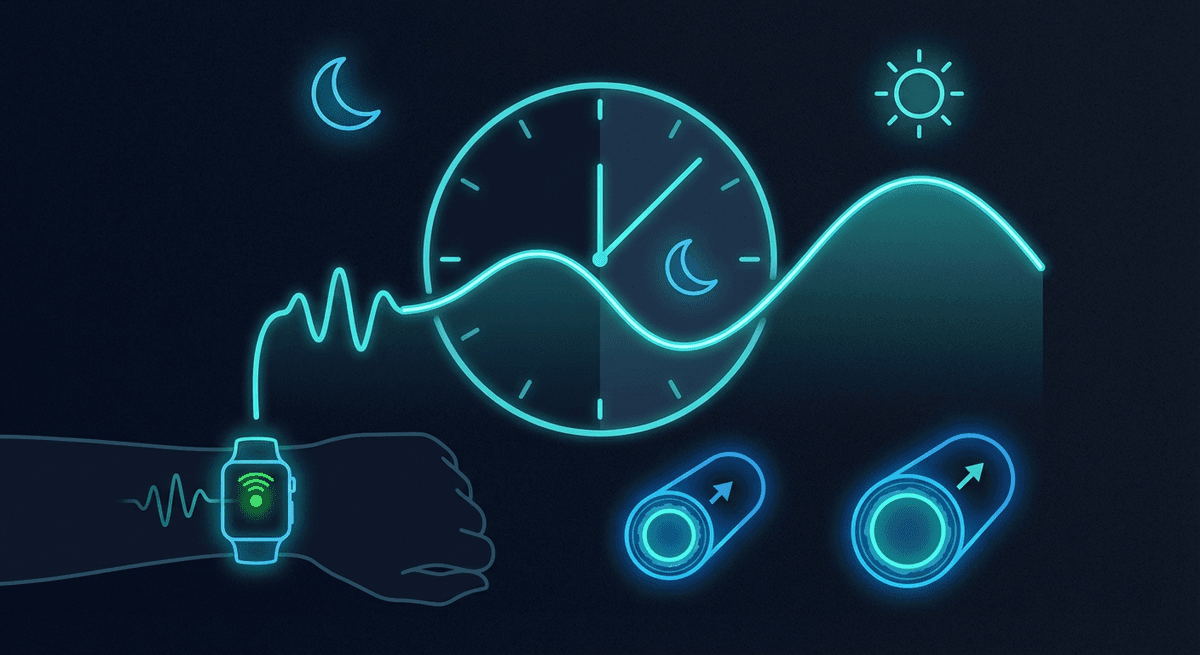
PPG nocturnal blood pressure dipping analysis uses overnight pulse features to approximate whether blood pressure follows a normal sleep-related decline. It is a useful screening idea because non-dipping carries real cardiovascular risk, but PPG does not directly measure nighttime blood pressure, so the result should be treated as an approximation rather than a formal dipping diagnosis.
Definition box: Nocturnal blood pressure dipping is the expected overnight fall in blood pressure during sleep, usually around 10% to 20% compared with daytime levels.
This matters because daytime clinic blood pressure can look acceptable while nighttime physiology tells a different story. Patients with hypertension, diabetes, kidney disease, or sleep apnea may have abnormal nighttime patterns that raise long-term risk.
Why dipping status matters
Blood pressure is not supposed to stay flat across the full 24-hour cycle. During healthy sleep, sympathetic tone drops and blood pressure usually falls.
When that does not happen, the patient may be a non-dipper or even a reverse dipper. Those patterns have been linked to:
- stroke risk
- left ventricular hypertrophy
- chronic kidney disease progression
- overall cardiovascular burden
The challenge is access. Ambulatory blood pressure monitoring is the standard, but it is not worn continuously by most patients.
Can PPG estimate dipping status at all?
Not directly in mmHg. That is the first thing to keep straight.
PPG may still contribute because pulse timing and waveform morphology reflect vascular and hemodynamic state. Overnight shifts in:
- pulse transit surrogates
- waveform stiffness markers
- heart rate trends
- amplitude behavior
- autonomic tone proxies
may correlate with whether blood pressure is falling normally at night.
This is conceptually related to PPG blood pressure estimation methods and PPG hypertension cuffless monitoring, but the use case here is pattern detection over a night rather than a spot estimate.
Why sleep is an appealing setting for this analysis
Sleep reduces some of the noise that plagues daytime cuffless monitoring.
- less motion
- more stable posture
- longer continuous signal windows
- more consistent autonomic conditions
That makes overnight PPG a better environment for trend inference than daytime life on the wrist.
What features might point toward non-dipping?
Persistently elevated nocturnal heart rate
If heart rate stays high overnight, it may reflect persistent sympathetic tone or sleep disruption.
Features linked to vascular stiffness may remain elevated in patients whose pressure does not fall normally.
Lack of overnight pulse timing shift
Some timing surrogates that should change with lower pressure may remain flat in non-dippers.
Coupling with sleep-disordered breathing
If the patient has repeated desaturation and arousal patterns, that can support a non-dipping phenotype because sleep apnea is strongly linked to abnormal nighttime blood pressure behavior.
Why PPG cannot replace ambulatory blood pressure monitoring
ABPM remains the standard because it directly measures blood pressure repeatedly over 24 hours. PPG does not.
A non-dipping inference from PPG can be wrong because of:
- sensor-specific waveform behavior
- vascular tone changes unrelated to pressure
- arrhythmia
- poor pulse quality
- weak calibration to true BP
That does not make the approach useless. It just defines its real role: screening.
Who might benefit most from screening with PPG?
Patients with resistant or masked hypertension
Nighttime patterns can reveal risk that office BP misses.
Sleep apnea populations
Breathing events and non-dipping often coexist.
Diabetes and kidney disease
These groups have higher rates of abnormal circadian BP regulation.
Remote monitoring programs
A wearable that suggests persistent non-dipping can help prioritize who should receive formal ABPM.
Best practical role today
The best role is identifying who deserves a higher-grade test. If a wearable suggests stable overnight non-dipping patterns across many nights, that is a useful reason to order ambulatory blood pressure monitoring rather than assume the office reading tells the whole story.
FAQ
What is nocturnal blood pressure dipping?
It is the normal fall in blood pressure during sleep compared with daytime values, often discussed as a percentage drop overnight.
Can PPG measure nocturnal dipping directly?
No. PPG does not directly measure blood pressure overnight, but it can capture pulse features that may correlate with dipping patterns.
Why does non-dipping matter?
Non-dipping is associated with higher cardiovascular risk, including stroke, kidney disease progression, and hypertensive target-organ damage.
Who might benefit from wearable dipping screening?
People with hypertension, sleep apnea, diabetes, kidney disease, or autonomic dysfunction may benefit most from non-dipping screening.
What is still the standard for assessing dipping status?
Twenty-four-hour ambulatory blood pressure monitoring remains the clinical standard for identifying dippers and non-dippers.
How sleep apnea complicates nighttime BP inference
Sleep apnea can distort the normal overnight blood pressure pattern through intermittent hypoxia, repeated arousals, and sympathetic surges. That means an overnight PPG system may be picking up a mixed picture of vascular tone, pulse timing, and sleep disruption rather than a clean isolated blood pressure trend.
In practice, that is not a reason to ignore the signal. It is a reason to interpret it through a sleep-breathing lens as well.
Best next step after suspected non-dipping on a wearable
The most useful next step is usually formal ambulatory blood pressure monitoring, especially if the patient already has hypertension, kidney disease, diabetes, or unexplained target-organ damage. The wearable helps identify who deserves that test sooner.
Frequently Asked Questions
- What is nocturnal blood pressure dipping?
- It is the normal fall in blood pressure during sleep compared with daytime values, often discussed as a percentage drop overnight.
- Can PPG measure nocturnal dipping directly?
- No. PPG does not directly measure blood pressure overnight, but it can capture pulse features that may correlate with dipping patterns.
- Why does non-dipping matter?
- Non-dipping is associated with higher cardiovascular risk, including stroke, kidney disease progression, and hypertensive target-organ damage.
- Who might benefit from wearable dipping screening?
- People with hypertension, sleep apnea, diabetes, kidney disease, or autonomic dysfunction may benefit most from non-dipping screening.
- What is still the standard for assessing dipping status?
- Twenty-four-hour ambulatory blood pressure monitoring remains the clinical standard for identifying dippers and non-dippers.