Does WHOOP Measure Blood Pressure? Accuracy, Calibration and the FDA
WHOOP estimates your blood pressure each morning after a cuff calibration. How Blood Pressure Insights works, how accurate it is, and why the FDA stepped in.
- Blood Pressure
- BP
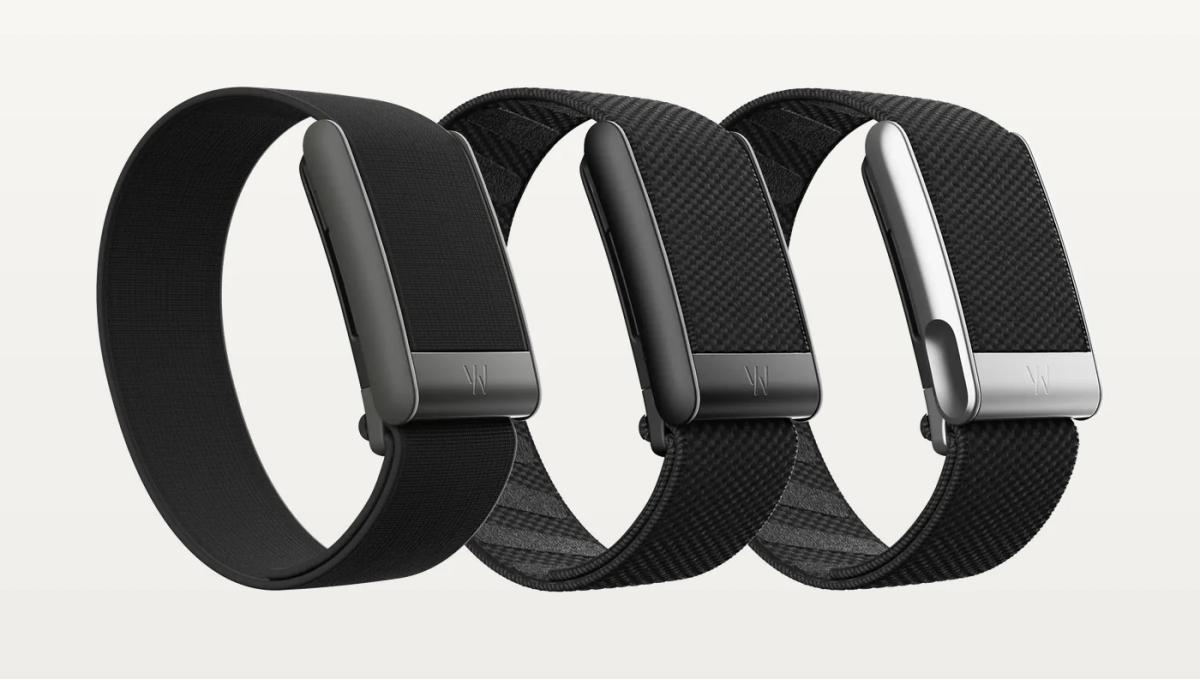
Short answer: WHOOP estimates blood pressure rather than measuring it. On the WHOOP MG band with a WHOOP Life membership, a feature called Blood Pressure Insights shows an estimated systolic and diastolic range each morning. You have to calibrate it first with three readings from an ordinary cuff, and WHOOP asks for a fresh cuff reading every 30 days (WHOOP). WHOOP calls it a general wellness feature, not a medical device.
WHOOP blood pressure is also the feature that drew an FDA warning letter in July 2025, which the agency closed in June 2026 after WHOOP changed the feature and the FDA rewrote its wellness policy. This post covers how it works, what WHOOP's accuracy numbers do and don't tell you, what independent research says about cuff-calibrated wrist estimates over several weeks, and the regulatory history.
How Blood Pressure Insights works
WHOOP launched the feature with WHOOP 5.0 and WHOOP MG on May 8, 2025, as a beta on the MG device (WHOOP launch post). WHOOP's own pages describe it this way:
Scroll horizontally if needed
| What you get | Details from WHOOP |
|---|---|
| Output | An estimated systolic and diastolic range, once per morning. The value doesn't change during the day. |
| Inputs | The optical (PPG) pulse waveform recorded through the night, plus heart rate, HRV, recovery metrics and demographic factors |
| Calibration | Log three cuff readings to unlock it, then add a new cuff reading every 30 days |
| Device and plan | WHOOP MG, included with WHOOP Life. WHOOP One and Peak use WHOOP 5.0 and don't include it. |
| Who it's not for | People who are pregnant or on blood pressure medication |
| Status | Beta; "not a medical device and cannot diagnose or manage medical conditions" |
Sources: Blood Pressure Insights, accuracy page, membership page.
WHOOP says it trained and validated the model on more than 11,000 users across 32,000 sleep sessions, recording overnight and taking a cuff reading shortly after waking (WHOOP). WHOOP picked sleep because daytime movement, caffeine and stress make readings harder to compare from one day to the next.
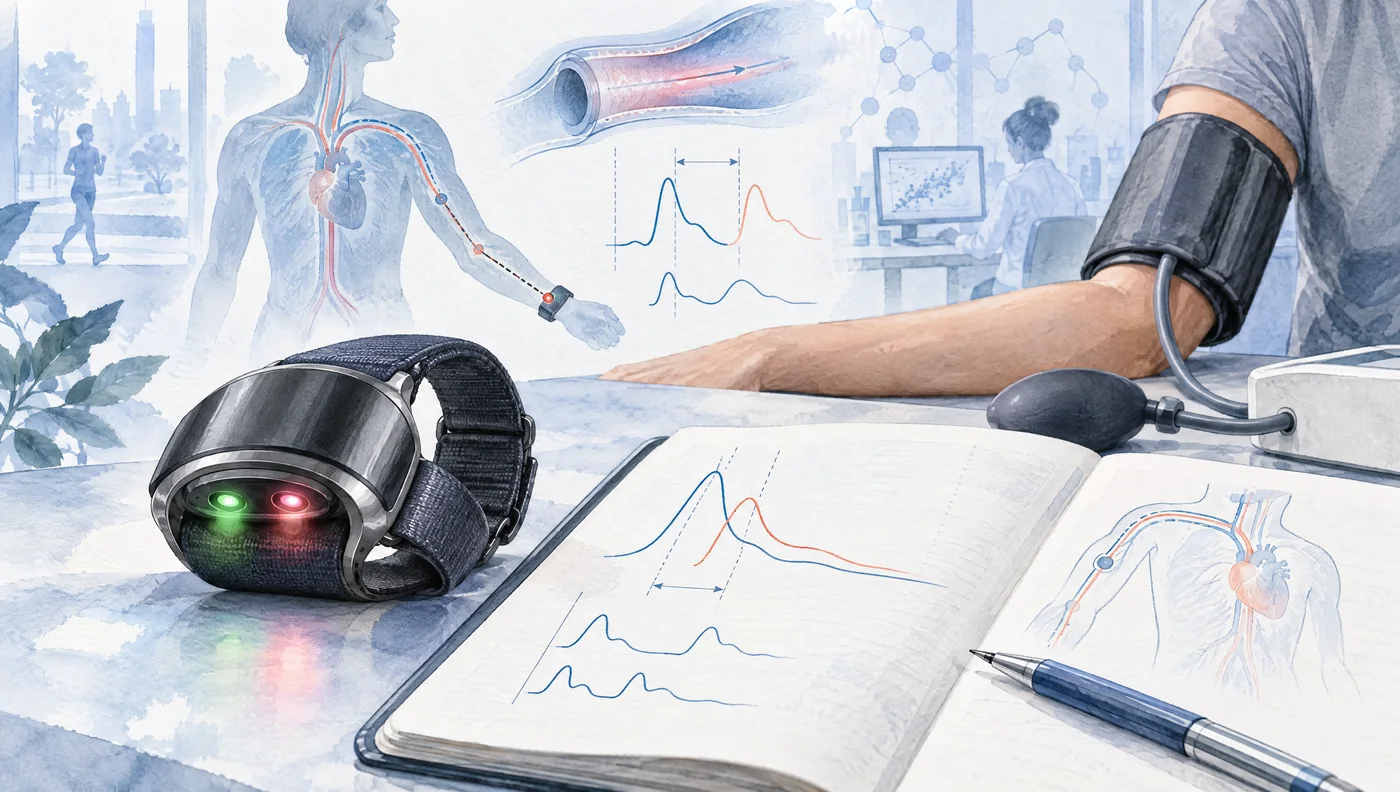
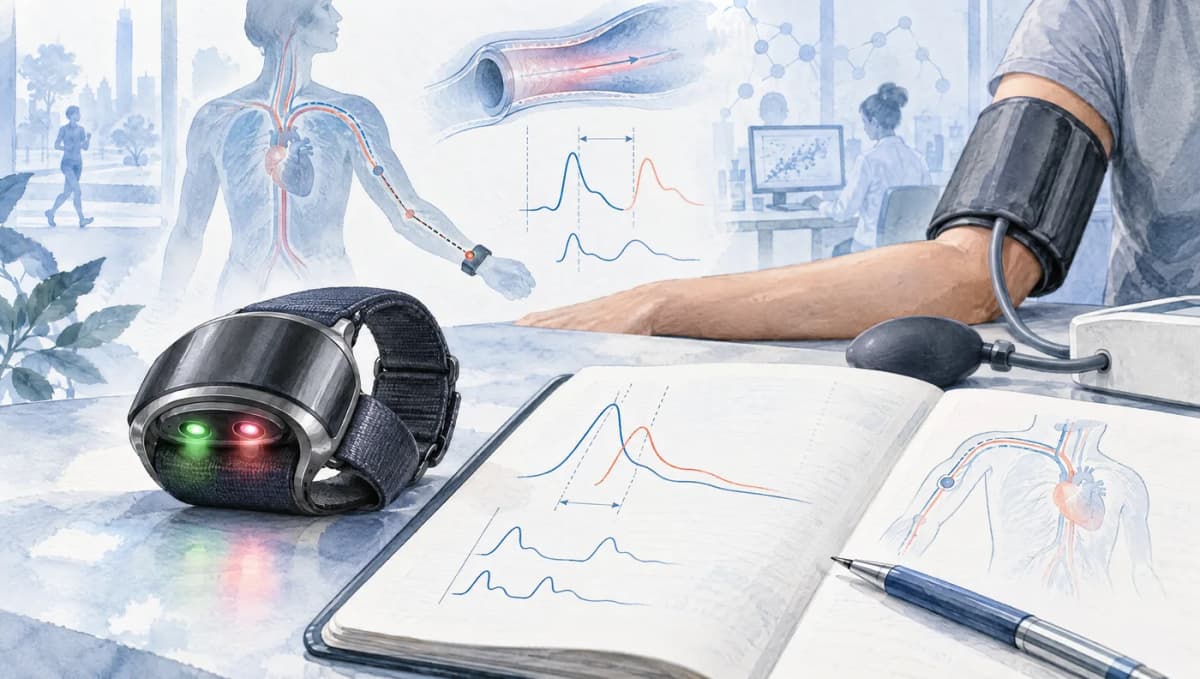
The band never squeezes your wrist. The PPG sensor tracks the shape and timing of each pulse, and features of that waveform shift as blood pressure and arterial stiffness change. Our explainers on PPG morphology, pulse wave velocity and pulse wave analysis for blood pressure cover the physiology. Pulse shape alone doesn't fix an absolute number in mmHg, though, which is why WHOOP, like Samsung, anchors each person's estimates to a cuff.
How accurate is WHOOP blood pressure?
WHOOP published its own validation numbers in June 2026. It compared Blood Pressure Insights estimates with readings from an FDA-cleared cuff across 10,746 paired measurements (WHOOP):
Scroll horizontally if needed
| Company-reported result | Systolic | Diastolic |
|---|---|---|
| Mean absolute error vs cuff | 5.03 mmHg | 3.64 mmHg |
| Estimates within 10 mmHg of the cuff | 88.68% | 96.57% |
Put another way, about one systolic estimate in nine was more than 10 mmHg off the cuff in WHOOP's data.
These figures come from WHOOP, not from a journal. The page doesn't say how many people the 10,746 pairs came from, their age or blood pressure range, how long after calibration the comparisons were made, or whether the calibration readings were kept out of the test. Those details decide whether a mean error of about 5 mmHg is impressive or expected. A calibrated estimate that hugs the calibration value can look accurate in people whose pressure doesn't move much.
WHOOP itself is direct about the evidence. Its April 2026 FAQ says the feature was "tested internally at WHOOP Labs" and "has not been independently validated or cleared by the FDA" (WHOOP). A PubMed search for WHOOP and blood pressure on November 12, 2026 returned three records: a scoping review, a physiology study, and a commentary on the FDA letter. None of them is a validation of Blood Pressure Insights. So far there is no independent, peer-reviewed validation of WHOOP blood pressure that we could find.
What WHOOP reports vs what independent wrist-BP research shows
Amber bars are WHOOP's own numbers. Blue bars come from a peer-reviewed study of a different cuff-calibrated wrist device (CSEM), so they show how the approach behaves over weeks, not how WHOOP performs. The metrics differ, so read each bar's label.
Typical error, mmHg (systolic)
- WHOOP (company-reported): Mean absolute error vs a cuff, 10,746 pairs.
- CSEM wrist PPG (independent study, not WHOOP): SD of the error in BP change between visits, 30 patients.
- CSEM mean change error: 0.2 mmHg (the cuff-monitor rule also asks for a mean difference of 5 mmHg or less).
Agreement with the cuff, % (systolic)
What it shows: Systolic: WHOOP reports a mean absolute error of 5.03 mmHg against a cuff and says 88.68% of estimates landed within 10 mmHg. Those are company figures, not peer reviewed. In an independent six-week study of a different calibrated wrist-PPG device, the error in tracking systolic change had a standard deviation of 12.8 mmHg, above the 8 mmHg limit that cuff monitors must meet, yet 83% of large changes went the same direction as the cuff.
Data table
| Source | Metric | Systolic | Diastolic | Where |
|---|---|---|---|---|
| WHOOP (company-reported) | Mean absolute error vs a cuff, 10,746 pairs | 5.03 mmHg | 3.64 mmHg | WHOOP, Blood Pressure Insights accuracy page, June 24, 2026 |
| CSEM wrist PPG (independent study, not WHOOP) | SD of the error in BP change between visits, 30 patients | 12.8 mmHg | 7.4 mmHg | Proença et al., Blood Pressure 2026, abstract |
| CSEM wrist PPG (independent study, not WHOOP) | Mean error in BP change between visits | 0.2 mmHg | -0.1 mmHg | Proença et al., Blood Pressure 2026, abstract |
| WHOOP (company-reported) | Within 10 mmHg of the cuff | 88.68% | 96.57% | WHOOP, Blood Pressure Insights accuracy page, June 24, 2026 |
| CSEM wrist PPG (independent study, not WHOOP) | Big changes, same direction as cuff | 83% | 86% | Proença et al., Blood Pressure 2026, abstract |
| ISO 81060-2 criterion 1 (cuff monitors) | Mean difference / SD of differences | ≤5 mmHg / ≤8 mmHg | Stergiou et al., J Hypertens 2018, full text | |
What independent research says about calibrated wrist BP over weeks
The closest independent evidence comes from devices that work the same way: a wrist PPG sensor, calibrated to a cuff, then tracking pressure for weeks. The newest example, published in Blood Pressure in September 2026, tested a wrist device from the Swiss research center CSEM (Proença et al., 2026). It is not a WHOOP, and its results say nothing direct about WHOOP's algorithm. They do show how this kind of system behaves over time.
Thirty people with hypertension (18 women, mean age 54) came in for four visits over six weeks while on blood pressure treatment. At each visit the team took the median of 5 to 7 readings from the wrist device and from a validated home cuff (Microlife WatchBP Home A), then compared how much each device said pressure had changed between visits. The findings:
- No drift. The gap between the cuff and the wrist device didn't grow over six weeks.
- Direction held up. When pressure changed a lot (systolic by more than 15 mmHg, diastolic by more than 10), the wrist device moved the same way as the cuff 83% of the time for systolic and 86% for diastolic.
- Size was less reliable. The difference between the two devices' change readings averaged 0.2 mmHg for systolic, but with a standard deviation of 12.8 mmHg. For diastolic it was −0.1 ± 7.4 mmHg.
That systolic spread is wide. For a single person, the wrist device's estimate of a change could easily differ from the cuff's by 10 mmHg or more. The authors call the device's tracking stable and concordant, and they also note that the home cuff used as the reference was itself quite variable. They frame the study as a feasibility study that needs a larger trial against a gold-standard reference. There's also a mismatch with WHOOP: everyone in this study was on blood pressure medication, the group WHOOP says its feature isn't meant for.
Real-world Galaxy Watch data point the same way. Each 28-day recalibration shifted users' weekly averages by roughly 6 to 8 mmHg, which we cover in our Samsung Galaxy Watch blood pressure post. A 2026 review in Pulse sums up the category: cuffless devices infer pressure from PPG and pulse-wave features rather than measuring it, their performance depends on calibration and on who is wearing them, and their accuracy is not yet good enough for routine clinical decisions (Sung, 2026). The review sees more promise in tracking blood pressure dynamics, which is roughly what WHOOP offers.
How validation standards judge cuffless BP
Upper-arm cuffs sold as medical devices are tested under the AAMI/ESH/ISO standard (ISO 81060-2). Its first pass/fail criterion requires a mean difference from reference readings of 5 mmHg or less, with a standard deviation of 8 mmHg or less, for both systolic and diastolic pressure (Stergiou et al., 2018). WHOOP's mean absolute error is a different statistic, so it can't be checked against that rule directly, and WHOOP hasn't published a mean difference with a standard deviation.
Cuffless devices need more than that one static test anyway. In 2023 the European Society of Hypertension noted that there were no generally accepted protocols for validating them. It set out six tests, including a treatment test for falling pressure, an awake/asleep test for night-time change, and a recalibration test for how well the cuff calibration holds over time (Stergiou et al., 2023). For a feature recalibrated every 30 days and read overnight, the recalibration and awake/asleep tests matter most. We walk through all six in cuffless blood pressure validation. No published study has put WHOOP through them.
The FDA warning letter and closeout
July 14, 2025: warning letter. The FDA wrote to WHOOP that Blood Pressure Insights was being marketed without clearance or approval and was a medical device under federal law (FDA warning letter). Its reasoning:
- A blood pressure estimate is "inherently associated with the diagnosis of hypo- and hypertension," even when shown as a daily range and midpoint rather than a live reading.
- WHOOP's site had listed the feature as an example of "medical-grade health & performance insights."
- The display used a gauge with green, yellow and orange zones marking a target range.
- Disclaimers weren't enough, the agency said, citing evidence of people using the feature to monitor their hypertension.
- Blood pressure estimation was "not a low-risk function," so the general wellness policy of the time didn't cover it. A falsely low reading could falsely reassure someone with hypertension and delay treatment.
WHOOP disagreed publicly and kept the feature live.
January 6, 2026: new wellness guidance. The FDA updated its general wellness guidance for low-risk devices (FDA closeout letter, footnote 1). A Journal of Medical Internet Research commentary reads the update as allowing optical blood pressure estimates to stay in the wellness category as long as companies don't claim "medical-grade" data or insights (Karow, 2026).
June 17, 2026: closeout. The FDA told WHOOP that, based on changes to the feature and its labeling and consistent with the updated guidance, it "does not intend to enforce the device statutory and regulatory requirements" for Blood Pressure Insights "as modified." The letter covers that version only, not other products or future changes (FDA closeout letter). The letter doesn't list the changes. A WHOOP spokesperson told Healthcare Dive that they included adjusting the dial boundaries so the feature wouldn't look like it was classifying blood pressure clinically (Healthcare Dive).
The closeout is not a clearance. The FDA has not reviewed whether the estimates are accurate. For how ChatPPG covers other regulatory letters, see our Owlet sock review and the FDA tracker.
WHOOP vs Oura vs Google: what each reports
The big wearable brands have taken different routes to blood pressure:
Scroll horizontally if needed
| Device | What you get | Cuff needed? | Regulatory status |
|---|---|---|---|
| WHOOP MG (WHOOP Life) | Daily estimated systolic and diastolic range | Yes, 3 readings to start, then every 30 days | General wellness; FDA closed its warning letter in June 2026 |
| Oura Ring | Pattern notice from 30 nights of PPG plus a dipping trend, no mmHg | No | Wellness feature |
| Pixel Watch 3/4/5, Fitbit Edge, Fitbit Air | Monthly High / Not high trend, no mmHg | No | Wellness feature; research model published in Nature |
| Samsung Galaxy Watch | Systolic and diastolic estimates | Yes, every 28 days | Wellness only in the US |
| Apple Watch | Possible-hypertension notification, no mmHg | No | FDA 510(k) cleared |
WHOOP and Samsung give you numbers and need a cuff to anchor them. Oura and Google skip the cuff but also skip the numbers. Apple is the only one of the five with an FDA-cleared feature. The blood pressure watch guide, when cuffless blood pressure is useful and the cuffless BP leaderboard cover the wider field. For WHOOP's other metrics, see how accurate is WHOOP, WHOOP calorie accuracy, the WHOOP sensor page, WHOOP 4.0 vs 5.0 and WHOOP vs Oura.
Using WHOOP blood pressure sensibly
- Treat it as a trend. Proença's data suggest calibrated wrist devices get the direction of a large change right more often than its size. A shift that lasts a couple of weeks tells you more than one morning's number.
- Calibrate carefully. The estimates are only as good as the cuff readings they're anchored to. Use a validated upper-arm cuff that fits your arm, sit quietly first, and recalibrate when WHOOP asks.
- Confirm anything unusual with a cuff. If the estimate looks high or changes a lot, take upper-arm readings over several days and check them against a blood pressure chart. Our ambulatory monitor vs smartwatch comparison explains why clinicians use 24-hour monitoring to confirm.
- Don't use it if you're pregnant or on blood pressure medication. WHOOP says it isn't intended for either group.
- Get help right away for chest pain, shortness of breath, weakness on one side, trouble speaking or seeing, or a sudden severe headache. Don't wait on a wearable.
Don't start, stop or change any medication based on a wearable estimate. This article is educational and not medical advice. For background on the condition, see hypertension. The Proença study hub card and the WHOOP 5.0 device card have more detail.
References
- Proença M, Rigon P-A, Bonnier G, Ferrario D, Zahnd J, Lemay M, Wuerzner G. Long-term stability and blood pressure change tracking with a cuffless wearable device in hypertensive patients. Blood Pressure. 2026;35(1). Published September 25, 2026. doi:10.1080/08037051.2026.2707794
- Sung K-C. An unfinished but necessary path: ring-based cuffless blood pressure monitoring at the crossroads of innovation and clinical reality. Pulse. Published October 5, 2026. doi:10.1159/pls/aeoag005
- Stergiou GS, Alpert B, Mieke S, et al. A universal standard for the validation of blood pressure measuring devices. Journal of Hypertension. 2018;36(3):472-478. doi:10.1097/HJH.0000000000001634
- Stergiou GS, Avolio AP, Palatini P, et al. European Society of Hypertension recommendations for the validation of cuffless blood pressure measuring devices. Journal of Hypertension. 2023;41(12):2074-2087. doi:10.1097/hjh.0000000000003483
- Karow B. WHOOP, There It Is: Lessons From WHOOP’s FDA Warning Letter. Journal of Medical Internet Research. 2026;28:e90882. Commentary. doi:10.2196/90882
- US Food and Drug Administration. Warning letter: WHOOP, Inc., MARCS-CMS 709755. July 14, 2025. fda.gov
- US Food and Drug Administration. Closeout letter: WHOOP, Inc., MARCS-CMS 709755. June 17, 2026. fda.gov
- WHOOP. How accurate is WHOOP Blood Pressure Insights? June 24, 2026. Company-reported. whoop.com
- WHOOP. WHOOP delivers innovative Blood Pressure Insights for a deeper look at your well-being. May 8, 2025. whoop.com
- WHOOP. Blood Pressure Insights for performance, sleep, and recovery. April 23, 2026. whoop.com
- WHOOP. Introducing WHOOP 5.0 and WHOOP MG. May 8, 2025. whoop.com
- WHOOP. Memberships. whoop.com
- Reuter E. FDA drops Whoop warning letter over blood pressure feature. Healthcare Dive. June 24, 2026. healthcaredive.com
Frequently Asked Questions
- Does WHOOP measure blood pressure?
- It estimates it. WHOOP MG, on the WHOOP Life membership, runs a feature called Blood Pressure Insights. After you calibrate it with three readings from a regular cuff, it uses pulse data recorded while you sleep to show an estimated systolic and diastolic range once each morning. WHOOP calls it a general wellness feature, not a medical device.
- Do you need a cuff for WHOOP blood pressure?
- Yes. WHOOP asks you to log three readings from a validated blood pressure cuff in the app to unlock the feature, and to add a new cuff reading every 30 days to keep the estimates accurate. The band doesn't inflate or press on your wrist.
- How accurate is WHOOP blood pressure?
- WHOOP reports a mean absolute error of 5.03 mmHg for systolic and 3.64 mmHg for diastolic across 10,746 paired measurements against an FDA-cleared cuff, with 88.68% of systolic and 96.57% of diastolic estimates within 10 mmHg. These are company figures. WHOOP says the feature has not been independently validated, and we found no peer-reviewed study of it on PubMed as of November 12, 2026.
- Which WHOOP membership includes Blood Pressure Insights?
- WHOOP Life, which comes with the WHOOP MG device. WHOOP One and WHOOP Peak, which use WHOOP 5.0, don't include it.
- Is WHOOP blood pressure FDA approved?
- No. The FDA has not cleared or approved Blood Pressure Insights. In June 2026 the agency sent WHOOP a closeout letter saying it does not intend to enforce device requirements on the feature as modified, under its updated general wellness policy. That is a decision not to enforce, not a clearance.
- Why did the FDA send WHOOP a warning letter?
- In its July 14, 2025 letter, the FDA said a blood pressure estimate is inherently associated with diagnosing hypertension and hypotension, so the feature counted as a medical device that needed clearance. It pointed to WHOOP's marketing language and to a gauge with green, yellow and orange zones. After the FDA updated its general wellness guidance in January 2026 and WHOOP changed the feature and its labeling, the FDA closed the matter on June 17, 2026.
- Can WHOOP detect high blood pressure?
- WHOOP says Blood Pressure Insights is not for diagnosing or managing any condition, including hypertension, and is not intended for people who are pregnant or on blood pressure medication. Hypertension is diagnosed with validated cuff readings, often home or 24-hour ambulatory monitoring, so talk to a clinician and use a cuff if you're concerned.
Related articles
Does Galaxy Watch measure blood pressure? Yes, with a cuff
Galaxy Watch4 and later estimate blood pressure after three cuff readings, redone every 28 days. In 1,714 users, each recalibration moved readings about 6 mmHg.
Does Fitbit Measure Blood Pressure? Google's Nature Study Explained
Fitbit and Pixel Watch don't show blood pressure numbers. Google's Blood pressure trends flags a monthly High trend. Here's what its Nature study found.
Does Oura Ring Measure Blood Pressure? What Ring BP Research Shows
Oura doesn't give you blood pressure numbers. Here's what its Blood Pressure Signals and Nighttime BP features track, and what ring BP studies show so far.
How Accurate Is Apple Watch Blood Oxygen? What Studies Show
Apple Watch blood oxygen tracks a clinical oximeter at rest but often gives no reading during exercise. What 2026 study data show, including skin tone.
How accurate are Apple Watch calories? Usually 15–25% off
Apple Watch calorie counts usually miss lab measurements by about 15–25%. What six validation studies found, and why body fat changed the error.
How Accurate Are WHOOP Calories? What Studies Show
WHOOP estimates calories from heart rate, and independent tests are scarce. In a Stanford test of seven wrist devices, none got calorie error under 20%.
Related Comparisons
Whoop vs Apple Watch: What the Sleep-Lab Studies Found
Two sleep-lab studies tested WHOOP and Apple Watch on the same people on the same night, against polysomnography (PSG) for sleep and ECG for heart rate. Miller and colleagues (2022) tested WHOOP 3.0 and Apple Watch Series 6 in 53 adults; Schyvens and colleagues (2025) tested WHOOP 4.0 and Apple Watch Series 8 in 62 adults. Overnight heart rate was close to ECG for both. WHOOP 3.0 tracked overnight HRV more closely than Apple Watch S6. For sleep stages the two studies point in different directions, so neither device clearly wins there.
Compare devices →Whoop vs Oura Ring: Which Tracks Sleep and HRV Better?
WHOOP is a screenless band worn on the wrist or body; Oura is a ring worn on the finger. Two peer-reviewed studies tested both on the same people. Miller et al. (2022; 53 adults, one night with polysomnography and ECG) found WHOOP 3.0 and Oura Gen 2 close for sleep staging (60% vs 61% epoch agreement) and WHOOP closer for overnight HRV (ICC 0.99 vs 0.63); WHOOP supplied its raw data and funds the lab's research. Dial et al. (2025; 13 adults, 536 nights at home against ECG, no competing interests) tested the newer hardware and found the opposite for HRV: overnight RMSSD error was 5.96% for Oura Ring 4 and 7.15% for Oura Gen3 versus 8.17% for WHOOP 4.0. Resting heart rate error was 1.94%, 1.67% and 3.00%.
Compare devices →WHOOP 4.0 vs 5.0: PPG Sensor Upgrade and Recovery Changes
WHOOP 5.0 and WHOOP MG launched in May 2025. WHOOP says they are 7% smaller than 4.0, sample sensors 26 times per second and last 14+ days per charge, versus five days for WHOOP 4.0. MG adds a medical-grade ECG via the clasp, and WHOOP's top membership adds Blood Pressure Insights. No independent study has compared 4.0 and 5.0 accuracy.
Compare devices →Devices in this article
Research records with the datasets, papers and published validation results for each device.