Pulse Rate Variability vs HRV: When PPG Agrees with ECG
Pulse rate variability times PPG pulses. HRV times ECG R-R intervals. Open reviews find usable agreement at rest and weaker agreement during activity.
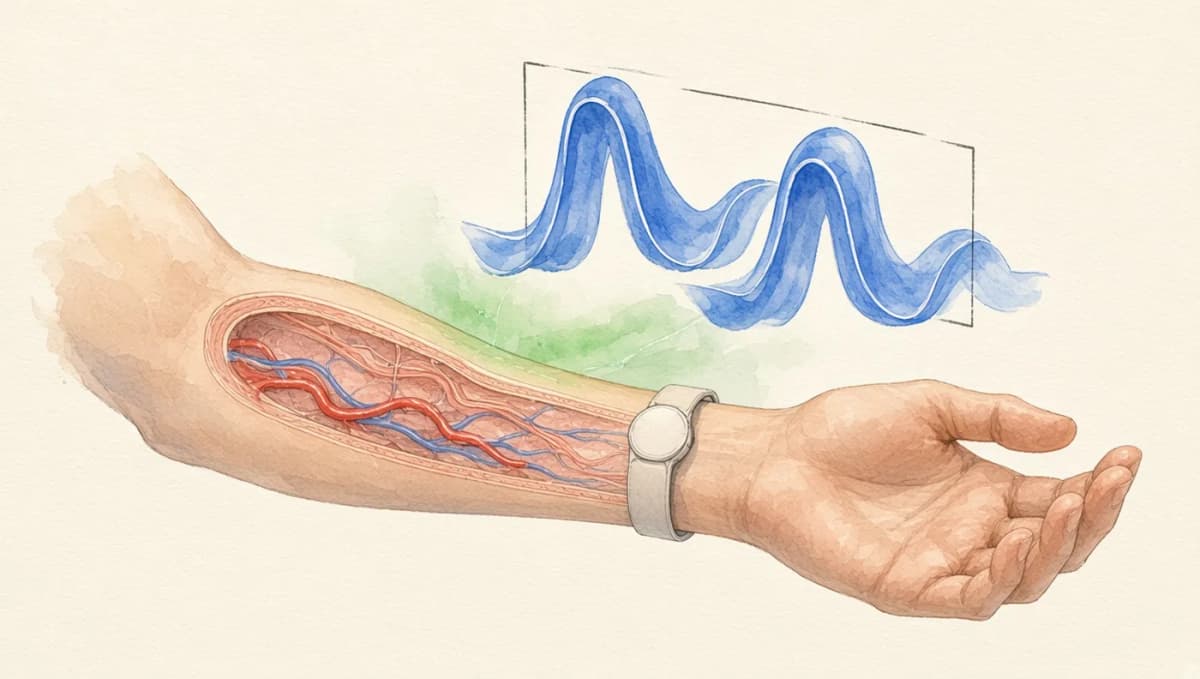
Short answer: Heart rate variability (HRV) is the scatter in ECG R-R intervals. Pulse rate variability (PRV) is the scatter in intervals taken from the pulse wave. At rest the two often sit close together, and short-term PRV is often a little higher. During activity, and during some mental stress, the agreement can fall apart.
This page is a reading guide to published comparisons. It does not diagnose a condition, set a training plan, or clear a device.
Two intervals, two sensors
An ECG marks the electrical trigger of each beat. The R-R interval is the time from one R wave to the next. HRV is whatever statistic you then compute on those intervals: RMSSD, SDNN, a frequency band, and so on.
A PPG sensor times a feature on the optical pulse: a foot, a peak, or a slope point. The gap between those features is an interbeat interval. That interval is the input to PRV. The arithmetic can be identical to an HRV formula. The input series is the pulse, so the name on the sensor is PRV even when a watch screen says HRV.
A longer side-by-side of the two waveforms is in the PPG versus ECG accuracy comparison. The formula most watches print is RMSSD, with a processing note on the RMSSD algorithm card.
What the open reviews actually pooled
Schäfer and Vagedes reviewed PRV against ECG RR intervals in 2013 (International Journal of Cardiology, 166(1):15–29, doi:10.1016/j.ijcard.2012.03.119, PubMed 22809539). The sensors in that review included PPG, continuous blood pressure, and impedance. Their abstract is the claim this page uses. They called accuracy sufficient at rest. Many of the included studies suggested that short-term variability was somewhat overestimated by PRV, which they tied to coupling between respiration and the circulation. Physical activity and some mental stressors impaired agreement, often to an extent they called unacceptable. Findings on sensor position and on the detection algorithm were not conclusive. The studies were mostly incommensurable, so the abstract does not offer one limits-of-agreement pair for "PPG versus ECG."
Xu and colleagues published a systematic review and meta-analysis in Sensors in 2026 (26(16):5192, doi:10.3390/s26165192). The population was healthy or apparently healthy, and the metrics were RMSSD and SDNN. They included 43 studies in the qualitative synthesis, summarized 33 narratively, and had enough numbers from 10 studies for a quantitative pool. Eight studies entered each metric's meta-analysis.
The pooled absolute standardized error was 0.188 for RMSSD (95% CI 0.066 to 0.309; I² = 11.69%) and 0.134 for SDNN (95% CI 0.014 to 0.255; I² = 0%). In the methods, the signed standardized error is the PPG mean minus the ECG mean, divided by the ECG reference standard deviation, which they describe as a descriptive cousin of Glass's delta. A positive sign means the PPG mean sits above the ECG mean. The absolute standardized error folds the sign away so opposite errors do not cancel in the pool. A secondary pool of the signed errors was 0.110 for RMSSD (95% CI −0.054 to 0.275, which crosses zero) and 0.134 for SDNN (95% CI 0.014 to 0.255).
Sensitivity checks left the RMSSD absolute-error pool in a similar place. The SDNN pool was directionally stable, and it lost statistical significance when individual studies were left out. The authors are explicit about the boundary: the quantitative synthesis was predominantly resting or controlled, it should not be generalized to sleep, exercise, stress, or free-living recordings, and it should not be read as proof that PPG and ECG numbers are interchangeable.
A delay that changes from beat to beat
The optical pulse reaches the wrist after the R wave. Pulse arrival time runs from the R wave to a point on the PPG, so it includes the heart's pre-ejection period and the travel time along the artery. Pulse transit time between two optical sites leaves the pre-ejection period out.
RMSSD is built from successive differences. A delay that is the same on every beat adds the same constant to every interval, and the constant disappears when one interval is subtracted from the next. A delay that wobbles from beat to beat remains inside those differences. Respiration, blood pressure, and vessel tone can move arrival time. That is the mechanical reading of the overestimation Schäfer and Vagedes described. It is a reason to expect disagreement. It is not a universal offset in milliseconds.
Rest, movement, and a night average
The resting and controlled settings are where both reviews leave room for PRV as a stand-in. Schäfer and Vagedes put the breakdown with physical activity and with some mental stressors. Xu and colleagues refuse to stretch their pooled error onto sleep, exercise, stress, or a free-living day. A nightly wearable average is its own object: several windows, a sleep detector, and a vendor's summary. One published nocturnal comparison, for a Garmin Fenix 6 against a chest-strap ECG, is written up separately on the Garmin HRV accuracy page.
Sleep timing across nights is a different statistic again. The sleep regularity index scores whether the same clock time is asleep or awake a day later. It does not replace an RMSSD.
A short checklist before comparing two numbers
When a paper or a watch export says "HRV," the useful questions are concrete.
- Which statistic: RMSSD, SDNN, or something else?
- Which fiducial point on the pulse, and was it held fixed?
- How long was the window, and was the reported value one window or an average of many?
- Was the person at rest, asleep, or moving?
- What was the reference, and was it an ECG?
- Which device generation produced the file?
Those questions are why a single correlation from a seated lab does not travel to a run, and why a sleep-lab night does not travel to a different watch. The PPG versus ECG comparison keeps the wider accuracy context. RMSSD is the metric to open next if the screen is showing that one number.
Frequently Asked Questions
- Is pulse rate variability the same thing as HRV?
- They are sibling measurements. HRV is the variation in ECG R-R intervals. Pulse rate variability is the variation in intervals taken from the pulse wave, usually a PPG recording. A wearable that reports HRV from an optical sensor is reporting pulse rate variability.
- When does PPG pulse-rate variability agree with ECG HRV?
- Schäfer and Vagedes (2013, doi:10.1016/j.ijcard.2012.03.119) reviewed comparisons and described sufficient accuracy at rest, with short-term variability often somewhat overestimated by the pulse method. Physical activity and some mental stressors impaired agreement, often to an unacceptable extent. Xu et al. (2026, doi:10.3390/s26165192) pooled resting or controlled studies and warned against generalizing that pool to sleep, exercise, stress, or free-living use.
- Why can a pulse interval differ from the R-R interval?
- The pulse arrives after the electrical beat. A delay that stays constant from beat to beat cancels when successive intervals are subtracted. A delay that changes from beat to beat stays in the difference. Pulse arrival time includes the pre-ejection period plus travel along the artery. Pulse transit time between two optical sites leaves the pre-ejection period out. See /learn/pulse-transit-time and /learn/ibi.
- Does a meta-analysis give one limits-of-agreement number for PPG versus ECG?
- Xu et al. (2026) pooled an absolute standardized error, which is a difference of means divided by the ECG standard deviation, then made positive. For RMSSD the pooled value was 0.188 (95% CI 0.066 to 0.309). That is not a Bland-Altman limits-of-agreement pair, and the authors say it is not evidence that the two methods are interchangeable.
- Where is the Garmin nocturnal comparison?
- A separate page, /accuracy/garmin-hrv, quotes Dial et al. (2025) on the Fenix 6 during sleep, the Garmin Enhanced BBI white paper, and Labfront's commentary. RMSSD itself is defined at /learn/rmssd.
Core guide: What Is HRV (Heart Rate Variability)?
Related articles
PPG Wearable Accuracy During Sleep: Heart Rate and HRV Validation
How accurate are wearable PPG devices for sleep heart rate and HRV? Review of validation studies for Oura, Apple Watch, Fitbit, and Garmin during overnight monitoring.
Driver Drowsiness Detection with PPG: How Pulse Sensors Monitor Fatigue
Technical guide to PPG-based driver drowsiness detection covering HRV fatigue markers, sensor placement options, algorithm accuracy, and integration with automotive safety systems.
Pulse Oximeter Readings Chart: SpO2 and Heart Rate Ranges Explained
A complete pulse oximeter readings chart covering normal, borderline, and dangerous SpO2 and heart rate ranges, plus factors that affect accuracy.
PPG Pulse Pressure Variation Noninvasive Monitoring: Can Pleth Variability Guide Fluid Response?
PPG pulse pressure variation monitoring estimates respiratory-linked hemodynamic variability noninvasively, but its value depends on ventilation, rhythm, and signal quality.