Learn PPG
Detecting Motion Artifacts in PPG
Motion artifact detection decides that a PPG window is unfit because the body moved. It is not the same job as removing the artifact and still printing a heart rate. On PPG-DaLiA, a simple spectral heart-rate estimate missed the ECG by more than 10 beats per minute in 5.8% of sitting windows and 63.8% of stair-climbing windows.
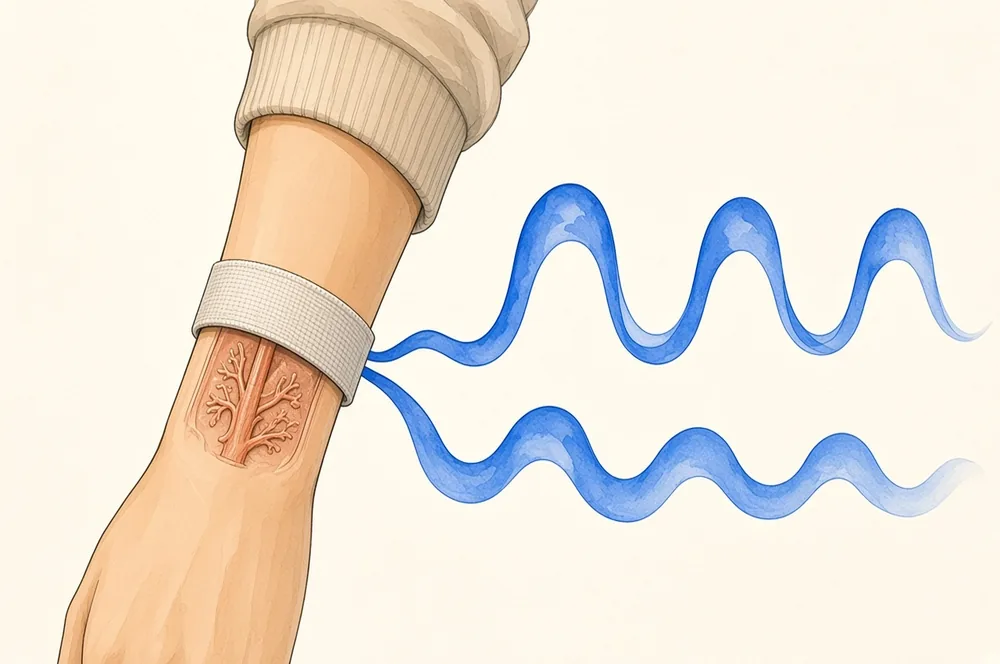
Detection is the decision to distrust
A motion artifact is optical change that came from movement. Detection marks the window. Removal tries to recover a pulse from it. This page is the first job. The algorithm survey for removal, adaptive filters and the rest, stays at motion artifact removal. The signal quality index is the parent map. The algorithm card motion artifact detection is a shorter method note.
You can see the cost of skipping detection in a public wrist set. Xu used PPG-DaLiA: 15 participants, Empatica E4 wrist PPG, chest electrocardiography, daily-life activities. Windows were 8 seconds with a 2-second step. Heart rate was a transparent dominant-frequency estimate. A large error was defined in advance as more than 10 beats per minute absolute deviation from the ECG heart rate. The abstract reports 14,622 large errors out of 47,182 non-transition windows, 31.0%. By activity the share ran from 5.8% during sitting to 63.8% during stair climbing (Xu 2026).
| Slice | Large-error share |
|---|---|
| All non-transition windows (47,182) | 31.0% (14,622 windows) |
| Sitting | 5.8% |
| Stair climbing | 63.8% |
Those percentages are failures of one heart-rate method, not a count of windows an expert marked "artifact." They are still the right exhibit for detection: the same sensor and the same estimator are usable while sitting and frequently wrong on stairs. An all-day error would smear that split.
Xu then asked whether wrist features could flag the unreliable windows in a person the model had not seen. Leave-one-subject-out AUROC was 0.743 from motion intensity alone. Wrist PPG and wrist-signal features alone (acceleration-band power, PPG-acceleration spectral overlap, peak dominance, and spectral entropy) gave 0.851. The 0.864 result includes activity context as well (Xu 2026). The abstract's claim is modest: a signal-based reliability flag may sit beside the heart-rate number, and it still needs a prospective test before clinical or consumer use. The landing page used here exposed the abstract and the reference list, not the full methods.
Stillness is not automatically clean
Motion is the loud cause. It is not the only one. Charlton and colleagues held people in supine, sitting, and standing positions and moved the wrist sensor relative to the heart, using Aurora-BP reflectance green PPG from 1,142 subjects (Charlton 2025). Signal-to-noise ratio at a natural sensor height was 18.6 dB supine, 13.7 dB sitting with the arm in the lap, and 9.0 dB standing with the arm down. Raising the arm to heart height while sitting reached 15.5 dB. Template correlation and perfusion index moved the same way. Someone standing still can have a worse optical window than someone lying down, before any step is taken.
Shao and colleagues list motion, perfusion loss, and ambient light together as the reasons wearable PPG becomes unfit for heart rate, saturation, respiration, or cuffless pressure estimates (arXiv:2509.12510). Their pipeline does not use an accelerometer label. It learns window embeddings and clusters a topological signature. The densest cluster is treated as acceptable. That is a detection rule aimed at device shift as well as motion. The cluster scores they publish (silhouette 0.72 on 10,000 windows) measure how separated the clusters are. They are not an accuracy against expert artifact labels.
Moscato built basic-quality and high-quality classifiers on 24-hour wrist PPG from 31 people and balanced the training pulses across accelerometer activity ranges, because daily motion was the point of the recording (doi:10.3390/s22155831). Nineteen features came from the pulse and from the accelerometer. The best support vector machine accuracies in the abstract are 0.96 and 0.97. The feature list's novel items are in the paper. This guide does not recite them beyond what the abstract and the quality definitions state.
A learned detector that stays small
Chen and colleagues built SMoLK for PPG artifact detection, among other tasks (Nature Machine Intelligence, 2024). The journal abstract says the model is a single sparse layer of learned kernels, tested on photoplethysmography artifact detection and on atrial fibrillation from a single-lead ECG, and that it matched models orders of magnitude larger. The article PDF was paywalled here. The journal page does state that code and data are public, including github.com/SullyChen/SMoLK. The open preprint of the same work (arXiv:2307.05385) describes the PPG path as convolutions with those kernels, rectified and summed into a quality measure that is smoothed and thresholded to mark artifact samples. That is detection at sample scale, closer to a mask than to a single score per minute.
Tiny-PPG makes the same choice with a small convolutional network trained on PPG-DaLiA (arXiv:2305.03308). It marks each sample of a 30-second window clean or artifact. Pruned to 19,726 parameters, it scored about 87% Dice against sample-level artifact labels and ran on an STM32 microcontroller board. Moved to a fingertip pulse sensor during deliberate tapping and hand movement, Dice fell to 73.9%. The earlobe reached 86.8%. A detector trained on one wrist device is a hypothesis about the next site, not a result. The machine-learning guide covers the model, its data split, and a code repository with no licence file.
Lai and Kar's abstract is a non-learned counterpart: sequential checks, then a minute-level keep-or-drop. Daytime PPG heart-rate error against ECG fell, and coverage fell with it, to 50% in the daytime slice they report (doi:10.1109/bibe66822.2025.00078). Full text was not available. The coverage number matters for detection design. A detector that fires on every stair step will blank the period when many people most want a heart rate.
The accelerometer is evidence of motion, not a verdict on the pulse. Xu's motion-only AUROC of 0.743 left room for the optical features. A hard swing with a still-readable pulse, and a corrupted pulse with a quiet accelerometer, are both possible. Contact loss can look like motion in the optical channel and like nothing in the acceleration if the whole arm is still and the strap has lifted.
Commercial watches and bands commonly skip or delay a displayed value when movement is severe. This page does not describe any company's internal rule.
How to subtract the artifact once it is found is the other article. How the families of quality scores relate is the index guide. This page is educational. A flagged window is not a diagnosis.
Research on this site
These records are public datasets, models, and papers linked from this guide.
Papers
 Beyond average accuracy: motion-related failure patterns in wrist PPG heart-rate monitoring (Xu, Theor. Nat. Sci. 2026)0.864 includes activity context; wrist-signal features alone were 0.851Theoretical and Natural Science · 2026
 Determinants of photoplethysmography signal quality at the wristPosture and sensor height change wrist SNR without exercisePLOS Digital Health · 2025
 Self-Supervised and Topological Signal-Quality Assessment for Any PPG DeviceMotion named as a reason wrist PPG becomes unfitarXiv preprint · 2025
Datasets

Go deeper
Frequently Asked Questions
What is motion artifact detection in PPG?
Marking optical windows whose shape is dominated by movement, so a later heart-rate or HRV step can ignore them. Xu's abstract on PPG-DaLiA found large heart-rate errors in 5.8% of sitting windows and 63.8% of stair-climbing windows (Xu 2026).
Is detection the same as motion artifact removal?
No. Detection flags the window. Removal tries to reconstruct a pulse. Removal methods are surveyed at /blog/ppg-motion-artifact-removal.
Can you detect motion artifact without an accelerometer?
Yes. Shao et al. 2025 cluster wrist windows from the PPG embedding alone (arXiv:2509.12510). Xu found motion intensity useful and found extra optical features raised AUROC from 0.743 to 0.851 in leave-one-subject-out tests. The second figure is from the abstract.
Why do standing and sitting change quality if the person is not exercising?
Charlton et al. 2025 measured lower wrist SNR when people stood with the arm down (9.0 dB) than when they lay supine (18.6 dB), and higher SNR when the sensor was raised toward heart height (Charlton 2025).