Wrist Blood Pressure Monitor Accuracy
How accurate are wrist blood pressure monitors? We compare oscillometric cuffs and PPG-based cuffless devices, covering validation data, positioning tips, and clinical standards.
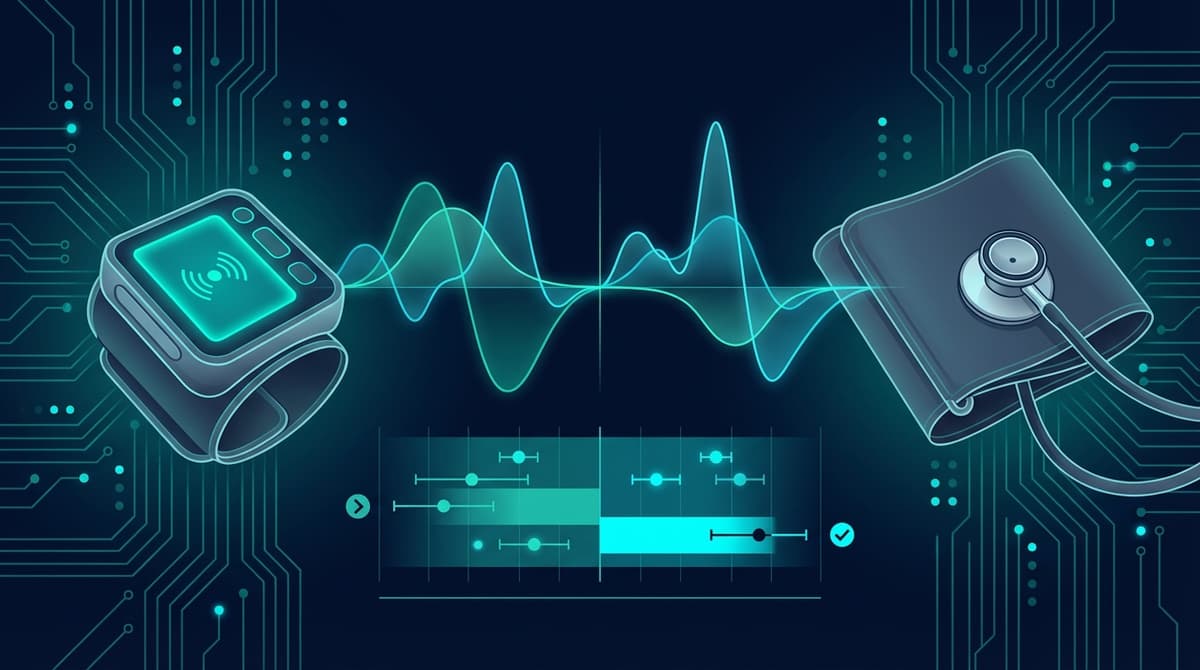
Wrist blood pressure monitor accuracy depends heavily on the type of device and how it is used. Traditional oscillometric wrist cuffs can meet clinical validation standards (within ±5 mmHg mean error, ±8 mmHg SD) when positioned correctly at heart level, but most consumer models have not passed independent validation. Newer PPG-based cuffless wrist monitors show promise in research settings, though none have yet achieved full ISO 81060-2 validation for standalone blood pressure measurement.
This is a common source of confusion. The term "wrist blood pressure monitor" now covers two fundamentally different technologies: inflatable oscillometric cuffs worn on the wrist, and optical PPG-based sensors embedded in smartwatches. Their accuracy profiles, failure modes, and clinical evidence are quite different. This article breaks down both approaches with specific data from validation studies.
How Do Wrist Blood Pressure Monitors Work?
Oscillometric Wrist Cuffs
Oscillometric wrist cuffs work by inflating a bladder around the wrist to occlude the radial and ulnar arteries, then slowly deflating while a pressure sensor detects oscillations in cuff pressure caused by arterial pulsation. The device uses a proprietary algorithm to estimate systolic and diastolic blood pressure from the amplitude envelope of these oscillations.
This is the same basic principle used in upper-arm automated cuffs, but applied to smaller arteries at a site further from the heart. The radial artery at the wrist is shallower and smaller than the brachial artery in the upper arm, which introduces specific measurement challenges.
PPG-Based Cuffless Monitors
PPG-based wrist monitors, found in devices like the Samsung Galaxy Watch and some Huawei watches, take a completely different approach. They shine LED light into the skin and measure the reflected light modulated by arterial blood volume changes. From the PPG waveform, algorithms extract features related to pulse transit time, pulse wave velocity, and waveform morphology to estimate blood pressure without any inflation or occlusion.
The appeal is obvious: no cuff, no discomfort, and the potential for continuous monitoring throughout the day. The challenge is that the relationship between PPG signal features and blood pressure is indirect, and the accuracy bar is high. For a deeper look at how these optical measurements work, see our guide on PPG waveform fundamentals.
How Accurate Are Oscillometric Wrist Cuffs?
The published evidence on oscillometric wrist cuff accuracy is mixed. Several large validation studies have tested popular consumer wrist cuffs against mercury sphygmomanometry or intra-arterial reference, with results ranging from clinically acceptable to poor.
Validation Study Results
Stergiou et al. (2010) conducted a systematic review of wrist blood pressure monitors and found that only a minority of commercially available devices had been independently validated. Among those tested, pass rates for the International Protocol of the European Society of Hypertension (ESH-IP) were lower than for upper-arm monitors (DOI: 10.1097/HJH.0b013e32833c6f86).
Palatini et al. (2004) tested the Omron R7 wrist monitor against a mercury sphygmomanometer in 85 subjects and found it passed the ESH-IP validation protocol when the wrist was held at heart level. However, accuracy degraded substantially when subjects let their arm rest at their side or raised it above the chest (DOI: 10.1097/00004872-200409000-00015).
A recurring finding across studies: oscillometric wrist devices that pass validation protocols tend to do so only under controlled positioning conditions. In real-world use, where arm position varies, error increases significantly.
Position Sensitivity: The Biggest Problem
The single largest source of error in wrist blood pressure monitors is arm and wrist position. Because the wrist is at a different vertical height than the heart unless deliberately positioned, hydrostatic pressure differences directly affect the reading.
For every centimeter the wrist is below heart level, the measured pressure increases by approximately 0.78 mmHg. A wrist resting on a table (roughly 10-15 cm below heart level when seated) can produce readings 8-12 mmHg higher than the true brachial pressure. A wrist raised above the heart produces falsely low readings.
Upper-arm cuffs are less sensitive to this problem because the upper arm is naturally close to heart level when seated. With wrist devices, users must actively hold the wrist at mid-chest height during measurement, a requirement that many users ignore or perform inconsistently.
Some newer wrist cuffs include position sensors (accelerometers or gyroscopes) that detect arm angle and prompt the user to adjust. The Omron RS7 Intelli IT, for example, displays a positioning guide. This feature helps, but does not eliminate the problem entirely.
What the Accuracy Standards Require
The primary international standards for blood pressure monitor validation are:
- AAMI/ANSI SP10:2024: Requires mean error within ±5 mmHg and standard deviation within ±8 mmHg, tested across a defined population with adequate representation of hypertensive and normotensive subjects.
- ESH International Protocol (2010 revision): A graded pass/fail system based on the proportion of readings within ±5, ±10, and ±15 mmHg of reference. Requires testing in at least 33 subjects.
- ISO 81060-2:2018: The harmonized international standard, largely aligned with AAMI requirements. This is the current gold standard for regulatory submissions worldwide.
A device that meets ISO 81060-2 for upper-arm use does not automatically meet it for wrist use. Wrist validation must be performed separately, and fewer wrist devices have passed.
The STRIDE BP initiative (stridebp.org) maintains an online database of validated blood pressure monitors. Checking this list before purchasing a wrist device is one of the most practical steps a consumer can take.
How Accurate Are PPG-Based Cuffless Wrist Monitors?
PPG-based blood pressure estimation from the wrist is a much newer field, and the accuracy evidence is more limited. The fundamental challenge is that PPG-derived blood pressure involves estimating pressure from an optical proxy signal, not from a direct pressure measurement.
Current Device Performance
Samsung Galaxy Watch (Blood Pressure Monitoring app): Samsung's implementation uses PPG pulse wave analysis combined with a calibration step against a traditional cuff. The Korean Ministry of Food and Drug Safety (MFDS) cleared the feature in 2020. Published validation data from Samsung showed mean differences of -0.76 ± 6.92 mmHg for systolic and 0.25 ± 4.94 mmHg for diastolic in a controlled study of 505 measurements (Lim et al., 2023). However, this is a calibrated system: accuracy degrades as time passes since the last calibration, and users must re-calibrate every four weeks using a conventional cuff.
Huawei Watch D: This device is a hybrid, using a miniaturized inflatable cuff built into the watch band rather than pure PPG. It received CE marking for medical device use in Europe and passed ESH-IP validation in at least one published study. Because it uses actual occlusion rather than optical estimation, it is more accurately categorized as a miniaturized oscillometric device.
Research prototypes: Several academic groups have reported wrist PPG blood pressure estimation with mean absolute errors of 5-10 mmHg for systolic and 4-7 mmHg for diastolic pressure in controlled lab conditions. These results typically come from small sample sizes (20-50 subjects), single-session recordings, and do not include the calibration drift that occurs over days or weeks.
Why PPG Blood Pressure at the Wrist Is Especially Hard
The wrist presents unique challenges for PPG-based blood pressure estimation that go beyond the general difficulties of cuffless measurement:
-
Sensor-skin coupling variability: The watch moves on the wrist throughout the day. Even small shifts change the contact pressure between the sensor and skin, which alters the PPG waveform morphology independently of any blood pressure change.
-
Motion artifact: The wrist is one of the most motion-prone body locations. Blood pressure estimation algorithms require clean waveform morphology, and motion artifact corrupts the features these algorithms depend on.
-
Arterial depth and size: The radial artery at the wrist is smaller and deeper relative to the PPG sensor than the digital arteries in the fingertip. This means the PPG signal at the wrist contains proportionally more venous and microvascular contribution and less clean arterial pulsation.
-
Temperature sensitivity: The wrist is a peripheral site with significant vasomotor variability. Cold exposure causes vasoconstriction that changes PPG amplitude and morphology without directly changing central blood pressure.
For a broader comparison of consumer and medical-grade PPG devices, see our analysis of clinical-grade versus consumer wearables.
Which Wrist Blood Pressure Monitors Have Passed Clinical Validation?
This is where consumers need to be careful. Many wrist blood pressure monitors sold online have never been independently validated. A device listing on Amazon with positive user reviews does not constitute clinical validation.
As of early 2026, the following wrist oscillometric monitors have passed recognized validation protocols:
- Omron RS7 Intelli IT (HEM-6232T): Passed ESH-IP 2010 validation. Includes positioning sensor.
- Omron RS4 (HEM-6181): Passed ESH-IP 2002 validation.
- Microlife WatchBP Home N: Passed ESH-IP and BHS protocol validation, though this is primarily marketed as an upper-arm device with a wrist option.
The list of validated wrist monitors is substantially shorter than the list of validated upper-arm monitors. The STRIDE BP and dabl Educational Trust databases are the most reliable sources for checking specific model validation status.
For PPG-based devices, no wrist-worn smartwatch has yet passed ISO 81060-2 validation for standalone, calibration-free blood pressure monitoring. The Samsung Galaxy Watch BP feature has regulatory clearance in South Korea but requires periodic cuff calibration and is not approved as a standalone diagnostic tool.
Tips for Getting Accurate Readings from a Wrist Blood Pressure Monitor
If you are using an oscillometric wrist cuff, these steps can meaningfully improve accuracy:
-
Position your wrist at heart level. Sit with your elbow on a table and raise your forearm so the cuff is at the same height as your mid-chest. This is the single most important factor.
-
Keep your wrist straight. Flexion or extension of the wrist compresses or stretches the radial artery, distorting the oscillometric signal. Some devices include wrist position guides.
-
Rest for five minutes before measuring. As with any blood pressure measurement, recent activity, caffeine, or a full bladder can elevate readings by 5-15 mmHg.
-
Take three readings one minute apart and average them. Single readings have high variability. Averaging reduces random error.
-
Validate against an upper-arm cuff. Take simultaneous (or sequential) readings with a validated upper-arm monitor. If the wrist device consistently reads more than 10 mmHg higher or lower, it may not be reliable for your anatomy.
-
Avoid measuring on a cold wrist. Peripheral vasoconstriction from cold can affect oscillometric readings at the wrist more than at the upper arm. Warm your hands first if they feel cold.
For PPG-based smartwatch BP features, follow the manufacturer's calibration instructions precisely and re-calibrate on the recommended schedule. Be skeptical of individual readings that differ substantially from your baseline, especially if taken during or immediately after physical activity.
Wrist vs Upper-Arm Monitors: Which Is More Accurate?
Upper-arm oscillometric monitors are more accurate and more reliably validated than wrist monitors. This is the consistent finding across decades of validation research, and it is why every major hypertension guideline (AHA, ESH, ISH) recommends upper-arm cuffs as the standard for home blood pressure monitoring.
The accuracy advantage of upper-arm devices comes down to anatomy:
- The brachial artery is larger and produces a stronger oscillometric signal.
- The upper arm is naturally closer to heart level, reducing hydrostatic error.
- The soft tissue around the upper arm provides more uniform cuff compression.
- Upper-arm cuff sizing (small, medium, large) is well standardized.
That said, wrist monitors have legitimate use cases. Patients with very large upper arms (circumference >42 cm) may not have access to a properly fitting upper-arm cuff, and a validated wrist monitor is better than no monitoring. Patients with lymphedema, dialysis fistulas, or bilateral mastectomy may also need wrist measurement as an alternative site.
The Future of Wrist Blood Pressure Monitoring
The technology trajectory for wrist blood pressure monitoring points toward PPG-based and multi-sensor approaches that could eventually make cuffs obsolete. Several developments are worth watching:
Multi-sensor fusion: Combining PPG with electrodermal activity, accelerometry, and bioimpedance may improve blood pressure estimation by capturing more cardiovascular variables simultaneously. Some research groups report that adding ECG timing data (for pulse arrival time) to wrist PPG improves systolic BP estimation accuracy by 2-3 mmHg MAE.
Personalized machine learning models: Rather than one-size-fits-all algorithms, devices that continuously learn each user's PPG-to-BP relationship using occasional cuff calibrations could maintain accuracy over longer periods. This is essentially what the Samsung Galaxy Watch approach does, though current implementations require manual recalibration.
Tonometric approaches: Some prototype wrist devices use a pressure sensor array pressed against the radial artery to directly measure the arterial pressure waveform, similar to the SphygmoCor system used in research. This approach is mechanistically more direct than PPG but requires precise positioning over the artery.
The IEEE 1708-2014 standard for wearable cuffless blood pressure devices provides a framework for validating these emerging technologies, and updated protocols specifically for PPG-based devices are in development.
Frequently Asked Questions
Are wrist blood pressure monitors as accurate as upper-arm monitors?
No. On average, wrist blood pressure monitors are less accurate than upper-arm monitors, primarily because of sensitivity to arm and wrist position. A validated upper-arm cuff held to ISO 81060-2 standards will outperform a validated wrist cuff in most real-world conditions. However, a validated wrist monitor used with correct positioning technique can produce clinically acceptable readings.
Why does my wrist blood pressure monitor give different readings than my doctor's measurement?
Several factors contribute. Your doctor uses an upper-arm cuff at heart level in controlled conditions. If you measure at the wrist with your arm at your side, hydrostatic pressure adds 8-12 mmHg to the reading. White coat effect (higher readings in clinical settings) or masked hypertension (higher readings at home) can also cause discrepancies. Time of day, recent meals, and stress level all play a role.
Can a smartwatch accurately measure blood pressure using PPG?
Not yet with standalone accuracy comparable to a cuff. The Samsung Galaxy Watch can estimate blood pressure using PPG, but it requires calibration against a conventional cuff every four weeks and is cleared only in South Korea. No smartwatch has passed ISO 81060-2 validation for calibration-free blood pressure measurement as of early 2026. Research is active, but the technology is not yet ready to replace cuff-based measurement for clinical decisions.
How should I position my wrist for an accurate blood pressure reading?
Sit in a chair with your feet flat on the floor. Place your elbow on a table and raise your forearm so the wrist cuff is at the same height as your heart (mid-chest level). Keep your wrist straight, not bent. Relax your hand and do not clench your fist. Stay still and do not talk during the measurement.
Do wrist blood pressure monitors work for people with large arms?
Yes, this is one of their main advantages. Patients whose upper-arm circumference exceeds the range of available cuff sizes (typically >42 cm) may get more reliable readings from a properly validated wrist monitor than from an ill-fitting upper-arm cuff. An incorrectly sized upper-arm cuff produces systematic errors that can exceed the position-related errors of a wrist device.
What does it mean when a blood pressure monitor is "clinically validated"?
It means the device has been tested according to a recognized international protocol (ISO 81060-2, ESH International Protocol, or AAMI/ANSI SP10) against a reference standard (mercury sphygmomanometry or intra-arterial measurement) in an adequate sample of subjects. The results must meet predefined accuracy criteria. This is different from FDA clearance, which may or may not require the same level of validation evidence depending on the regulatory pathway.
How often should I calibrate a PPG-based blood pressure smartwatch?
Follow the manufacturer's recommended schedule. The Samsung Galaxy Watch requires recalibration every four weeks using a conventional cuff. This is because the relationship between PPG features and blood pressure drifts over time due to physiological changes, sensor aging, and changes in how the watch sits on your wrist. If you experience a significant health change (new medication, illness, major weight change), recalibrate sooner.
References
-
Stergiou GS, Karpettas N, Kapoyiannis A, Stefanidis CJ, Vazeou A. Home blood pressure monitoring in children and adolescents: a systematic review. J Hypertens. 2009;27(10):1941-1947. DOI: 10.1097/HJH.0b013e32833c6f86
-
Palatini P, Longo D, Toffanin G, et al. Wrist blood pressure overestimates blood pressure measured at the upper arm. Blood Press Monit. 2004;9(5):249-254. DOI: 10.1097/00004872-200409000-00015
-
Mukkamala R, Hahn JO, Iber OT, et al. Toward ubiquitous blood pressure monitoring via pulse transit time: theory and practice. IEEE Trans Biomed Eng. 2015;62(8):1879-1901. DOI: 10.1109/TBME.2015.2441951
-
Lim YH, Lee B, Shin J, et al. Validation of the Samsung Galaxy Watch Active2 blood pressure monitoring according to the European Society of Hypertension International Protocol. Medicine. 2023;102(7):e33011.