Dataset

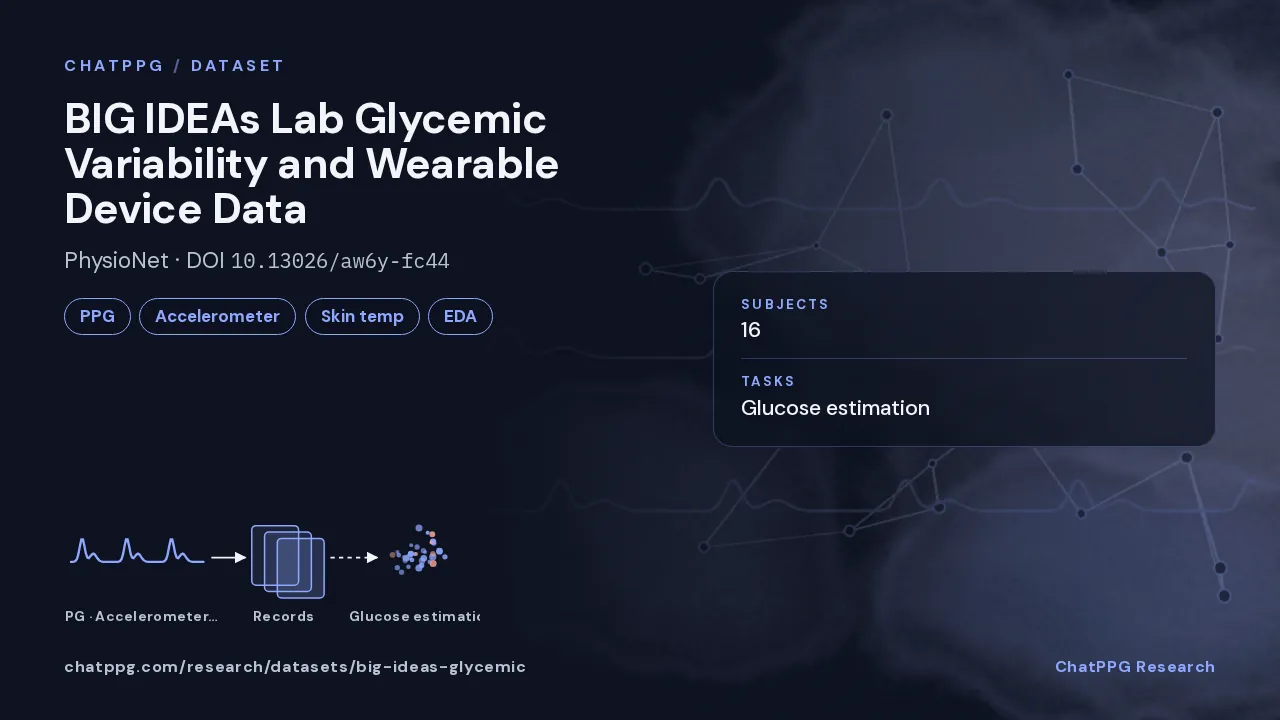
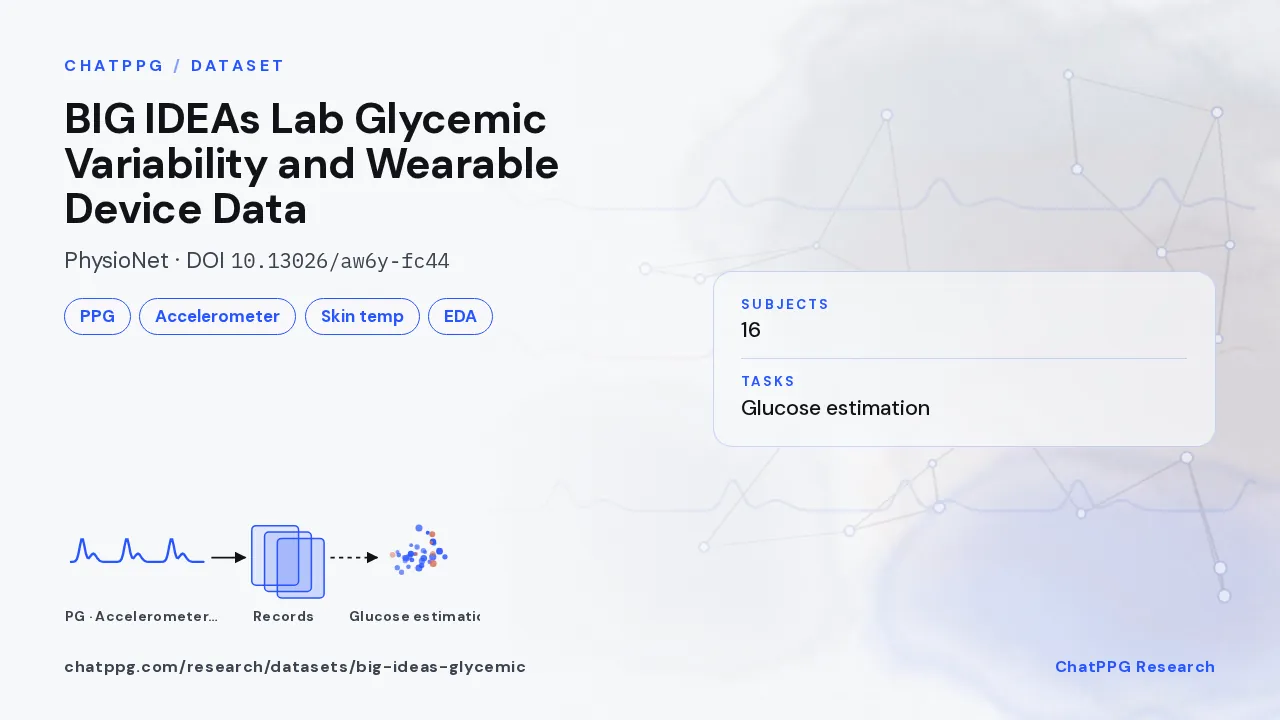
BIG IDEAs Lab Glycemic Variability and Wearable Device Data

PhysioNet big-ideas-glycemic-wearable v1.1.3 (DOI 10.13026/aw6y-fc44, published April 13, 2026). Continuous free-living wrist PPG with interstitial glucose.

License
Open Data Commons Attribution License v1.0

Original description

This study aimed to determine the feasibility and effectiveness of wearable devices in detecting early physiological changes prior to the development of prediabetes [1-3]. The study generated digital biomarkers for remote, mHealth-based prediabetes and hyperglycemia risk to classify which individuals should undergo further clinical testing. The primary inclusion criteria were subjects aged 35-65 years, inclusive, including only post-menopausal females, with a point of care A1C measurement between 5.2-6.4%, inclusive. Blood was collected during the study for measurement of glucose, hemoglobin A1C, lipoproteins, and triglycerides. Participants wore a Dexcom 6 continuous glucose monitor (CGM) and an Empatica E4 wristband for 10 days while receiving a standardized breakfast meal every other day. At the end of the 10 days, the participant returned to the clinic for an oral glucose tolerance test (OGTT). Research data collected includes physiological measurements from wearable devices such as heart rate, accelerometry, and electrodermal conductance.

Verbatim fromPhysioNet· Licence: Open Data Commons Attribution License v1.0

BIG IDEAs Lab Glycemic Variability and Wearable Device Data: overview

The BIG IDEAs Lab Glycemic Variability and Wearable Device Data (Duke University, on PhysioNet) follows 16 adults aged 35-65 with HbA1c in the high-normal or prediabetes range for 8-10 days. Each wore an Empatica E4 wristband (PPG/BVP at 64 Hz, EDA and skin temperature at 4 Hz, accelerometry at 32 Hz) and a Dexcom G6 continuous glucose monitor reading interstitial glucose every 5 minutes, and kept a food log. It is the most used open dataset for estimating glucose from a wrist wearable.

What's inside

Participants
16 (folders 001-016); HbA1c and sex in Demographics.csv
Duration
8-10 days per participant, free-living, standardized breakfast every other day
Wearable
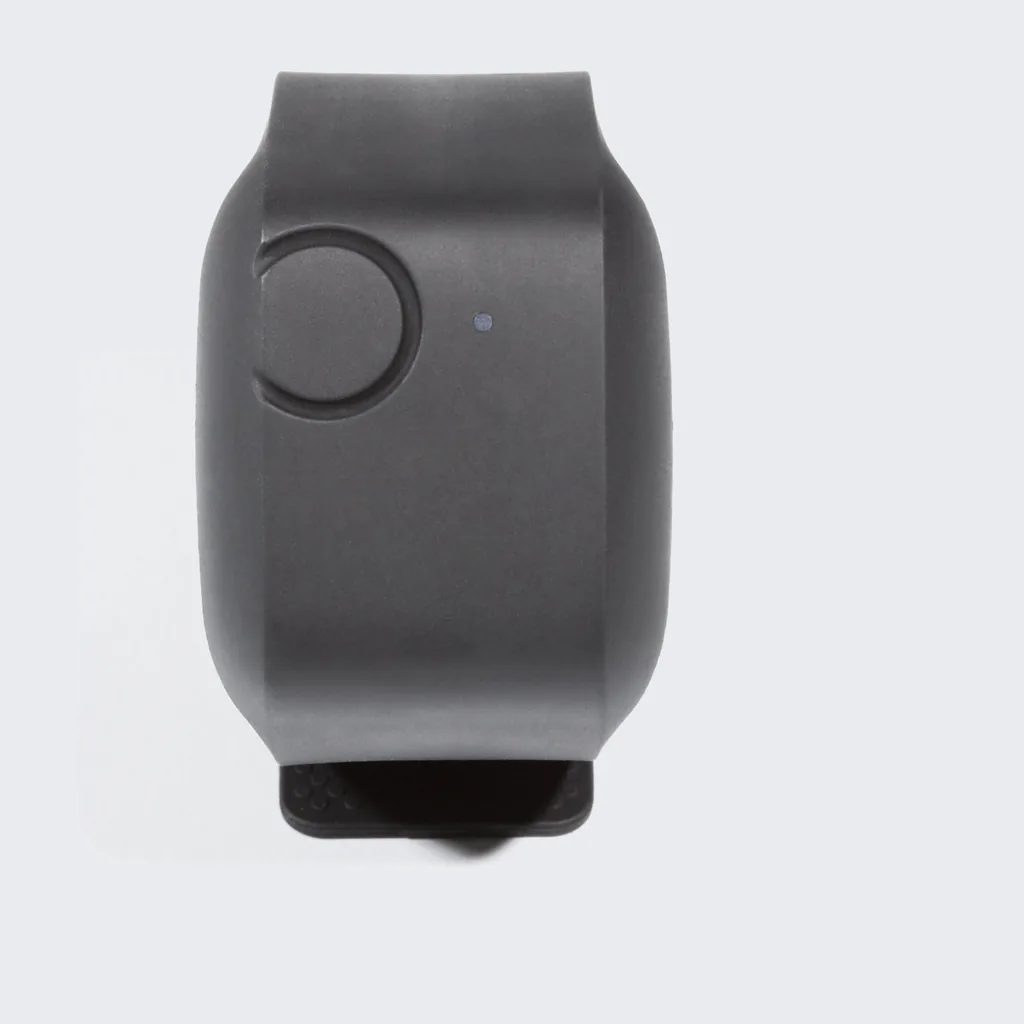
Empatica E4: BVP (PPG) 64 Hz, HR 1 Hz, IBI, EDA 4 Hz, skin temperature 4 Hz, 3-axis accelerometer 32 Hz
Glucose reference
Dexcom G6 CGM, interstitial glucose (mg/dL) every 5 min
Other
Per-participant food logs with calories and macronutrients
Format
One CSV per signal per participant: ACC, BVP, Dexcom, EDA, HR, IBI, TEMP, Food_Log
Size
34.1 GB uncompressed (4.7 GB ZIP)

How to access it

Host: PhysioNet

  1. Open the PhysioNet project page; files are open access (no credentialing).
  2. Download the 4.7 GB ZIP or mirror with wget -r -N -c -np https://physionet.org/files/big-ideas-glycemic-wearable/1.1.2/ (swap in the latest version number).
  3. Version 1.1.3 (April 2026) fixed misaligned food-log dates; use it if you model meals.

Licence: Open Data Commons Attribution License v1.0

What it allows: Use, sharing and adaptation, including commercial, with attribution.

Load BIG IDEAs Lab Glycemic Variability and Wearable Device Data in Python

Untestedpip install pandas
import pandas as pd
from pathlib import Path

root = Path("big-ideas-glycemic-wearable/1.1.3")
pid = "001"

def load(name):
    df = pd.read_csv(root / pid / f"{name}_{pid}.csv")
    ts = next(c for c in df.columns if "time" in c.lower())
    df[ts] = pd.to_datetime(df[ts])
    return df.set_index(ts).sort_index()

cgm = load("Dexcom")        # interstitial glucose, every 5 min
bvp = load("BVP")           # 64 Hz PPG
print(cgm.head(), bvp.shape)

# align: summarise PPG in the 5-min window ending at each CGM reading
val = [c for c in bvp.columns if c.lower() != "index"][0]
feat = bvp[val].resample("5min", label="right", closed="right").agg(["mean", "std"])
# check file names and column headers against the project page; they can differ slightly by participant

Caveats

  • Only 16 participants: use leave-one-person-out evaluation. Random splits of 5-minute windows put the same person in train and test and inflate accuracy.
  • CGM reads interstitial glucose, which lags blood glucose by several minutes.
  • Participants were not diabetic (HbA1c 5.2-6.4%), so the glucose range is narrow; hypoglycemia and high hyperglycemia are rare.
  • Time-of-day, meals and activity predict glucose by themselves. Include a time-only or food-log-only baseline before claiming the PPG carries glucose information.
  • Dates are shifted for de-identification; use relative time, not calendar dates.

Similar datasets

DatasetSubjectsSignalsLicence
AI-READI2,280hr, spo2, accel, cgm, ecgNot stated
BrisT1D-Open24hr, cgm, steps, distance, calories, activity-derivedNot stated
D1NAMO29ecg, accel, resp, cgmNot stated
Smartwatch PPG paired with CGM glucose (Zenodo)5ppg, cgmCC BY 4.0
STU-BA PPG Blood Glucose Dataset (Zenodo)24ppg, accelCC0 1.0

Sources: BIG IDEAs Lab Glycemic Variability and Wearable Device Data (PhysioNet) · Bent et al. 2021, npj Digital Medicine · Karunarathna & Liang 2025, Sensors · Updated 2026-10-16

BIG IDEAs Lab Glycemic Variability and Wearable Device Data: ChatPPG research summary card

Key numbers

16
Subjects
1
Reference labels
GLUCOSE
4Hz
Released sampling rate
BVP 64Hz; ACC 32Hz; EDA/TEMP 4Hz; CGM ~5 min

How it works

How BIG IDEAs Lab Glycemic Variability and Wearable Device Data works: Devices & body sites → Signals recorded → TasksDevices & body sites: Empatica E4 (Empatica · Wrist). PPG sites: Wrist. Signals recorded: BIG IDEAs Lab Glycemic Variability and Wearable Device Data, 16 subjects · 4Hz, signals PPG, IMU, EDA, Temperature, Glucose. Tasks: Glucose.Devices & body sitesEmpatica E4: Empatica · WristEmpatica E4Empatica · WristPPG sites: WristPPG sitesWristSignals recordedBIG IDEAs Lab Glycemic…16 subjects · 4HzPPGxyzIMUEDATemperatureGlucoseTasksGlucoseGlucose
Sampling
BVP 64Hz; ACC 32Hz; EDA/TEMP 4Hz; CGM ~5 min
Reference labels
glucose
Device roles
Study wearable (IMU)

Devices· 1

Full photo credits, sources and licences are on each device page.

Leaderboard rows· 8

All leaderboards
TaskDatasetMetricValueRank
Glucose estimationBIG IDEAs Lab Glycemic Variability and Wearable Device Dataclarke_a_pct ↑94.2#1 / 2
Glucose estimationBIG IDEAs Lab Glycemic Variability and Wearable Device Dataclarke_a_pct ↑89.1#2 / 2
Glucose estimationBIG IDEAs Lab Glycemic Variability and Wearable Device Datamard_pct ↓7.1#1 / 4
Glucose estimationBIG IDEAs Lab Glycemic Variability and Wearable Device Datamard_pct ↓9.7#2 / 4
Glucose estimationBIG IDEAs Lab Glycemic Variability and Wearable Device Datamard_pct ↓13.26#3 / 4
Glucose estimationBIG IDEAs Lab Glycemic Variability and Wearable Device Datarmse_mgdl ↓11.9#1 / 4
Glucose estimationBIG IDEAs Lab Glycemic Variability and Wearable Device Datarmse_mgdl ↓15.6#2 / 4
Glucose estimationBIG IDEAs Lab Glycemic Variability and Wearable Device Datarmse_mgdl ↓21.1#3 / 4

Papers and models using this dataset· 4

#63 of 186 most-used datasets by published papers and models · #32 of 88 PPG · #30 of 84 IMU · #4 of 15 EDA

Browse these 2 papers in the research explorer (filtered to BIG IDEAs Lab Glycemic Variability and Wearable Device Data)

FAQ

What signals are in the BIG IDEAs glycemic dataset?

Empatica E4 wristband signals (BVP/PPG at 64 Hz, heart rate, inter-beat intervals, EDA, skin temperature, 3-axis accelerometry) and Dexcom G6 interstitial glucose every 5 minutes, plus food logs and demographics.

How accurate are published glucose estimates on BIG IDEAs?

Bent et al. (2021) reported RMSE 21.22 mg/dL and MAPE 14.33% with leave-one-person-out cross-validation. Karunarathna and Liang (2025) reported RMSE 11.9 mg/dL and MARD 7.1%, but with a random 80/20 split of 5-minute epochs, so the same people were in training and test.

Is the BIG IDEAs dataset free for commercial use?

It is released under the Open Data Commons Attribution License v1.0, which allows commercial use with attribution.

Cite this dataset

Cite this dataset with the fields recorded here. Check it against the publisher before submitting.

BIG IDEAs Lab Glycemic Variability and Wearable Device Data [Data set]. (n.d.). physionet. https://doi.org/10.13026/aw6y-fc44
@misc{bigideasglycemicideas,
  title         = {{BIG IDEAs Lab Glycemic Variability and Wearable Device Data}},
  howpublished  = {physionet},
  doi           = {10.13026/aw6y-fc44}
}

Cite the ChatPPG record

Cite the dated snapshot 2026-10 for a fixed, reproducible version. Please also cite the original publications listed above.

APA

ChatPPG. (2026). BIG IDEAs Lab Glycemic Variability and Wearable Device Data: dataset record (Version 2026-10) [Data set]. ChatPPG Research Hub. https://chatppg.com/research/datasets/big-ideas-glycemic

BibTeX
@misc{chatppg_dataset_big_ideas_glycemic,
  author       = {{ChatPPG}},
  title        = {{BIG IDEAs Lab Glycemic Variability and Wearable Device Data: dataset record}},
  year         = {2026},
  month        = nov,
  version      = {2026-10},
  howpublished = {\url{https://chatppg.com/research/datasets/big-ideas-glycemic}},
  note         = {ChatPPG Research Hub, Snapshot 2026-10, https://chatppg.com/research/snapshots/2026-10}
}
CITATION.cff
cff-version: 1.2.0
message: "If you use this resource, please cite it as below."
type: dataset
title: "BIG IDEAs Lab Glycemic Variability and Wearable Device Data: dataset record"
authors:
  - name: "ChatPPG"
url: "https://chatppg.com/research/datasets/big-ideas-glycemic"
repository-artifact: "https://chatppg.com/research/snapshots/2026-10"
version: "2026-10"
date-released: "2026-11-13"

History

  1. Record updated