Activity counts measure attention, not model quality. Missing counts are unknown. Publication status follows the linked source; a listed venue alone does not confirm peer review.
GlucoPRISM is a CGM encoder that splits each day's representation into person, day and sensor parts, so sensor differences do not carry over when the model moves to a new cohort. It learns this from synthetic sensor views calibrated on paired Dexcom and Libre data, without clinical labels. Dropping the sensor part raised mean cross-cohort AUROC from 68.75 to 73.57, against 69.3 for GlucoFM.
Published
arXiv preprint, 2026
Signals
Glucose
Result
cross-cohort AUROC 73.57 vs 69.3 (GlucoFM)
External cohort
9,303 participants
Year
2026
Method
Trait / State / Sensor representation bands, protocol supervision
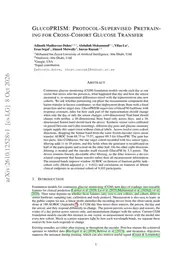
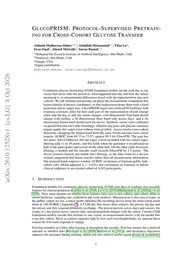
Continuous glucose monitoring (CGM) foundation models encode each day as one vector that mixes who the person is, what happened that day and how the sensor measured it, so measurement differences travel with the representation into new cohorts. We ask whether pretraining can place the measurement component that harms transfer in known coordinates, so that deployment drops them with a fixed projection and no target data. GlucoPRISM supervises a GlucoFM backbone with response contracts, rules for how each part of the representation should change when only the day or only the sensor changes: a 64-dimensional Trait band should change with neither, a 48-dimensional State band only across days, and a 16-dimensional Sensor band should track the device. Synthetic sensor views calibrated on paired Dexcom and Libre recordings, different-day pairs and glucose-summary targets supply this supervision without clinical labels. Across twelve cross-cohort directions, dropping the Sensor band from the same frozen encoder raises mean transfer AUROC from 68.75 to 73.57, against 69.3 for GlucoFM. The gain has two parts. Into CGMacros, the one target cohort recorded with two sensor types, filtering adds 11 to 19 points, and this holds when the generator is recalibrated on half of the participants and scored on the other half. On the other eight directions filtering is neutral and the encoder itself exceeds GlucoFM by 3.5 points. The device remains linearly decodable after filtering, so the filter removes a device-related component that harms transfer rather than all measurement information. The retained bands improve window AUROC on thirteen of fourteen public task–cohort cells (Holm-adjusted p=0.031) and correlation on fourteen of fifteen clinical endpoints in an external cohort of 9,303 participants.
Verbatim fromarXiv· arXiv metadata (abstracts are released under CC0)
Key results
68.75
AUROC
Dropping the sensor part raised mean cross-cohort AUROC from 68.75 to 73.57, against 69.3 for GlucoFM.
How it works
Datasets linked in the hub; pretraining vs evaluation roles follow the paper.
Pretraining data
514 participants, 10,952 daily windows, 5 public CGM cohorts
Architecture
GlucoFM backbone, 128-d output split Trait 64 / State 48 / Sensor 16 (backbone type not stated)
Inputs
Glucose
Approach
CGM · glucose · foundation model · sensor invariance · GlucoFM
Cite the publication recorded for this model. Check it against the publisher before submitting.
Dukre, A. M., Mohammad, A., Lu, Y., Segal, E., Metwally, A., & Razzak, I. (2026). GlucoPRISM: Protocol-Supervised Pretraining for Cross-Cohort Glucose Transfer. arXiv preprint. https://arxiv.org/abs/2610.12528
Dukre, Adinath Madhavrao, Abdullah Mohammad, Yifan Lu, Eran Segal, Ahmed Metwally, and Imran Razzak. 2026. "GlucoPRISM: Protocol-Supervised Pretraining for Cross-Cohort Glucose Transfer." arXiv preprint. https://arxiv.org/abs/2610.12528.
Dukre, A. M., Mohammad, A., Lu, Y., Segal, E., Metwally, A. and Razzak, I. (2026) 'GlucoPRISM: Protocol-Supervised Pretraining for Cross-Cohort Glucose Transfer', arXiv preprint. Available at: https://arxiv.org/abs/2610.12528
Dukre, Adinath Madhavrao, et al. "GlucoPRISM: Protocol-Supervised Pretraining for Cross-Cohort Glucose Transfer." arXiv preprint, 2026. https://arxiv.org/abs/2610.12528.
A. M. Dukre, A. Mohammad, Y. Lu, E. Segal, A. Metwally, and I. Razzak, "GlucoPRISM: Protocol-Supervised Pretraining for Cross-Cohort Glucose Transfer," arXiv preprint, 2026, [Online]. Available: https://arxiv.org/abs/2610.12528.
@misc{dukre2026glucoprism,
  title         = {{GlucoPRISM: Protocol-Supervised Pretraining for Cross-Cohort Glucose Transfer}},
  author        = {Dukre, Adinath Madhavrao and Mohammad, Abdullah and Lu, Yifan and Segal, Eran and Metwally, Ahmed and Razzak, Imran},
  year          = {2026},
  howpublished  = {arXiv preprint},
  eprint        = {2610.12528},
  archivePrefix = {arXiv}
}
History
Record updated
Added to the ChatPPG research hub
Newsletter
Get new PPG datasets, papers and models
Get alerts when GlucoPRISM (protocol-supervised CGM encoder; Trait/State/Sensor bands) is benchmarked on new datasets, plus the weekly digest.
New datasets, papers and models
Practical guides from the hub
Unsubscribe anytime
The waveform is an illustration of a PPG pulse, not a recording.