State of PPG, October 2026: the first 38 SOTA stars
October 2026 in the ChatPPG research hub: 574 papers, 147 leaderboards and the first 38 SOTA stars. AnyPPG holds six; no star changed hands yet.
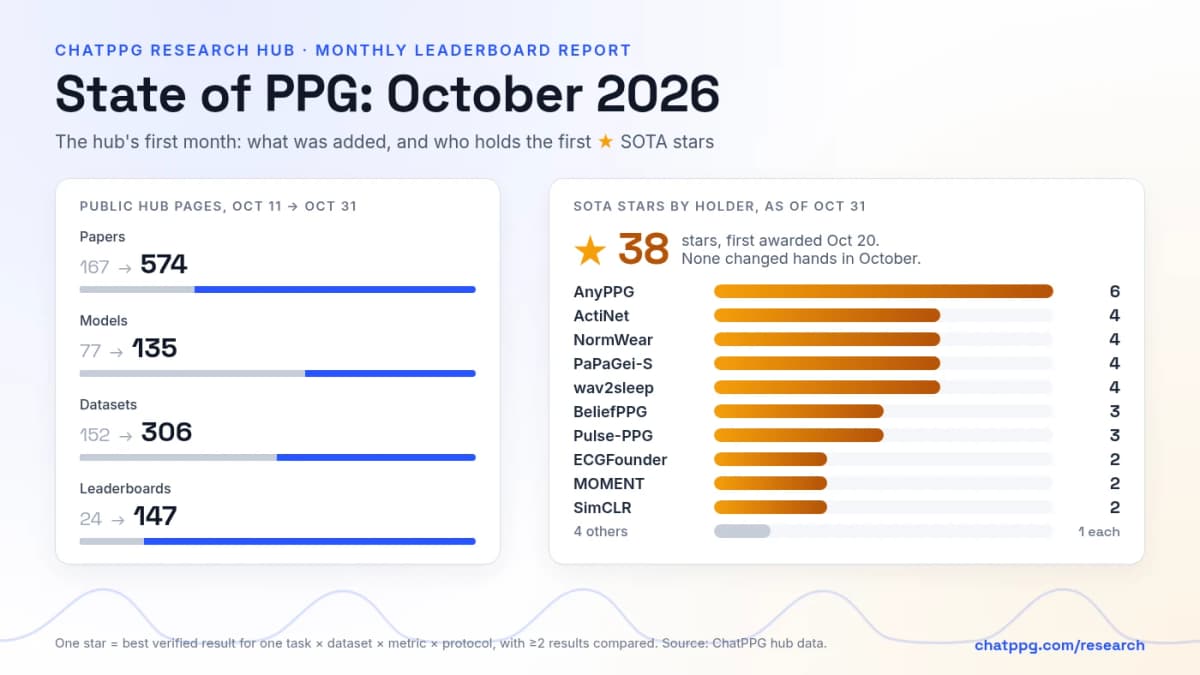
Short version: October was the hub's first month. The ChatPPG research hub went live on October 11 with 167 papers, 77 models, 152 datasets and 24 leaderboards. By October 31 it had 574 public paper pages, 135 models, 306 datasets and 147 leaderboards. On October 20 we started awarding SOTA stars, and by the end of the month 38 groups had one. AnyPPG holds the most, with six. No star changed hands, so treat this edition as the baseline that future months get measured against.
Every number below comes from the hub's results explorer, and each one points back to a table or section of its source paper. These are research benchmark results. They are not accuracy claims for any consumer device, and none of this is medical advice.
How a star is awarded
A star goes to the best verified result for one task, one dataset, one metric and one evaluation protocol. Protocol here means the split (subject-wise, leave-one-session-out, cross-dataset), how the model was evaluated (fine-tuned, linear probe on frozen embeddings, no fine-tuning) and the label set. A group needs at least two results under the same protocol before it is crowned, and ties go to the earlier paper.
The rule keeps a lot of results out. At the end of October, 39 more groups had only one reported result and stay uncrowned. It also means two numbers on the same dataset often can't be compared. PPG-DaLiA heart rate is the clearest example, and we come back to it below.
The month in numbers
Scroll horizontally if needed
| Hub data | Oct 11 | Oct 31 |
|---|---|---|
| Public paper pages | 167 | 574 |
| Models | 77 | 135 |
| Datasets | 152 | 306 |
| Leaderboards (task x dataset x metric) | 24 | 147 |
| Leaderboard rows | 35 | 264 |
| Key results with full protocol | 0 | 77 |
| SOTA stars | 0 | 38 |
Leaderboards grew fastest in four areas. Sleep apnea went from no boards to 42 (47 rows), activity recognition from 4 boards to 28 (4 rows to 58), cuffless blood pressure from 5 boards to 22 (5 rows to 32), and glucose estimation from none to 10 boards (58 rows). The leaderboards now span 13 tasks, up from 7 at launch. The single busiest board was heart rate MAE on PPG-DaLiA, which went from 6 rows to 14.
Leaderboard rows can mix protocols, which is why they show context instead of a crown. Stars only come from the protocol-matched key results.
Who holds the stars
Scroll horizontally if needed
| Holder | Stars | Where the results come from |
|---|---|---|
| AnyPPG | 6 | AnyPPG paper (Tables 3, 4); PPG-Bench (Table 1) |
| ActiNet | 4 | ActiNet paper (Tables 1, 2) |
| NormWear | 4 | NormWear paper (Table 2) |
| PaPaGei-S | 4 | PaPaGei paper (Tables 3, 4) |
| wav2sleep | 4 | wav2sleep paper (Tables 3, 5) |
| BeliefPPG | 3 | GPT-PPG paper (Table 2) |
| Pulse-PPG | 3 | Pulse-PPG paper (Table 6) |
| ECGFounder | 2 | ECGFounder paper (Table 2) |
| MOMENT | 2 | Pulse-PPG paper (Table 6); PPG-Bench (Table 1) |
| SimCLR | 2 | AnyPPG paper (Tables 3, 4) |
| GPT-PPG, PulseLM, SiamQuality, one ICASSP 2026 sleep model | 1 each | see below |
Headline results
AnyPPG: six stars, three of them from an outside benchmark
AnyPPG is an ECG-guided PPG foundation model trained on more than 100,000 hours of recordings, from Guangkun Nie, Shenda Hong and colleagues. Its own paper gives it three stars, all with a linear probe on frozen embeddings. On BUT PPG heart rate it reaches an MAE of 5.47 BPM against 7.05 for Chronos-2, out of six results (Table 3). The other two margins are small: PPG-DaLiA heart rate at 9.27 BPM against 9.37 for SimCLR (Table 3), and AF detection on DeepBeat with an AUROC of 0.69 against 0.68 for SimCLR (Table 4, seven results).
Its other three stars carry more weight. They come from PPG-Bench, an open benchmark from a separate group that compares five public PPG foundation models on nine datasets. The heart rate and WESAD numbers use subject-disjoint 5-fold cross-validation with 5 seeds and a linear probe. There, AnyPPG leads PPG-DaLiA heart rate at 7.39 BPM against 8.24 for MOMENT (seven results), WildPPG heart rate at 9.76 against 10.83 for Pulse-PPG (six results), and WESAD emotion classes at a balanced accuracy of .543 against .504 for MOMENT (Table 1). On the same benchmark, MOMENT beats it for heart rate on PPG-BP, 3.21 BPM against 3.31.
PaPaGei-S: four stars on the most crowded boards
The four PaPaGei stars, from Arvind Pillai, Dimitris Spathis and colleagues, each sit in a group with nine reported results, the most of any group in the hub. All four use a subject-level split and a linear probe (Tables 3 and 4). PaPaGei-S leads hypertension on PPG-BP at an AUROC of 0.77 against 0.76 for TF-C, ICU admission on VitalDB at 0.79 against 0.78 for BYOL, sleep-disordered breathing at 0.70 against 0.61 for SimCLR, and apnea-hypopnea index on MESA with an MAE of 12.97 events per hour against 13.85 for its sibling PaPaGei-P. Two of those leads are 0.01 AUROC, and the tables do not show whether a gap that size is larger than run-to-run noise.
BeliefPPG keeps three heart rate stars inside the GPT-PPG paper
The GPT-PPG paper compares its own fine-tuned models against earlier heart rate methods under leave-one-session-out evaluation with no quality filtering. In its Table 2, the 2023 BeliefPPG model has the lowest error on all three heart rate datasets: PPG-DaLiA at 3.57 BPM against 4.77 for GPT-PPG 1B, WESAD at 4.28 against 4.98, and IEEE SPC 2015 at 1.75 against 1.98. GPT-PPG 1B does hold one star from the same paper, AF detection on DeepBeat with an F1 of 0.847 against 0.841 for the 345M version (Table 1), and SiamQuality holds respiratory rate on BIDMC at 0.89 breaths per minute against 0.93 (Table 3).
Baselines that still lead
Two stars went to SimCLR, a 2020 self-supervised baseline, both from tables in the AnyPPG paper. On UCI-BP diastolic pressure SimCLR and AnyPPG tie at an MAE of 7.14 mmHg, and the tie goes to the earlier paper (Table 3). On WESAD emotion recognition SimCLR scores an AUROC of 0.77 against 0.76 for AnyPPG (Table 4). MOMENT, a general time-series model, holds two more: instantaneous heart rate on PPG-DaLiA in the Pulse-PPG paper by Mithun Saha, Santosh Kumar and colleagues (7.508 BPM against 8.170 for Chronos, Table 6) and PPG-BP heart rate in PPG-Bench. That fits PPG-Bench's own headline finding: in 83.8% of its 68 task and adaptation combinations, no PPG-specific model beat both simple pulse-rate-variability features and MOMENT.
Outside PPG: activity, sleep and ECG
ActiNet, an open-source wrist accelerometer classifier from Aidan Acquah, Shing Chan and Aiden Doherty, published in Scientific Reports on October 13, took four activity recognition stars. On CAPTURE-24 it reaches a Cohen's kappa of 0.860 against 0.800 for a random forest with HMM smoothing, and on external tests it scores a macro F1 of 0.661 on RealWorld and 0.741 on WISDM against 0.531 and 0.679 (Tables 1 and 2). Each of those boards has only two results so far.
NormWear, from Yunfei Luo and Tauhidur Rahman, leads its own 18-task benchmark with a macro AUROC of 84.381% against 81.230% for TF-C, plus WESAD stress, UCI-HAR and an ECG abnormality set (Table 2, linear probe). wav2sleep holds four sleep staging stars on MESA and SHHS, including a kappa of 0.742 on MESA with PPG as the only input at test time (Table 3). ECGFounder leads 12-lead AF detection on PTB-XL with an AUROC of 0.993 against 0.953 for CTN, tested without fine-tuning (Table 2).
Same dataset, four different answers
PPG-DaLiA now has four separate heart rate groups, each with its own star:
Scroll horizontally if needed
| Protocol | Best MAE | Holder | Source |
|---|---|---|---|
| Leave-one-session-out, fine-tuned | 3.57 BPM | BeliefPPG | GPT-PPG paper, Table 2 |
| Subject-disjoint 5-fold CV, linear probe | 7.39 BPM | AnyPPG | PPG-Bench, Table 1 |
| Subject-wise, linear probe, instantaneous HR | 7.508 BPM | MOMENT | Pulse-PPG paper, Table 6 |
| Paper-defined split, linear probe | 9.27 BPM | AnyPPG | AnyPPG paper, Table 3 |
The spread between 3.57 and 9.27 BPM comes mostly from how the models were trained and tested, not from one model being nearly three times better. A fine-tuned specialist and a frozen foundation model with a linear head are answering different questions, so the hub does not rank across these rows. The same applies to PPG-BP hypertension, where PaPaGei-S (0.77) and Pulse-PPG (0.7971) each hold a star under different protocols, and the two numbers should not be read as a head-to-head.
Caveats
- No star has been taken yet. Every holder listed here won its group when the group was first scored, so "38 new stars" means 38 first awards, not 38 new records.
- Many leads are tiny. In 11 of the 38 groups the holder beats the runner-up by less than 2% of the runner-up's value, and one (UCI-BP) is an exact tie. Few of these tables come with confidence intervals.
- Most stars, 27 of the 38, come from the paper that introduced the winning model. PPG-Bench, which benchmarks other groups' models, is the main independent source, which is why its three AnyPPG stars are worth more attention than the margins alone suggest.
- One star, a self-supervised PPG and accelerometer sleep staging model on DREAMT (kappa 0.30 against 0.06 for a fully supervised baseline), comes from an ICASSP 2026 abstract that does not state the split. Treat it as provisional.
What to watch in November
November is the first month where a star can move. The likeliest places are the boards that are already crowded and close: PPG-DaLiA and WildPPG heart rate in PPG-Bench, the PaPaGei boards with nine results each, and DeepBeat AF detection. Each star has a share card, for example AnyPPG on WildPPG or PaPaGei-S on MESA AHI, and an embeddable badge. If a result of yours is missing or misread, tell us through the about page and we will check it against the paper.
For background on the models themselves, see our guide to PPG foundation models and the full results explorer.
References
- Nie G, Fang X, Tang G, et al. AnyPPG: an ECG-guided PPG foundation model trained on over 100,000 hours of recordings for holistic health profiling. KDD 2026. arXiv:2511.01747
- Kulkarni A, Jain M, Mishra AR, Singh S, Panwar S. PPG-Bench: a unified benchmark for PPG foundation models. arXiv preprint, 2026. arXiv:2610.13435
- Pillai A, Spathis D, Kawsar F, Malekzadeh M. PaPaGei: open foundation models for optical physiological signals. arXiv preprint, 2024. arXiv:2410.20542
- Chen Z, Ding C, Kataria S, et al. GPT-PPG: a GPT-based foundation model for photoplethysmography signals. Physiological Measurement, 2025. arXiv:2503.08015
- Saha M, Xu MA, Mao W, et al. Pulse-PPG: an open-source field-trained PPG foundation model for wearable applications. Proc ACM IMWUT, 2025. arXiv:2502.01108
- Luo Y, Chen Y, Salekin A, Rahman T. NormWear: toward foundation model for multivariate wearable sensing of physiological signals. IMWUT/UbiComp 2025. arXiv:2412.09758
- Acquah A, Chan S, Doherty A. ActiNet: an open-source tool for activity intensity classification of wrist-worn accelerometry using self-supervised deep learning. Scientific Reports, 2026. arXiv:2510.01712
- Carter JF, Tarassenko L. wav2sleep: a unified multi-modal approach to sleep stage classification from physiological signals. ML4H 2024. arXiv:2411.04644
- Li J, Aguirre A, Moura J, et al. ECGFounder: an ECG foundation model built on 10+ million recordings. arXiv preprint, 2024. arXiv:2410.04133
- Pham HM, Wu J, Ma X, et al. PulseLM: a foundation dataset and benchmark for PPG-text learning. arXiv preprint, 2026. arXiv:2603.03331
- Lee J, Lee SA, Tanade C, et al. Multimodal self-supervised learning for wearable sleep staging using photoplethysmography and accelerometer signals. ICASSP 2026. doi:10.1109/ICASSP55912.2026.11462724
Frequently Asked Questions
- What is a SOTA star on ChatPPG?
- A star marks the best verified result for one task, dataset, metric and evaluation protocol in the research hub, for example heart rate MAE on PPG-DaLiA with a subject-disjoint split and a linear probe. A group needs at least two reported results under the same protocol before anyone gets a star. Ties go to the earlier publication.
- Did any SOTA star change hands in October 2026?
- No. Stars were first awarded on October 20, 2026, when 37 groups were crowned, and one more was added on October 21. None of the 38 moved to a new holder before the end of the month, so this edition is a baseline. November will be the first month where a star can actually be taken.
- Which model holds the most SOTA stars?
- AnyPPG, with six. Three come from its own paper (heart rate on BUT PPG and PPG-DaLiA, AF detection on DeepBeat) and three from the independent PPG-Bench benchmark (heart rate on PPG-DaLiA and WildPPG, emotion classes on WESAD). ActiNet, NormWear, PaPaGei-S and wav2sleep hold four each.
- Can I compare results across different PPG-DaLiA leaderboards?
- Not directly. The hub has four separate PPG-DaLiA heart rate groups because the papers use different splits and training setups. The best results run from 3.57 BPM with leave-one-session-out fine-tuning to 9.27 BPM with a linear probe on frozen embeddings. Those gaps mostly reflect protocol, so the hub only ranks results that share one.
Related articles
PPG Foundation Models: The Complete Guide to Every Pre-Trained Model for Photoplethysmography
PPG foundation models are large pretrained networks that learn reusable pulse-wave representations for heart rate, AF screening, blood pressure proxies, and related tasks. Compare PaPaGei, Pulse-PPG, GPT-PPG, AnyPPG, SiamQuality, and more.
Which Wearable Has the Most Accurate Heart Rate Monitor in 2026?
Comparing heart rate accuracy across Apple Watch, Garmin, Fitbit, Samsung, Polar, and Oura Ring. Based on independent clinical validation studies.
Best Heart Rate Monitor 2026: PPG Expert Picks for Every Use Case
Expert-selected best heart rate monitors for 2026 covering every use case from general wellness to clinical AFib detection. Includes PPG sensor analysis, accuracy comparisons, and recommendations for the Apple Watch Series 10, Garmin Forerunner 965, Oura Ring 4, WHOOP 5.0, Polar H10, Fitbit Charge 6, and Apple Watch Ultra 2.
Zone 2 Heart Rate: What It Is and How to Find Yours
Zone 2 heart rate is 60–70% of maximum in the five-zone model most watches use. Here is how to work out yours, why lab definitions differ, and what the research on easy training says.