PaperarXiv:2510.01712
ActiNet: an open-source tool for activity intensity classification of wrist-worn accelerometry using self-supervised deep learning

Scientific Reports (published 2026-10-13); preprint arXiv 2510.01712 (v1 2025-10-02, v2 2026-04-30)
 (opens in a new tab)
Acquah, Aidan et al., "ActiNet: An Open-Source Tool for Activity Intensity Classification of Wrist-Worn Accelerometry Using Self-Supervised Deep Learning", arXiv:2510.01712, CC BY 4.0
Key results4 SOTA
All results0.860
Cohen's κ ↑
Activity recognition · CAPTURE-24
ActiNet
4-class activity intensity · fine-tuned + HMM smoothing
Best comparison: Random forest + HMM (accelerometer package) 0.800
0.741
Macro F1 ↑
Activity recognition · WISDM
ActiNet
activity intensity · cross-dataset (trained on CAPTURE-24) · fine-tuned + HMM smoothing
Best comparison: Random forest + HMM (accelerometer package) 0.679
0.661
Macro F1 ↑
Activity recognition · RealWorld
ActiNet
4-class activity intensity · cross-dataset (trained on CAPTURE-24) · fine-tuned + HMM smoothing
Best comparison: Random forest + HMM (accelerometer package) 0.531
0.818
Macro F1 ↑
Activity recognition · CAPTURE-24
ActiNet
4-class activity intensity · fine-tuned + HMM smoothing
Best comparison: Random forest + HMM (accelerometer package) 0.764
Results as reported by the authors; not independently reproduced. A SOTA star marks the best value among results reported under the same evaluation protocol; ties go to the earlier publication.
Embed this badge (4 badges for READMEs and project pages)
 Markdown
[](https://chatppg.com/research/models/actinet#key-results)HTML<a href="https://chatppg.com/research/models/actinet#key-results"><img src="https://chatppg.com/research/badges/actinet--har-capture-24-cohen-kappa.svg" alt="SOTA on ChatPPG: Activity recognition · CAPTURE-24" height="20"></a> Markdown
[](https://chatppg.com/research/models/actinet#key-results)HTML<a href="https://chatppg.com/research/models/actinet#key-results"><img src="https://chatppg.com/research/badges/actinet--har-wisdm-macro-f1-har.svg" alt="SOTA on ChatPPG: Activity recognition · WISDM" height="20"></a> Markdown
[](https://chatppg.com/research/models/actinet#key-results)HTML<a href="https://chatppg.com/research/models/actinet#key-results"><img src="https://chatppg.com/research/badges/actinet--har-realworld-har-macro-f1-har.svg" alt="SOTA on ChatPPG: Activity recognition · RealWorld" height="20"></a> Markdown
[](https://chatppg.com/research/models/actinet#key-results)HTML<a href="https://chatppg.com/research/models/actinet#key-results"><img src="https://chatppg.com/research/badges/actinet--har-capture-24-macro-f1-har.svg" alt="SOTA on ChatPPG: Activity recognition · CAPTURE-24" height="20"></a>
TL;DR
The use of accurate and reliable open-source human activity recognition (HAR) models on passively collected wrist-accelerometer data is essential in large-scale epidemiological studies that investigate the association between physical activity and health outcomes. While self-supervised learning has generated considerable excitement in improving HAR, the extent to which these models, coupled with hidden Markov models (HMMs), would make a tangible improvement to classification performance and the effect this may have on the predicted daily activity intensity compositions is unknown. Using up to 24 h of wrist-worn accelerometer data from 151 CAPTURE-24 participants (aged 18–91, mean age 42, 66% female), the authors trained the ActiNet model, consisting of HARNet, a self-supervised, 18-layer, modified ResNet-V2 model, followed by hidden Markov model (HMM) smoothing, to classify labels of activity intensity.
- Result: Using up to 24 h of wrist-worn accelerometer data from 151 CAPTURE-24 participants (aged 18–91, mean age 42, 66% female), the authors trained the ActiNet model, consisting of HARNet, a self-supervised, 18-layer, modified ResNet-V2 model, followed by hidden…
- Result: The ActiNet model was able to distinguish labels of activity intensity with a mean macro F1 score of 0.82 and a mean Cohen’s kappa score of 0.86.
Abstract
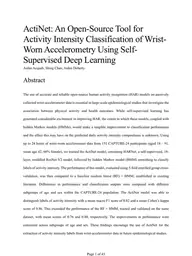
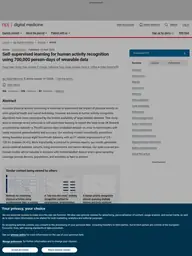
The use of accurate and reliable open-source human activity recognition (HAR) models on passively collected wrist-accelerometer data is essential in large-scale epidemiological studies that investigate the association between physical activity and health outcomes. While self-supervised learning has generated considerable excitement in improving HAR, the extent to which these models, coupled with hidden Markov models (HMMs), would make a tangible improvement to classification performance and the effect this may have on the predicted daily activity intensity compositions is unknown. Using up to 24 hours of wrist-worn accelerometer data from 151 CAPTURE-24 participants (aged 18 - 91, mean age 42, 66% female), we trained the ActiNet model, consisting HARNet, a self-supervised, 18-layer, modified ResNet-V2 model, followed by hidden Markov model (HMM) smoothing to classify labels of activity intensity. The performance of this model, evaluated using 5-fold stratified group cross-validation, was then compared to a baseline random forest (RF) + HMM, established in existing literature. Differences in performance and classification outputs were compared with different subgroups of age and sex within the CAPTURE-24 population. The ActiNet model was able to distinguish labels of activity intensity with a mean macro F1 score of 0.82 and a mean Cohen's kappa score of 0.86. This exceeded the performance of the RF + HMM, trained and validated on the same dataset, with mean scores of 0.76 and 0.80, respectively. The improvements in performance were consistent across subgroups of age and sex. These findings encourage the use of ActiNet for the extraction of activity intensity labels from wrist-accelerometer data in future epidemiological studies.
Verbatim from arXiv (opens in a new tab) · arXiv metadata (abstracts are released under CC0)
Results on ChatPPG leaderboards · 4
All leaderboards| Leaderboard | Method | Result | Rank |
|---|---|---|---|
| CAPTURE-24 Cohen's kappa (4-class activity intensity)Human activity recognition | ActiNet | 0.86Cohen's kappa, higher is better | #1 of 1 |
| CAPTURE-24 macro-F1 (4-class activity intensity)Human activity recognition | ActiNet | 0.818macro-F1, higher is better | #1 of 1 |
| RealWorld HAR macro-F1 (4-class activity intensity)Human activity recognition | ActiNet | 0.661macro-F1, higher is better | #1 of 1 |
| WISDM AR v1.1 macro-F1Human activity recognition | ActiNet | 0.741macro-F1, higher is better | #1 of 1 |
4 rows are credited to this paper. Ranks apply within each leaderboard only, as reported by the source.
Tasks & signals
Tasks
Signals
Devices
Keywords
Datasets used


Models
How it works
- Cohort
- 24 participants
Cite this paper
Acquah, A., Chan, S., & Doherty, A. (2026). ActiNet: an open-source tool for activity intensity classification of wrist-worn accelerometry using self-supervised deep learning. Scientific Reports. https://doi.org/10.1038/s41598-026-65900-y
Acquah, Aidan, Shing Chan, and Aiden Doherty. 2026. "ActiNet: an open-source tool for activity intensity classification of wrist-worn accelerometry using self-supervised deep learning." Scientific Reports. https://doi.org/10.1038/s41598-026-65900-y.
Acquah, A., Chan, S. and Doherty, A. (2026) 'ActiNet: an open-source tool for activity intensity classification of wrist-worn accelerometry using self-supervised deep learning', Scientific Reports. doi: 10.1038/s41598-026-65900-y.
Acquah, Aidan, et al. "ActiNet: an open-source tool for activity intensity classification of wrist-worn accelerometry using self-supervised deep learning." Scientific Reports, 2026. https://doi.org/10.1038/s41598-026-65900-y.
A. Acquah, S. Chan, and A. Doherty, "ActiNet: an open-source tool for activity intensity classification of wrist-worn accelerometry using self-supervised deep learning," Scientific Reports, 2026, doi: 10.1038/s41598-026-65900-y.
@article{acquah2026actinet,
  title         = {{ActiNet: an open-source tool for activity intensity classification of wrist-worn accelerometry using self-supervised deep learning}},
  author        = {Acquah, Aidan and Chan, Shing and Doherty, Aiden},
  year          = {2026},
  journal       = {Scientific Reports},
  doi           = {10.1038/s41598-026-65900-y},
  eprint        = {2510.01712},
  archivePrefix = {arXiv}
}Record updated
Added to the ChatPPG research hub