Li, Jun et al., "An Electrocardiogram Foundation Model Built on over 10 Million Recordings with External Evaluation across Multiple Domains", arXiv:2410.04133, CC BY 4.0
Activity counts measure attention, not model quality. Missing counts are unknown. Publication status follows the linked source; a listed venue alone does not confirm peer review.
ECGFounder is a general-purpose ECG foundation model from Jun Li, Aaron Aguirre, Junior Moura, Che Liu, Lanhai Zhong, Chenxi Sun, Gari Clifford, Brandon Westover and Shenda Hong, described in "An Electrocardiogram Foundation Model Built on over 10 Million Recordings with External Evaluation across Multiple Domains" (arXiv 2410.04133).
The authors point to three problems with earlier AI-ECG work: databases that were too small, weak generalization across domains, and a clear performance gap between single-lead and multi-lead analysis. ECGFounder addresses the first two with scale and expert labels. It was trained on over 10 million ECGs with 150 label categories from the Harvard-Emory ECG Database, using real-world annotations from cardiology experts. For the third, the model was extended to lower-lead ECGs, in particular arbitrary single-lead recordings, which makes it relevant to mobile and wearable monitoring.
ECGFounder is meant to work both out of the box and as a starting point for fine-tuning. On internal validation sets it reached expert-level performance, with AUROC exceeding 0.95 for eighty diagnoses, and it showed strong classification and generalization on external validation sets. After fine-tuning, it beat baseline models in demographic analysis, clinical event detection and cross-modality cardiac rhythm diagnosis.
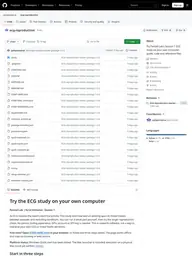
The code is on GitHub (PKUDigitalHealth/ECGFounder), and since March 2025 the pre-training checkpoint has been available on Hugging Face under the MIT license. The README warns that you must follow the preprocessing in dataset.py, including filtering and z-score normalization, if you use the pretrained weights. Downstream examples in the repository use PTB-XL and MIMIC-ECG from PhysioNet.
For PPG researchers, ECGFounder matters mostly as a teacher or partner model. It comes from the same PKUDigitalHealth GitHub organization as AnyPPG, which uses ECG guidance to pre-train a PPG model, and its single-lead support is the closest ECG setting to what a smartwatch records.
Signals
ECG
Internal validation
AUROC above 0.95 for eighty diagnoses
Weights
Hugging Face PKUDigitalHealth/ECGFounder (MIT)
Code
github.com/PKUDigitalHealth/ECGFounder
Year
2024
Paper
An Electrocardiogram Foundation Model Built on over 10 Million Recordings with External Evaluation across Multiple Domains (Li et al.), arXiv 2410.04133
Training data
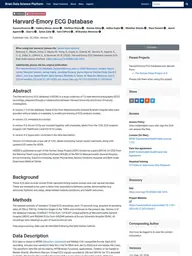
over 10 million ECGs, 150 label categories, Harvard-Emory ECG Database
AF, single-lead · cross-dataset · pretrained classifier
Results as reported by the authors; not independently reproduced. A SOTA star marks the best value among results reported under the same evaluation protocol; ties go to the earlier publication.
Embed this badge (2 badges for READMEs and project pages)
Markdown
[](https://chatppg.com/research/models/ecgfounder#key-results)
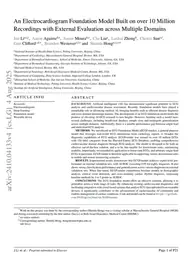
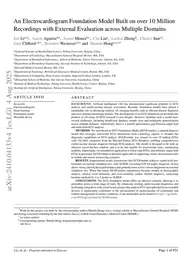
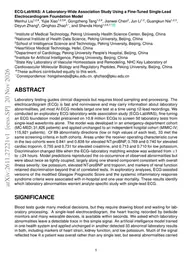
Artificial intelligence (AI) has demonstrated significant potential in ECG analysis and cardiovascular disease assessment. Recently, foundation models have played a remarkable role in advancing medical AI. The development of an ECG foundation model holds the promise of elevating AI-ECG research to new heights. However, building such a model faces several challenges, including insufficient database sample sizes and inadequate generalization across multiple domains. Additionally, there is a notable performance gap between single-lead and multi-lead ECG analyses. We introduced an ECG Foundation Model (ECGFounder), a general-purpose model that leverages real-world ECG annotations from cardiology experts to broaden the diagnostic capabilities of ECG analysis. ECGFounder was trained on over 10 million ECGs with 150 label categories from the Harvard-Emory ECG Database, enabling comprehensive cardiovascular disease diagnosis through ECG analysis. The model is designed to be both an effective out-of-the-box solution, and a to be fine-tunable for downstream tasks, maximizing usability. Importantly, we extended its application to lower rank ECGs, and arbitrary single-lead ECGs in particular. ECGFounder is applicable to supporting various downstream tasks in mobile monitoring scenarios. Experimental results demonstrate that ECGFounder achieves expert-level performance on internal validation sets, with AUROC exceeding 0.95 for eighty diagnoses. It also shows strong classification performance and generalization across various diagnoses on external validation sets. When fine-tuned, ECGFounder outperforms baseline models in demographic analysis, clinical event detection, and cross-modality cardiac rhythm diagnosis. The trained model and data will be publicly released upon publication through the bdsp.io. Our code is available at https://github.com/PKUDigitalHealth/ECGFounder
Verbatim fromarXiv· arXiv metadata (abstracts are released under CC0)
ECGFounder is an ECG foundation model trained on over 10 million ECGs with 150 expert label categories from the Harvard-Emory ECG Database. It supports 12-lead and single-lead input.
How do I download ECGFounder?
The checkpoint is at https://huggingface.co/PKUDigitalHealth/ECGFounder under the MIT license; the code is at https://github.com/PKUDigitalHealth/ECGFounder.
ECGFounder vs ECG-FM?
ECGFounder is trained with supervised expert labels on over 10 million ECGs. ECG-FM is a transformer pretrained with a hybrid contrastive and generative self-supervised approach on 1.5 million ECGs. Both release weights under MIT.
What are ECGFounder's benchmark results?
It reached AUROC above 0.95 for eighty diagnoses on internal validation, generalized well on external sets, and beat baselines after fine-tuning on demographic analysis, clinical event detection and cross-modality rhythm diagnosis.
Cite this model
Cite the publication recorded for this model. Check it against the publisher before submitting.
Li, J., Aguirre, A., Moura, J., Liu, C., Zhong, L., Sun, C., Clifford, G., Westover, B., & Hong, S. (2024). An Electrocardiogram Foundation Model Built on over 10 Million Recordings with External Evaluation across Multiple Domains. NEJM AI 2025. https://doi.org/10.48550/ARXIV.2410.04133
Li, Jun, Aaron Aguirre, Junior Moura, Che Liu, Lanhai Zhong, Chenxi Sun, Gari Clifford, Brandon Westover, and Shenda Hong. 2024. "An Electrocardiogram Foundation Model Built on over 10 Million Recordings with External Evaluation across Multiple Domains." NEJM AI 2025. https://doi.org/10.48550/ARXIV.2410.04133.
Li, J., Aguirre, A., Moura, J., Liu, C., Zhong, L., Sun, C., Clifford, G., Westover, B. and Hong, S. (2024) 'An Electrocardiogram Foundation Model Built on over 10 Million Recordings with External Evaluation across Multiple Domains', NEJM AI 2025. doi: 10.48550/ARXIV.2410.04133.
Li, Jun, et al. "An Electrocardiogram Foundation Model Built on over 10 Million Recordings with External Evaluation across Multiple Domains." NEJM AI 2025, 2024. https://doi.org/10.48550/ARXIV.2410.04133.
J. Li et al., "An Electrocardiogram Foundation Model Built on over 10 Million Recordings with External Evaluation across Multiple Domains," NEJM AI 2025, 2024, doi: 10.48550/ARXIV.2410.04133.
@misc{li2024electrocardiogram,
  title         = {{An Electrocardiogram Foundation Model Built on over 10 Million Recordings with External Evaluation across Multiple Domains}},
  author        = {Li, Jun and Aguirre, Aaron and Moura, Junior and Liu, Che and Zhong, Lanhai and Sun, Chenxi and Clifford, Gari and Westover, Brandon and Hong, Shenda},
  year          = {2024},
  howpublished  = {NEJM AI 2025},
  publisher     = {arXiv},
  doi           = {10.48550/ARXIV.2410.04133},
  eprint        = {2410.04133},
  archivePrefix = {arXiv}
}
History
Record updated
Added to the ChatPPG research hub
Newsletter
Get new PPG datasets, papers and models
Get alerts when ECGFounder is benchmarked on new datasets, plus the weekly digest.
New datasets, papers and models
Practical guides from the hub
Unsubscribe anytime
The waveform is an illustration of a PPG pulse, not a recording.