Paperdoi:10.3390/s20113127
Estimating Blood Pressure from the Photoplethysmogram Signal and Demographic Features Using Machine Learning Techniques
Sensors 20(11):3127
 (opens in a new tab)
Moajjem Hossain Chowdhury et al., "Estimating Blood Pressure from the Photoplethysmogram Signal and Demographic Features Using Machine Learning Techniques", doi:10.3390/s20113127, CC BY 4.0
TL;DR
PPG-BP (Guilin) public set (ppgbp-guilin): 657 finger PPG signals from 219 subjects, 1 kHz, 2.1 s each. After signal-quality screening: 222 signals from 126 subjects.
- Result: Gaussian process regression (GPR) along with the ReliefF feature selection algorithm outperforms other algorithms in estimating SBP and DBP with a root mean square error (RMSE) of 6.74 and 3.59, respectively.
Abstract
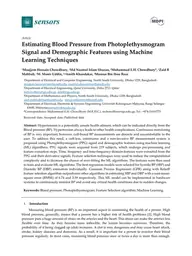
Hypertension is a potentially unsafe health ailment, which can be indicated directly from the blood pressure (BP). Hypertension always leads to other health complications. Continuous monitoring of BP is very important; however, cuff-based BP measurements are discrete and uncomfortable to the user. To address this need, a cuff-less, continuous, and noninvasive BP measurement system is proposed using the photoplethysmograph (PPG) signal and demographic features using machine learning (ML) algorithms. PPG signals were acquired from 219 subjects, which undergo preprocessing and feature extraction steps. Time, frequency, and time-frequency domain features were extracted from the PPG and their derivative signals. Feature selection techniques were used to reduce the computational complexity and to decrease the chance of over-fitting the ML algorithms. The features were then used to train and evaluate ML algorithms. The best regression models were selected for systolic BP (SBP) and diastolic BP (DBP) estimation individually. Gaussian process regression (GPR) along with the ReliefF feature selection algorithm outperforms other algorithms in estimating SBP and DBP with a root mean square error (RMSE) of 6.74 and 3.59, respectively. This ML model can be implemented in hardware systems to continuously monitor BP and avoid any critical health conditions due to sudden changes.
Verbatim from the publisher's DOI record (opens in a new tab) · Publisher licence: https://creativecommons.org/licenses/by/4.0/
Results on ChatPPG leaderboards · 1
All leaderboards| Leaderboard | Method | Result | Rank |
|---|---|---|---|
| Guilin / Liang 2018 MAE (mmHg)Cuffless blood pressure estimation | Chowdhury GPR + ReliefF | 3.02MAE (mmHg), lower is better | #1 of 4 |
1 row is credited to this paper. Ranks apply within each leaderboard only, as reported by the source.
Tasks & signals
Tasks
Signals
Keywords
Datasets used

How it works
- Cohort
- 219 subjects
Cite this paper
Chowdhury, M. H., Shuzan, M. N. I., Chowdhury, M. E., Mahbub, Z. B., Uddin, M. M., Khandakar, A., & Reaz, M. B. I. (2020). Estimating Blood Pressure from the Photoplethysmogram Signal and Demographic Features Using Machine Learning Techniques. Sensors, 20(11), 3127. https://doi.org/10.3390/s20113127
Chowdhury, Moajjem Hossain, Md Nazmul Islam Shuzan, Muhammad E.H. Chowdhury, Zaid B. Mahbub, M. Monir Uddin, Amith Khandakar, and Mamun Bin Ibne Reaz. 2020. "Estimating Blood Pressure from the Photoplethysmogram Signal and Demographic Features Using Machine Learning Techniques." Sensors 20 (11): 3127. https://doi.org/10.3390/s20113127.
Chowdhury, M. H., Shuzan, M. N. I., Chowdhury, M. E., Mahbub, Z. B., Uddin, M. M., Khandakar, A. and Reaz, M. B. I. (2020) 'Estimating Blood Pressure from the Photoplethysmogram Signal and Demographic Features Using Machine Learning Techniques', Sensors, 20(11), p. 3127. doi: 10.3390/s20113127.
Chowdhury, Moajjem Hossain, et al. "Estimating Blood Pressure from the Photoplethysmogram Signal and Demographic Features Using Machine Learning Techniques." Sensors, vol. 20, no. 11, 2020, p. 3127. https://doi.org/10.3390/s20113127.
M. H. Chowdhury et al., "Estimating Blood Pressure from the Photoplethysmogram Signal and Demographic Features Using Machine Learning Techniques," Sensors, vol. 20, no. 11, p. 3127, 2020, doi: 10.3390/s20113127.
@article{chowdhury2020estimating,
  title         = {{Estimating Blood Pressure from the Photoplethysmogram Signal and Demographic Features Using Machine Learning Techniques}},
  author        = {Chowdhury, Moajjem Hossain and Shuzan, Md Nazmul Islam and Chowdhury, Muhammad E.H. and Mahbub, Zaid B. and Uddin, M. Monir and Khandakar, Amith and Reaz, Mamun Bin Ibne},
  year          = {2020},
  journal       = {Sensors},
  volume        = {20},
  number        = {11},
  pages         = {3127},
  doi           = {10.3390/s20113127}
}Added to the ChatPPG research hub