PaperarXiv:2408.08488
PITN: Physics-Informed Temporal Networks for Cuffless Blood Pressure Estimation
arXiv preprint (cs.LG, cs.AI, eess.SP) · 12 pages, 6 figures
TL;DR
Monitoring blood pressure with non-invasive sensors has gained popularity for providing comfortable user experiences, one of which is a significant function of smart wearables. Although providing a comfortable user experience, such methods are suffering from the demand for a significant amount of realistic data to train an individual model for each subject, especially considering the invasive or obtrusive BP ground-truth measurements.
- Form factor: lab
Abstract
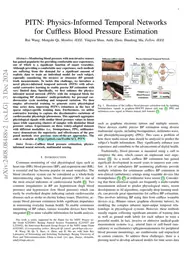
Monitoring blood pressure with non-invasive sensors has gained popularity for providing comfortable user experiences, one of which is a significant function of smart wearables. Although providing a comfortable user experience, such methods are suffering from the demand for a significant amount of realistic data to train an individual model for each subject, especially considering the invasive or obtrusive BP ground-truth measurements. To tackle this challenge, we introduce a novel physics-informed temporal network~(PITN) with adversarial contrastive learning to enable precise BP estimation with very limited data. Specifically, we first enhance the physics-informed neural network~(PINN) with the temporal block for investigating BP dynamics' multi-periodicity for personal cardiovascular cycle modeling and temporal variation. We then employ adversarial training to generate extra physiological time series data, improving PITN's robustness in the face of sparse subject-specific training data. Furthermore, we utilize contrastive learning to capture the discriminative variations of cardiovascular physiologic phenomena. This approach aggregates physiological signals with similar blood pressure values in latent space while separating clusters of samples with dissimilar blood pressure values. Experiments on three widely-adopted datasets with different modailties (i.e., bioimpedance, PPG, millimeter-wave) demonstrate the superiority and effectiveness of the proposed methods over previous state-of-the-art approaches. The code is available at~https://github.com/Zest86/ACL-PITN.
Verbatim from arXiv (opens in a new tab) · arXiv metadata (abstracts are released under CC0)
Results on ChatPPG leaderboards
All leaderboardsNo results from this paper on ChatPPG leaderboards yet. Browse the leaderboards.
Tasks & signals
Tasks
Signals
Keywords
How it works
Cite this paper
APA
Wang, R., Qi, M., Shao, Y., Zhou, A., & Ma, H. (2024). PITN: Physics-Informed Temporal Networks for Cuffless Blood Pressure Estimation. arXiv preprint · 12 pages, 6 figures. https://doi.org/10.48550/arXiv.2408.08488
BibTeX
@misc{wang2024pitn,
  title         = {{PITN: Physics-Informed Temporal Networks for Cuffless Blood Pressure Estimation}},
  author        = {Wang, Rui and Qi, Mengshi and Shao, Yingxia and Zhou, Anfu and Ma, Huadong},
  year          = {2024},
  howpublished  = {arXiv preprint · 12 pages, 6 figures},
  doi           = {10.48550/arXiv.2408.08488},
  eprint        = {2408.08488},
  archivePrefix = {arXiv}
}
Built from the hub record. Check it against the publisher before submitting.
Added to the ChatPPG research hub