Fitbit Heart Rate Accuracy: What Validation Studies and Real-World Data Show
How accurate is Fitbit heart rate? We review validation studies across Charge 6, Sense 2, Versa 4, and Inspire 3, plus factors like skin tone, fit, and exercise type.
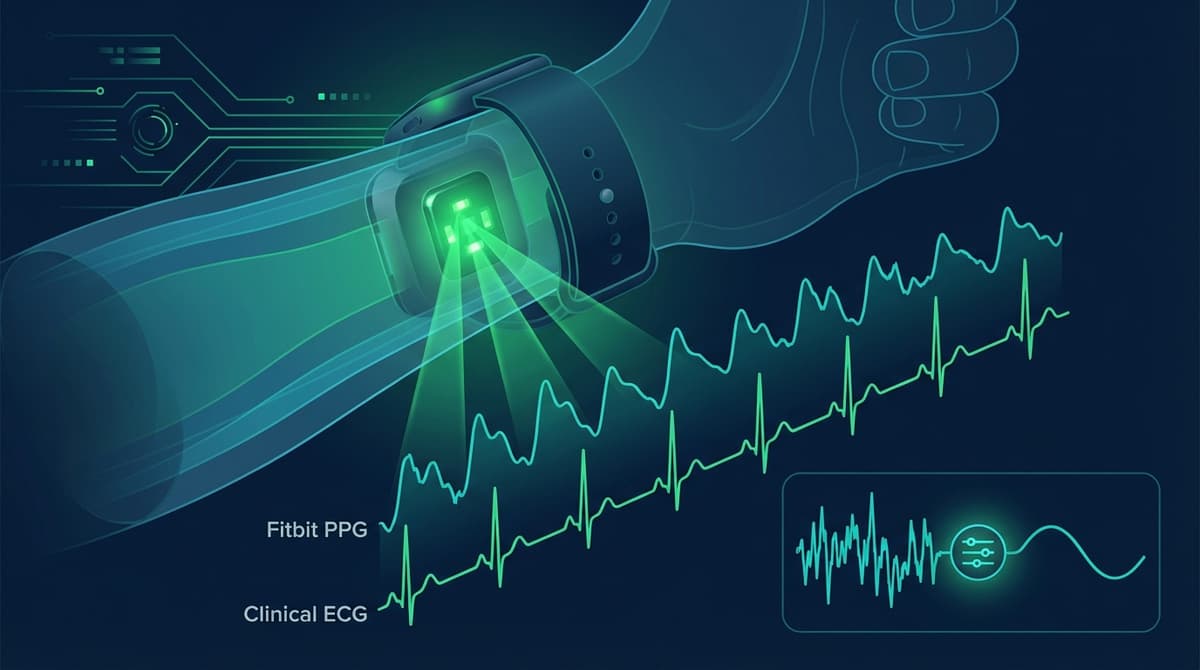
Fitbit heart rate accuracy is generally within 2 to 5 bpm of an ECG reference at rest, placing it in the same range as other mainstream wrist-worn wearables. During exercise, accuracy drops considerably, with mean absolute errors reaching 10 to 20 bpm during high-intensity workouts. The specifics depend on which Fitbit model you use, what activity you are doing, how the band fits, and your skin characteristics.
This article breaks down what independent validation studies show across current Fitbit models, how the PurePulse optical sensor technology works, where it performs well, and where the numbers fall short.
How Does Fitbit Measure Heart Rate?
Fitbit uses photoplethysmography (PPG) to measure heart rate. The sensor on the back of the device shines green LED light into the skin and measures how much light is reflected back to the photodetector. Because oxygenated blood absorbs green light differently than surrounding tissue, the sensor can detect volumetric changes in blood flow with each heartbeat. The time between pulsations gives the heart rate.
Fitbit calls its implementation PurePulse. The original version used a single green LED pair. More recent models, including the Charge 5, Charge 6, and Sense 2, use an upgraded multi-path optical sensor array with additional photodetectors and, in some cases, red and infrared LEDs. These additional wavelengths can improve signal quality under conditions where green light alone struggles, such as low perfusion or darker skin tones.
For a deeper look at how PPG sensors extract heart rate across different wearable platforms, see our guide to PPG heart rate accuracy.
The accelerometer plays an equally important role. Wrist motion creates noise in the optical signal that overlaps with the cardiac frequency range. Fitbit pairs its optical data with three-axis accelerometer readings to separate motion artifact from the true pulse signal. This is the same general approach all major wrist-worn devices use, though the specific algorithms and their effectiveness vary by manufacturer and generation.
Fitbit Heart Rate Accuracy at Rest
Resting heart rate is where Fitbit performs best. The wrist is relatively still, the PPG signal is clean, and the algorithms have an easy job isolating the cardiac component.
Nelson and Allen (2019) conducted a 24-hour ecologically valid comparison of consumer wearables against a chest-worn ECG reference in free-living conditions. The Fitbit Charge 2 showed a mean absolute error of approximately 5.9 bpm overall, but resting periods were considerably more accurate, with errors closer to 2 to 4 bpm. This is consistent with what other research groups have reported.
Shah et al. (2020) tested Fitbit Sense against Holter ECG in 100 participants at rest and found a mean absolute error of 2.7 bpm, with no significant differences across age or sex groups. The limits of agreement (Bland-Altman) were approximately plus or minus 8 bpm, meaning most individual readings fell within that range.
For resting measurements, Fitbit heart rate accuracy is clinically acceptable for wellness monitoring purposes. It is reliable enough for tracking resting heart rate trends over days and weeks, identifying overnight heart rate patterns, and detecting obvious resting tachycardia. It is not a substitute for medical-grade monitoring in patients with known cardiac conditions. Our comparison of clinical-grade vs consumer wearables explains why that distinction matters.
How Accurate Is Fitbit Heart Rate During Exercise?
Exercise accuracy is where Fitbit, like all wrist-worn PPG devices, runs into real limitations. The numbers get worse as intensity and arm movement increase.
Moderate Steady-State Exercise
During activities like cycling, elliptical training, and brisk walking, Fitbit devices generally maintain reasonable accuracy. Mean absolute errors of 5 to 10 bpm are typical. Cycling tends to produce the best results because the wrist is relatively stable on the handlebars and the motion frequency is distinct from the cardiac frequency.
Running
Running is harder. Foot strike and arm swing generate motion artifacts at frequencies that overlap with exercise heart rates (cadence of 160 to 200 steps per minute translates to 80 to 100 Hz arm swing, right in the zone of typical exercise heart rates). Shcherbina et al. (2017) tested multiple wearables during treadmill running and found MAE values ranging from 4.6 to 34.8 bpm across devices. Fitbit devices in their study sat in the middle of the pack.
High-Intensity Interval Training
HIIT creates the worst conditions for wrist PPG. Heart rate changes rapidly, arm movement is vigorous and irregular, and the sensor may shift on the wrist during explosive movements. Errors of 15 to 25 bpm are not unusual. Peak heart rate detection is especially unreliable during sprint intervals because the algorithm's update rate cannot keep pace with actual physiological changes.
Strength Training
Weight lifting presents unique challenges. Grip pressure changes blood flow to the wrist, and forearm muscle contractions create venous pooling that distorts the PPG signal. Fitbit accuracy during resistance exercises has not been extensively validated in peer-reviewed literature, but anecdotal reports and small studies suggest errors can be large and inconsistent.
For a broader look at how PPG accuracy changes during different types of exercise and recovery, see our exercise recovery monitoring guide.
Fitbit Heart Rate Accuracy by Model
Not all Fitbit devices are equal. Hardware generations differ in sensor configuration, algorithm maturity, and form factor.
Charge 5 and Charge 6
The Charge series has consistently been Fitbit's most accurate heart rate tracker in independent comparisons. The slim band form factor allows tighter, more consistent wrist contact than bulkier smartwatches. The Charge 6, released in 2023, added a multi-path optical sensor similar to what Google uses in the Pixel Watch 2. Early independent tests suggest it performs on par with or slightly better than the Apple Watch Series 9 during moderate exercise.
Sense 2
The Sense 2 has the most advanced sensor suite in the Fitbit lineup, including a multi-path PPG sensor, an on-wrist EDA sensor, and a skin temperature sensor. For heart rate specifically, the larger device footprint means the optical sensor has more surface contact area. Accuracy at rest is excellent. During exercise, it performs comparably to the Charge 5 in most published comparisons.
Versa 4
The Versa 4 uses a slightly older optical sensor configuration than the Sense 2. It is adequate for resting heart rate and moderate exercise but tends to show larger errors during vigorous activity compared to the Charge 6 or Sense 2.
Inspire 3
The Inspire 3 is the entry-level Fitbit tracker. Its smaller sensor and narrower band make consistent skin contact harder to maintain. Accuracy at rest is still acceptable (3 to 6 bpm MAE), but it falls behind the Charge and Sense lines during exercise.
How Does Fitbit Compare to Chest Straps?
Chest strap heart rate monitors like the Polar H10 or Garmin HRM-Pro use ECG-based detection, measuring the electrical impulse of the heart through electrodes pressed against the skin. This is fundamentally different from optical PPG and significantly more accurate during exercise.
Chest straps typically achieve mean absolute errors under 2 bpm across all activity types. They are largely immune to the motion artifact problems that plague wrist PPG. The tradeoff is comfort: most people will not wear a chest strap 24 hours a day, and they can chafe during long sessions.
For serious training where accurate heart rate zones matter, a chest strap paired with a Fitbit (via Bluetooth) is the best combination. You get the lifestyle tracking and sleep monitoring from the wrist sensor plus exercise-grade accuracy from the chest.
Factors That Affect Fitbit Heart Rate Accuracy
Band Fit and Sensor Contact
A loose band is the single most common cause of inaccurate Fitbit heart rate readings. The sensor must maintain consistent contact with the skin to get a clean optical signal. Fitbit recommends wearing the device one to two finger-widths above the wrist bone, snug enough that it does not slide but not so tight it restricts circulation.
During exercise, Fitbit suggests moving the band slightly higher on the wrist and tightening it one notch. This reduces the chance of the sensor bouncing against the skin during arm movement.
Skin Tone and Melanin
This is one of the most important accuracy factors and one that the wearable industry has been slow to address transparently. Green LED PPG sensors are more affected by melanin content in the skin than red or infrared wavelengths. Higher melanin absorbs more green light before it reaches the blood vessels, reducing the signal-to-noise ratio of the cardiac pulsation.
Bent et al. (2020) directly investigated this in a study published in npj Digital Medicine. They found that wrist-worn optical heart rate sensors, including Fitbit, showed higher error rates in individuals with darker skin tones. The effect was most pronounced during exercise, where the already-reduced signal had to compete with motion artifact.
Fitbit's newer multi-wavelength sensors (green plus red plus infrared) partially mitigate this problem, but they do not eliminate it. For a detailed review of how skin tone affects PPG across devices, see our analysis of PPG skin tone bias.
Tattoos
Tattoos under the sensor area can significantly affect Fitbit heart rate accuracy. Dark ink absorbs the green LED light, reducing or eliminating the pulsatile signal the sensor depends on. Black and dark blue tattoos have the largest effect. Some users with wrist tattoos report that their Fitbit cannot detect heart rate at all, while others see wildly erratic readings.
The practical solution is to wear the device on a non-tattooed part of the wrist, or on the other arm entirely.
Cold Temperatures and Vasoconstriction
Cold environments cause peripheral vasoconstriction, reducing blood flow to the wrist and shrinking the PPG signal amplitude. Winter outdoor exercise is a common scenario where Fitbit accuracy suffers. The combination of cold, exercise motion, and reduced perfusion can push errors well beyond typical ranges.
Wrist Hair
Dense wrist hair can create small air gaps between the sensor and skin, scattering the optical signal. This is a minor factor for most people but can be meaningful for some individuals.
The 2023 Fitbit Heart Rate Accuracy Lawsuit
In 2023, Fitbit (by then owned by Google) settled a class action lawsuit that had been working through the courts since 2016. The original complaint alleged that Fitbit PurePulse technology was "dangerously inaccurate" during exercise, with some plaintiffs reporting heart rate readings that were 20 to 40 bpm lower than actual values during high-intensity workouts.
The lawsuit centered on older devices, primarily the Charge HR, Surge, and Blaze models that used the original PurePulse single-LED sensor. Plaintiffs argued that Fitbit marketed these devices as accurate heart rate monitors while knowing the technology had significant limitations during exercise.
Fitbit settled without admitting wrongdoing. The settlement offered affected users a partial refund or account credit. From a technical standpoint, the core claim was not unreasonable. Early wrist PPG algorithms from all manufacturers were significantly worse at exercise heart rate than current versions, and Fitbit's marketing at the time did not clearly communicate the exercise accuracy limitations.
The lawsuit did push the industry toward more conservative heart rate accuracy claims and more prominent disclaimers about exercise limitations.
Is Fitbit Heart Rate Accurate Enough for HRV?
Heart rate variability (HRV) requires more precise timing than average heart rate. Instead of just counting beats per minute, HRV algorithms need to resolve the time between individual beats with millisecond precision. PPG-derived HRV introduces additional uncertainty because the pulse wave at the wrist arrives 150 to 300 ms after the electrical event in the heart (the electromechanical delay), and this delay varies beat to beat.
Fitbit reports HRV during sleep, when motion artifact is minimal and the signal is cleanest. In this context, Fitbit HRV measurements correlate reasonably well with ECG-derived HRV for tracking trends over time. They are not interchangeable with clinical HRV measurements for absolute values.
For more detail on how wearable PPG HRV compares to clinical standards, see our HRV wearable guide.
How to Get the Most Accurate Heart Rate from Your Fitbit
A few practical steps can meaningfully improve your readings:
- Wear it snugly, one to two finger-widths above the wrist bone. Not over the bone itself, where tendons create optical interference.
- Tighten the band during exercise and move it slightly higher on the forearm.
- Keep the sensor clean. Sweat residue and skin oils can build up on the optical window, scattering light.
- Pair with a chest strap for serious training. Fitbit devices can receive Bluetooth heart rate from external sensors, giving you the best of both worlds.
- Watch for firmware updates. Fitbit regularly pushes algorithm improvements that can meaningfully change accuracy without any hardware changes.
- Avoid wearing over tattoos. If you have wrist tattoos, try the other wrist or a different sensor location.
The Bottom Line on Fitbit Heart Rate Accuracy
Fitbit heart rate accuracy is solid for what most people use it for: tracking resting heart rate trends, monitoring sleep heart rate, and getting a general sense of exercise intensity. At rest, it matches the performance of Apple Watch, Garmin, and Samsung devices. During exercise, it shares the same fundamental limitations as all wrist-worn PPG, with accuracy degrading as intensity and arm movement increase.
Where Fitbit falls short is in transparency. The marketing has historically overstated exercise accuracy, and the company was slow to communicate known limitations around skin tone, tattoos, and high-intensity activity. The newer Charge 6 and Sense 2 represent genuine improvements in sensor hardware, but the physics of wrist PPG still impose hard limits that no algorithm update can fully overcome.
For clinical or training purposes that demand accurate heart rate data during vigorous exercise, a chest strap remains the better tool. For continuous 24/7 wellness monitoring with reasonable accuracy at rest and during moderate activity, current Fitbit devices do the job well.
Frequently Asked Questions
How accurate is the Fitbit heart rate monitor at rest?
Within 2 to 5 bpm of ECG, comparable to Apple Watch and other major wrist-worn wearables. The Charge 6 and Sense 2 perform best.
Is Fitbit heart rate accurate during exercise?
Moderate steady-state activities show 5 to 10 bpm error. Running and HIIT produce 10 to 20 bpm errors. Peak heart rate detection during sprints is unreliable.
Does skin tone affect Fitbit heart rate accuracy?
Yes. Green LED sensors show higher error rates on darker skin tones due to melanin absorption. Multi-wavelength sensors in newer models reduce but do not eliminate this gap (Bent et al., 2020).
Can tattoos affect Fitbit heart rate readings?
Dark tattoos under the sensor block or scatter the optical signal, causing missing or erratic readings. Moving the device to a non-tattooed area is the simplest fix.
How does Fitbit compare to a chest strap for heart rate?
Chest straps using ECG electrodes are more accurate in all conditions, with typical error under 2 bpm. They lack all-day comfort and lifestyle tracking features.
What was the Fitbit heart rate accuracy lawsuit about?
A class action filed in 2016 and settled in 2023 alleged PurePulse devices were inaccurate during exercise by 20 to 40 bpm. It targeted older models (Charge HR, Surge, Blaze). Fitbit settled without admitting fault.
Which Fitbit model has the best heart rate accuracy?
The Charge 6 and Sense 2, thanks to multi-path optical sensors and better motion compensation. The Charge 6 benefits from a slim form factor that maintains good skin contact.
Frequently Asked Questions
- How accurate is the Fitbit heart rate monitor at rest?
- At rest, Fitbit devices typically measure heart rate within 2 to 5 bpm of an ECG reference, which is comparable to other major wrist-worn wearables.
- Is Fitbit heart rate accurate during exercise?
- During moderate steady-state exercise, Fitbit accuracy is reasonable at 5 to 10 bpm error, but during high-intensity or interval training, errors of 10 to 20 bpm are common.
- Does skin tone affect Fitbit heart rate accuracy?
- Yes. Green LED PPG sensors, which Fitbit relies on heavily, show reduced accuracy on darker skin tones due to higher melanin absorption of green light wavelengths.
- Can tattoos affect Fitbit heart rate readings?
- Yes. Dark or densely colored tattoos under the sensor can block or scatter the optical signal, leading to intermittent or inaccurate heart rate readings.
- How does Fitbit compare to a chest strap for heart rate?
- Chest straps using ECG electrodes are consistently more accurate than Fitbit wrist PPG, especially during vigorous exercise, with typical errors under 2 bpm.
- What was the Fitbit heart rate accuracy lawsuit about?
- A class action lawsuit alleged Fitbit PurePulse devices significantly underreported heart rate during exercise, sometimes by 20 bpm or more. Fitbit settled the case in 2023.
- Which Fitbit model has the best heart rate accuracy?
- The Charge 6 and Sense 2 tend to perform best in independent tests, likely due to improved multi-LED sensor arrays and tighter wrist contact.