WavesFM
hierarchical longitudinal FM for raw wearable PPG + accelerometer waveforms
Activity counts measure attention, not model quality. Missing counts are unknown. Publication status follows the linked source; a listed venue alone does not confirm peer review.
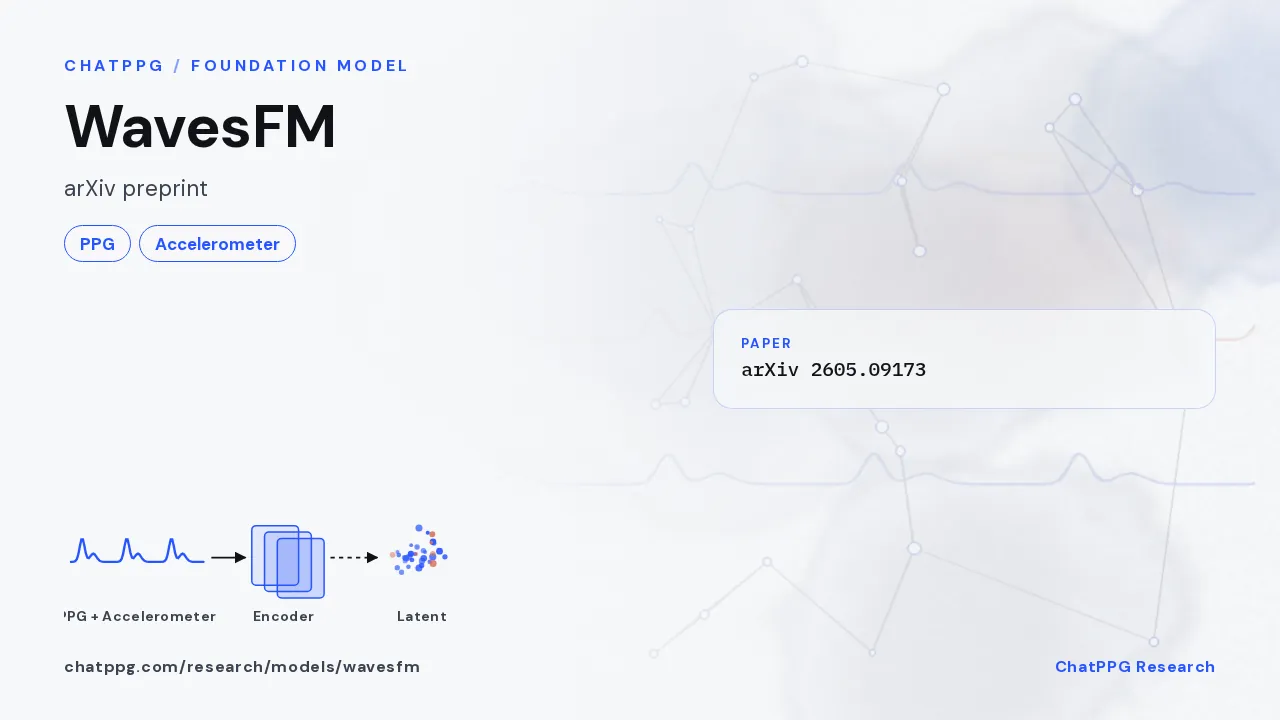
WavesFM is a foundation model for longitudinal physiological data that uses two stages of self-supervised learning. It aims to keep both fine waveform detail and long-term behavioural patterns over weeks of recordings, which earlier methods usually traded off.
- Published: arXiv preprint, 2026
- Cohort: N = 324
- Method: two-stage SSL (short waveforms + longitudinal dynamics)
Abstract
Wearable sensors enable the continuous acquisition of high-resolution physiological waveforms, such as photoplethysmography and accelerometry, under free-living conditions. However, inferring health-related phenotypes from these signals presents significant challenges due to high sampling frequencies, multimodal dependencies, and extreme sequence lengths (e.g., weeks of recordings), compounded by a scarcity of ground-truth labels. To address these challenges, existing self-supervised learning (SSL) methodologies typically follow two paradigms: (1) learning rich morphological representations from short waveform segments while collapsing longitudinal dynamics through simple aggregation, or (2) modeling behavioral patterns from coarse, hand-crafted features (e.g. heart rate, step counts) spanning longer horizons but foregoing subtle, predictive signatures in raw waveforms. To bridge this gap, we propose WavesFM, a foundation model utilizing a two-stage SSL framework for longitudinal physiological data. Specifically, we decompose the learning problem into two stages: first, a segment-level encoder is pretrained to extract local embeddings from short waveforms; subsequently, a temporal encoder is trained to model the sequence of these embeddings across a multi-day horizon. This hierarchical approach overcomes the computational complexity of high-resolution, long-sequence data, allowing the overall model to capture both local signal semantics and the complex circadian and inter-day variations governing physiological dynamics. Pretrained on over 6.8M hours (N=324k individuals) of recordings for the first stage and 5.3M hours (N=10k) for the second stage, WavesFM demonstrates superior performance across 58 diverse tasks spanning demographics, lifestyle, health conditions, and medications.
Verbatim fromarXiv· arXiv metadata (abstracts are released under CC0)
How it works
- Inputs
- PPG, IMU
- Approach
- foundation model · raw waveform · longitudinal · hierarchical ssl
Datasets
Papers· 1
Cite
@misc{wavesfm2026,
  title = {{WavesFM}},
  author = {Peng Cao and Zhijian Yang and Tennison Liu and Jonathan Wang and Jiang Wu and Magdalena Proszewska and Arvind Pillai and Mingwu Gao and Amir Farjadian and Lawrence Cai and Emily Blanchard and Daniel McDuff et al.},
  year = {2026},
  howpublished = {arXiv preprint},
  eprint = {2605.09173},
  url = {https://arxiv.org/abs/2605.09173}
}History
Added to the ChatPPG research hub