PaperarXiv:2610.11111
Lapras: Latent Reasoning for Time Series Language Models

arXiv 2610.11111 (cs.CL; v1 submitted 2026-10-08)
 (opens in a new tab)
Chen, Yuliang et al., "Lapras: Latent Reasoning for Time Series Language Models", arXiv:2610.11111, CC BY 4.0
TL;DR
Post-training framework for time-series language models (TSLMs): instead of verbalising the signal in an explicit chain-of-thought, the model reasons through continuous "thoughts" in the joint time-series–language space and emits text only for the answer. Trained by teacher–student self-distillation: a CoT-SFT teacher reasons in text, and the student aligns its answer-stage hidden states to the teacher's. Evaluated on four TSLM backbones (ChatTS-7B, OpenTSLM-1B Flamingo variant, SLIP-1B, ITFormer-0.5B) and five QA tasks: ECG (ECG-Reasoning benchmark, Oh et al.
- Form factor: other
Abstract
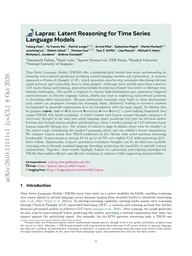
Time Series Language Models (TSLMs) offer a promising path toward time series understanding by reasoning over temporal signals and producing natural language answers and explanations. A common approach is Chain-of-Thought (CoT), which generates step-by-step rationales linking relevant signal patterns to final answers. Although these models learn from reference CoT traces during post-training, generating faithful descriptions of input time series at inference remains challenging. Expressing high-dimensional, continuous temporal representations in discrete language tokens may cause the model to neglect task-relevant patterns or describe them inaccurately. Because later reasoning steps build on these descriptions, early errors propagate, leading to incorrect answers with plausible explanations that are inconsistent with the input signal. We propose Lapras (Latent Post-trained Reasoning Across Series), a post-training framework that equips TSLMs with latent reasoning. A model trained with Lapras reasons through a sequence of continuous thoughts in the joint time series-language space, producing text only for the final answer. It learns this through teacher-student self-distillation, where a teacher trained on CoT reference traces reasons explicitly through text. The student aligns its hidden states with the teacher's at the answer stage, transferring the teacher's reasoning ability into its latent computation. We evaluate Lapras across four TSLM backbones on five time series question answering benchmarks. Lapras improves average F1 by up to 10.79% over explicit CoT while generating 23.9x fewer tokens. Lapras's continuous thoughts can also be decoded into readable reasoning traces via standard language decoding, preserving textual explanations. Together, these results highlight Lapras as a promising post-training paradigm for efficient, effective, and interpretable TSLM reasoning.
Verbatim from arXiv (opens in a new tab) · arXiv metadata (abstracts are released under CC0)
Results on ChatPPG leaderboards · 2
All leaderboards| Leaderboard | Method | Result | Rank |
|---|---|---|---|
| opentslm-har-cot macro-F1Human activity recognition | Lapras | 73.53 (%)macro-F1, higher is better | #1 of 1 |
| opentslm-sleep-cot macro-F1Sleep staging | Lapras | 79.49 (%)macro-F1, higher is better | Unranked |
2 rows are credited to this paper. Ranks apply within each leaderboard only, as reported by the source.
Tasks & signals
Tasks
Signals
Keywords
Models
How it works
Cite this paper
Chen, Y., Wu, Y. Y., Langer, P., Pillai, A., Regmi, S., Maritsch, M., Liu, J., Jakob, R., Kaar, T., Griffin, T. Z., Marsch, L., Heinz, M. V., Jacobson, N. C., & Campbell, A. (2026). Lapras: Latent Reasoning for Time Series Language Models. arXiv 2610.11111. https://arxiv.org/abs/2610.11111
Chen, Yuliang, Yu Yvonne Wu, Patrick Langer, Arvind Pillai, Sudarshan Regmi, Martin Maritsch, and Juncheng Liu, et al. 2026. "Lapras: Latent Reasoning for Time Series Language Models." arXiv 2610.11111. https://arxiv.org/abs/2610.11111.
Chen, Y., Wu, Y. Y., Langer, P., Pillai, A., Regmi, S., Maritsch, M. and Liu, J. et al. (2026) 'Lapras: Latent Reasoning for Time Series Language Models', arXiv 2610.11111. Available at: https://arxiv.org/abs/2610.11111
Chen, Yuliang, et al. "Lapras: Latent Reasoning for Time Series Language Models." arXiv 2610.11111, 2026. https://arxiv.org/abs/2610.11111.
Y. Chen et al., "Lapras: Latent Reasoning for Time Series Language Models," arXiv 2610.11111, 2026, [Online]. Available: https://arxiv.org/abs/2610.11111.
@misc{chen2026lapras,
  title         = {{Lapras: Latent Reasoning for Time Series Language Models}},
  author        = {Chen, Yuliang and Wu, Yu Yvonne and Langer, Patrick and Pillai, Arvind and Regmi, Sudarshan and Maritsch, Martin and Liu, Juncheng and Jakob, Robert and Kaar, Thomas and Griffin, Tess Z. and Marsch, Lisa and Heinz, Michael V. and Jacobson, Nicholas C. and Campbell, Andrew},
  year          = {2026},
  howpublished  = {arXiv 2610.11111},
  eprint        = {2610.11111},
  archivePrefix = {arXiv}
}Record updated
Added to the ChatPPG research hub