Pretraining on Sleep Data Improves non-Sleep Biosignal Tasks
Activity counts measure attention, not model quality. Missing counts are unknown. Publication status follows the linked source; a listed venue alone does not confirm peer review.
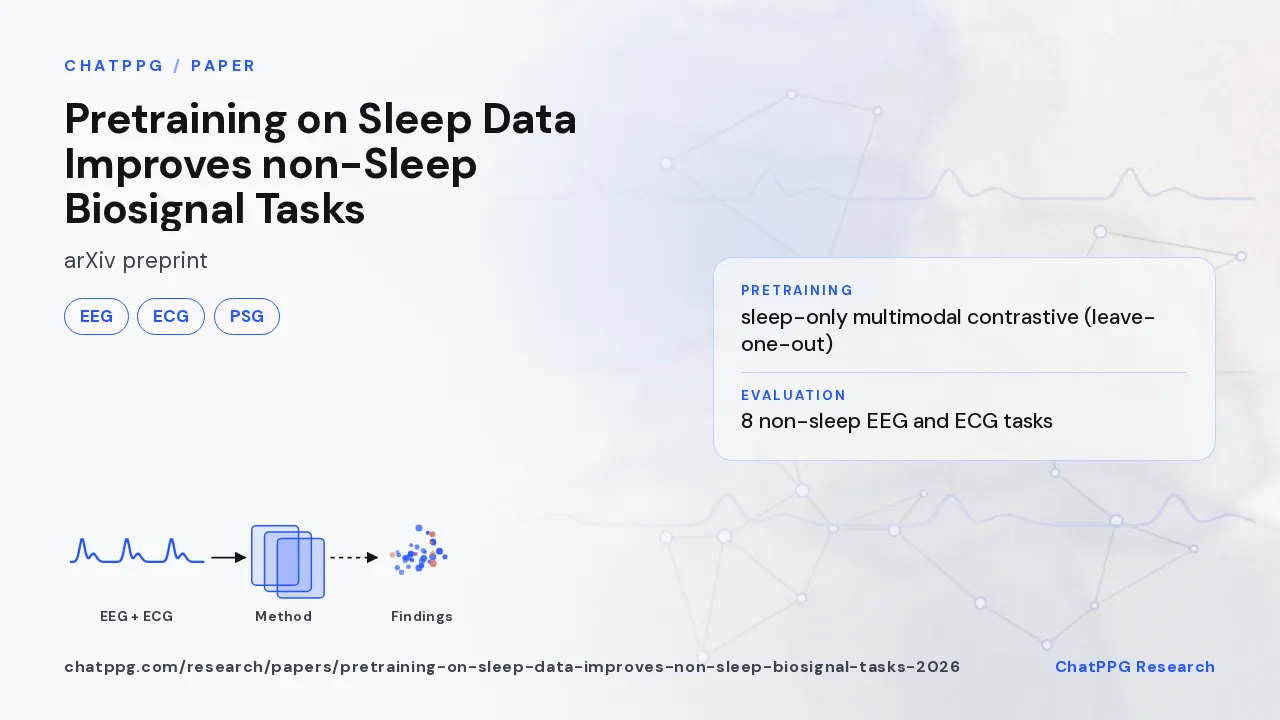
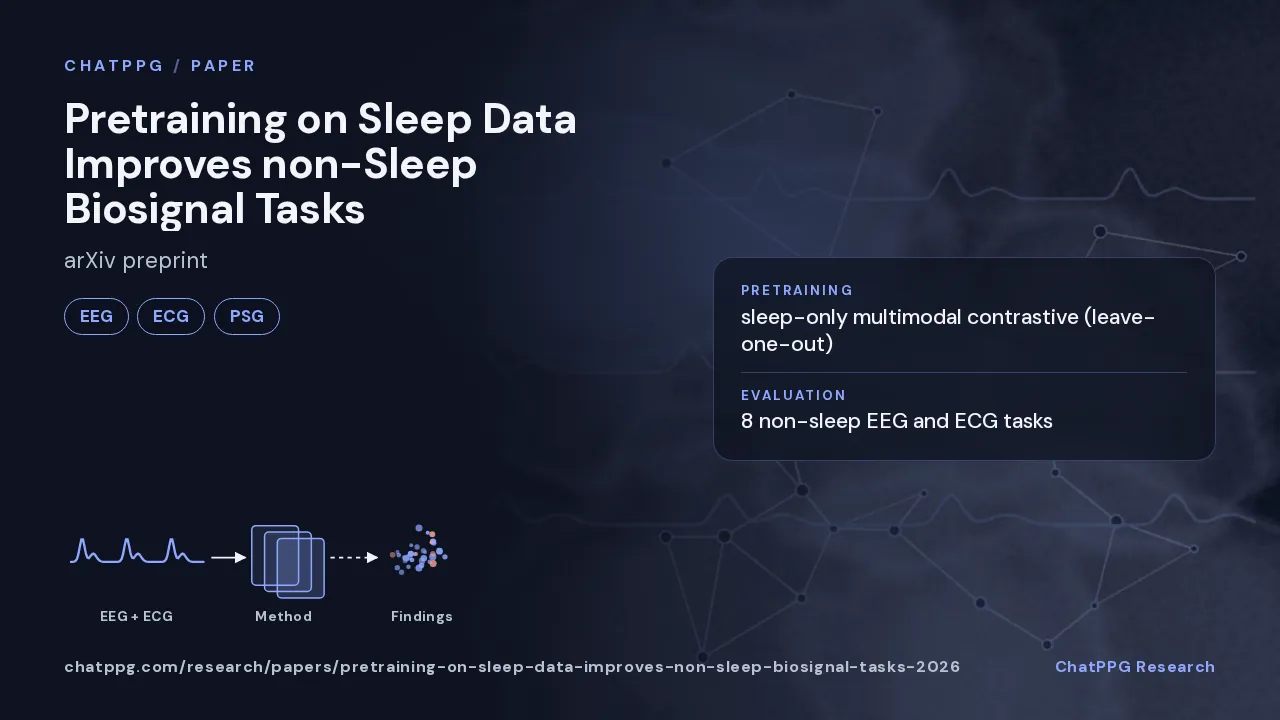
This paper asks whether pretraining on sleep recordings helps with biosignal tasks outside sleep. The authors pretrained only on multimodal sleep data with a leave-one-out contrastive objective and tested on non-sleep EEG and ECG. Across eight tasks, sleep pretraining consistently beat training from scratch.
- Pretraining: sleep-only multimodal contrastive (leave-one-out)
- Evaluation: 8 non-sleep EEG and ECG tasks
- Result: consistent gains over training from scratch
- Venue
- arXiv preprint
- Published
- 2026
- DOI
- Not reported
- PMID
- Not reported
- Licence
- Not reported
- Form factor
- Not reported
- Subjects
- Not reported
- Code
- Not reported
- Added
- Oct 11, 2026
Abstract
Sleep foundation models have recently demonstrated strong performance on in-domain polysomnography tasks, including sleep staging, apnea detection, and disease risk prediction. In this work, we investigate whether sleep biosignals can serve as an effective pretraining distribution for learning representations that transfer beyond sleep to adjacent domains. Following sleep foundation models, we perform sleep-only multimodal contrastive pretraining (with a leave-one-out objective) and evaluate transfer to non-sleep EEG and ECG, two well-benchmarked biosignal modalities with heterogeneous datasets and clinically meaningful downstream tasks. Across eight downstream tasks spanning multiple EEG and ECG datasets, sleep pretraining consistently improves performance relative to training from scratch. Moreover, on several tasks, we achieve performance competitive with or surpassing prior specialized state-of-the-art and foundation models.
Verbatim fromarXiv· arXiv metadata (abstracts are released under CC0)
How it works
Cite
@article{pretrainingonsleepdataim2026,
  title = {{Pretraining on Sleep Data Improves non-Sleep Biosignal Tasks}},
  author = {William Lehn-Schiøler and Magnus Ruud Kjær and Phillip Hempel and Magnus Guldberg Pedersen and Rahul Thapa and Bryan He and Nicolai Spicher and Andreas Brink-Kjaer and Lars Kai Hansen and Emmanuel Mignot},
  year = {2026},
  journal = {arXiv preprint},
  eprint = {2605.02500}
}History
Added to the ChatPPG research hub
More on ChatPPG
- A meta-learning method with reduced data requirements for training and updating deep learning models on wearable devices
This paper proposes a meta-learning method that cuts how much labelled data a new wearable needs bef
- Agentic AI-enabled discovery across large-scale sleep physiology (AI Sleep Co-Scientist)
AI Sleep Co-Scientist is a setup in which human scientists direct specialist AI agents for hypothesi
- AnyECG-Echo: Wearable Single-Lead ECG Detects Fine-Grained Structural Heart Disease Through Echo-Report Supervision
AnyECG-Echo uses contrastive pretraining between single-lead ECGs and echocardiography reports to sc