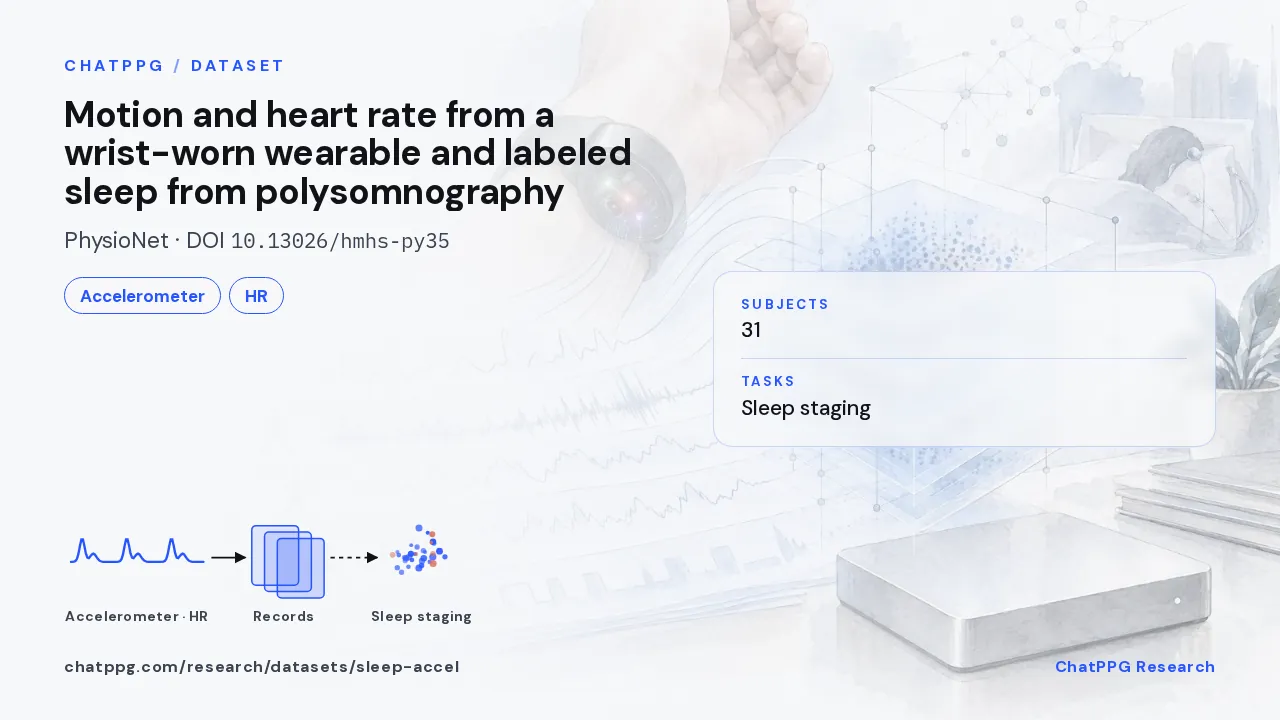
This PhysioNet dataset, "Motion and heart rate from a wrist-worn wearable and labeled sleep from polysomnography", pairs Apple Watch acceleration and heart rate with sleep stages scored from gold-standard polysomnography. It was published by Olivia Walch as version 1.0.0 on October 8, 2019, alongside "Sleep stage prediction with raw acceleration and photoplethysmography heart rate data derived from a consumer wearable device" by Walch, Huang, Forger and Goldstein in the journal Sleep (2019).
Consumer wearables that estimate sleep are everywhere, but their scoring algorithms are not open and their raw sensor data is rarely available outside the manufacturer. That limits their use in research and the clinic. The team wrote their own mobile app to pull raw acceleration and heart rate from the Apple Watch, so that sleep could be predicted from these signals with disclosed methods.
Data was collected at the University of Michigan from June 2017 to March 2019. Of 39 subjects recruited, 31 are in the release. Each wore an Apple Watch for 7 to 14 days to record ambulatory steps, then spent one night in the sleep lab with an eight hour sleep opportunity while acceleration and heart rate were recorded during polysomnography. The release includes acceleration in g, heart rate in beats per minute measured from photoplethysmography, step counts and the labeled sleep stages, each in a separate text file per subject with a random identifier. Note that the PPG appears here only as heart rate, not as a raw waveform.
In the paper, the authors compared motion, local standard deviation in heart rate and a "clock proxy" feature across several classifiers. Neural nets did best, though differences between classifiers were small. Sleep-wake classification scored 90% of epochs correctly, with 93% sensitivity for sleep and 59.6% specificity for wake. Separating wake, NREM and REM reached about 72% accuracy with all features. Models trained on Apple Watch data also held up when tested on data from the Multi-ethnic Study of Atherosclerosis (MESA).
The dataset is open access on PhysioNet under the Open Data Commons Attribution License v1.0. It is 2.2 GB uncompressed, or a 550.1 MB ZIP, and code to read and process the files is on GitHub. It is one of the few public sleep staging datasets recorded with a consumer smartwatch.
Sleep-wake
90% of epochs correct; wake/NREM/REM about 72%
License
ODC-By 1.0
Paper
Walch, Huang, Forger, Goldstein, Sleep (2019), doi 10.1093/sleep/zsz180
Size
2.2 GB uncompressed, 550.1 MB ZIP; DOI 10.13026/hmhs-py35
This project contains acceleration (in units of g) and heart rate (bpm, measured from photoplethysmography) recorded from the Apple Watch, as well as labeled sleep scored from gold-standard polysomnography. Data were collected at the University of Michigan from June 2017 to March 2019, and there are 31 subjects in total. Code to read and process these files is available on GitHub. The paper corresponding to the work is Walch et al., "Sleep stage prediction with raw acceleration and photoplethysmography heart rate data derived from a consumer wearable device", SLEEP (2019).
Verbatim fromPhysioNet· Licence: Open Data Commons Attribution License v1.0
Motion and heart rate from a wrist-worn wearable and labeled sleep from polysomnography: overview
This PhysioNet dataset (Walch et al., SLEEP 2019) pairs Apple Watch acceleration and PPG-derived heart rate with polysomnography-scored sleep for 31 subjects at the University of Michigan (June 2017 to March 2019). Subjects wore the watch for 7 to 14 days and then spent one night in the sleep lab; the overnight watch data are aligned to PSG start. It is a standard benchmark for wake/NREM/REM classification from consumer wearables.
What's inside
Subjects
31 (39 recruited; excluded for transmission errors, sleep apnea, RBD)
Motion
Acceleration x, y, z in g
Heart rate
bpm from Apple Watch PPG
Steps
Ambulatory step counts
Labels
PSG stages: 0 wake, 1 N1, 2 N2, 3 N3, 5 REM
Format
Text files per subject: _acceleration, _heartrate, _steps, _labeled_sleep; time in seconds since PSG start
Apple Watch acceleration, PPG-derived heart rate and step counts, plus PSG-scored sleep stages, for 31 subjects.
Does it include the raw PPG signal?
No. Heart rate is provided in beats per minute as measured by the watch.
What sleep stage codes are used?
0 wake, 1 N1, 2 N2, 3 N3 and 5 REM.
What is the licence?
Open Data Commons Attribution License v1.0 on PhysioNet. The analysis code is MIT licensed.
How do I download the sleep-accel dataset?
Open access on PhysioNet (https://physionet.org/content/sleep-accel/1.0.0/) under ODC-By 1.0. Download the motion, heart_rate, steps and labels folders.
What is the Sleep-Accel dataset?
It is a PhysioNet dataset of 31 subjects with Apple Watch acceleration and PPG-derived heart rate recorded during a night of polysomnography, with scored sleep stages.
How do I download Sleep-Accel?
It is open access at https://physionet.org/content/sleep-accel/1.0.0/ as a 550.1 MB ZIP under ODC-By 1.0.
Sleep-Accel vs DREAMT?
Sleep-Accel gives Apple Watch acceleration and heart rate only. DREAMT has raw Empatica E4 signals, including the BVP waveform at 64 Hz, from 100 participants, under restricted access.
What are Sleep-Accel benchmark results?
The original paper scored 90% of epochs correctly for sleep-wake and about 72% for wake, NREM and REM using motion, heart rate and a clock proxy feature.
Cite this dataset
This citation is the paper recorded with this dataset. Check it against the publisher before submitting.
Walch, O., Huang, Y., Forger, D., & Goldstein, C. (2019). Sleep stage prediction with raw acceleration and photoplethysmography heart rate data derived from a consumer wearable device. Sleep, 42(12). https://doi.org/10.1093/sleep/zsz180
Walch, Olivia, Yitong Huang, Daniel Forger, and Cathy Goldstein. 2019. "Sleep stage prediction with raw acceleration and photoplethysmography heart rate data derived from a consumer wearable device." Sleep 42 (12). https://doi.org/10.1093/sleep/zsz180.
Walch, O., Huang, Y., Forger, D. and Goldstein, C. (2019) 'Sleep stage prediction with raw acceleration and photoplethysmography heart rate data derived from a consumer wearable device', Sleep, 42(12). doi: 10.1093/sleep/zsz180.
Walch, Olivia, et al. "Sleep stage prediction with raw acceleration and photoplethysmography heart rate data derived from a consumer wearable device." Sleep, vol. 42, no. 12, 2019. https://doi.org/10.1093/sleep/zsz180.
O. Walch, Y. Huang, D. Forger, and C. Goldstein, "Sleep stage prediction with raw acceleration and photoplethysmography heart rate data derived from a consumer wearable device," Sleep, vol. 42, no. 12, 2019, doi: 10.1093/sleep/zsz180.
@article{walch2019sleep,
  title         = {{Sleep stage prediction with raw acceleration and photoplethysmography heart rate data derived from a consumer wearable device}},
  author        = {Walch, Olivia and Huang, Yitong and Forger, Daniel and Goldstein, Cathy},
  year          = {2019},
  journal       = {Sleep},
  volume        = {42},
  number        = {12},
  publisher     = {Oxford University Press (OUP)},
  doi           = {10.1093/sleep/zsz180}
}
Cite the ChatPPG record
Cite the dated snapshot 2026-10 for a fixed, reproducible version. Please also cite the original publications listed above.
APA
ChatPPG. (2026). Motion and heart rate from a wrist-worn wearable and labeled sleep from polysomnography: dataset record (Version 2026-10) [Data set]. ChatPPG Research Hub. https://chatppg.com/research/datasets/sleep-accel
BibTeX
@misc{chatppg_dataset_sleep_accel,
  author       = {{ChatPPG}},
  title        = {{Motion and heart rate from a wrist-worn wearable and labeled sleep from polysomnography: dataset record}},
  year         = {2026},
  month        = nov,
  version      = {2026-10},
  howpublished = {\url{https://chatppg.com/research/datasets/sleep-accel}},
  note         = {ChatPPG Research Hub, Snapshot 2026-10, https://chatppg.com/research/snapshots/2026-10}
}
CITATION.cff
cff-version: 1.2.0
message: "If you use this resource, please cite it as below."
type: dataset
title: "Motion and heart rate from a wrist-worn wearable and labeled sleep from polysomnography: dataset record"
authors:
  - name: "ChatPPG"
url: "https://chatppg.com/research/datasets/sleep-accel"
repository-artifact: "https://chatppg.com/research/snapshots/2026-10"
version: "2026-10"
date-released: "2026-11-16"
History
Record updated
Newsletter
Get new PPG datasets, papers and models
Get alerts when new models are benchmarked on Motion and heart rate from a wrist-worn wearable and labeled sleep from polysomnography, plus the weekly digest.
New datasets, papers and models
Practical guides from the hub
Unsubscribe anytime
The waveform is an illustration of a PPG pulse, not a recording.
Articles and algorithm explainers
Read more about Motion and heart rate from a wrist-worn wearable and labeled sleep from polysomnography