Wrist PPG During Exercise is a small PhysioNet dataset of wrist PPG recorded during walking, running and cycling, with both accelerometer and gyroscope measures of motion and a reference chest ECG. It was contributed by Alexander J Casson of the University of Manchester and published on PhysioNet as version 1.0.0 on October 20, 2017. The accompanying paper is "Description of a Database Containing Wrist PPG Signals Recorded during Physical Exercise with Both Accelerometer and Gyroscope Measures of Motion" by Delaram Jarchi and Alexander Casson in Data 2(1):1.
PPG works well when people sit still, but exercise corrupts the signal with motion artifacts. The database was built so that researchers could create and validate algorithms that recover heart rate and heart rate variability from wrist PPG during exercise. What made it different from earlier public sets was the motion sensing. Alongside the PPG, it records a 3-axis low-noise accelerometer, a 3-axis wide-range accelerometer and a 3-axis gyroscope, and the gyroscope makes it possible to separate acceleration due to gravity from acceleration due to true motion.
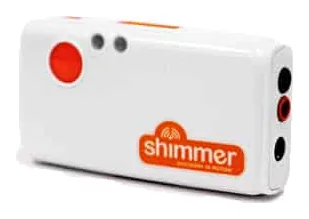
PPG and motion data came from a Shimmer 3 GSR+ unit worn on the left wrist in roughly the position of a watch, with the PPG sensor glued to the unit so the motion sensors tracked it exactly. A single-channel Actiwave recorder on the upper chest captured ECG, and R peaks were identified by hand to give a gold-standard heart rate. All signals were sampled at 256 Hz.
Records come from 8 participants (3 male, 5 female) aged 22 to 32. Each could do up to four activities for up to 10 minutes: treadmill walking, a light jog or run, and low and higher resistance cycling on an exercise bike. Participants set their own pace and most spent 4 to 6 minutes on each activity. Walking and running PPG is raw; cycling PPG was low pass filtered at 15 Hz because of heavy high-frequency noise, and the ECG has a 50 Hz notch filter.
Files are in WFDB format with R-peak annotation files, 49.8 MB in total. The dataset is open access under the Open Data Commons Attribution License v1.0. It is small, but its gyroscope channels make it a useful companion to larger motion datasets such as PPG-DaLiA when testing motion artifact removal.
Paper
Jarchi and Casson, Data 2(1):1, doi 10.3390/data2010001
Participants
8 (3 male, 5 female), aged 22 to 32
Sampling
256 Hz
Size
49.8 MB; DOI 10.13026/C2PQ1X; ODC-By 1.0
Activities
treadmill walk and run, low and high resistance cycling, up to 10 minutes each
Sensors
Shimmer 3 GSR+ wrist PPG, low-noise and wide-range accelerometers, gyroscope; Actiwave chest ECG with hand-marked R peaks
This database contains wrist PPGs recorded during walking, running and bike riding. Simultaneous motion estimates are collected using both accelerometers and gyroscopes to give multiple options for the removal of motion interference from the PPG traces. A reference chest ECG is included to allow a gold-standard comparison of heart rate during exercise.
Verbatim fromPhysioNet· Licence: Open Data Commons Attribution License v1.0
Wrist PPG During Exercise (PhysioNet wrist): overview
Wrist PPG During Exercise is a small PhysioNet database from Alex Casson's group at the University of Manchester, built to test motion-artifact removal. A Shimmer 3 GSR+ unit with a rigidly attached PPG sensor sat on the left wrist and recorded PPG, a gyroscope, low-noise and wide-range accelerometers and a magnetometer, while a single-channel Actiwave chest ECG gave the heart-rate reference. Eight participants (3 male, 5 female, aged 22 to 32) walked or ran on a treadmill and pedalled an exercise bike at low or high resistance for up to 10 minutes each. All signals are at 256 Hz, and hand-identified ECG R-peaks are included as WFDB annotations. It is open under ODC-By 1.0 and only 49.8 MB.
What's inside
Participants
8 (3 male, 5 female), aged 22 to 32 (mean 26.5)
Records
19 (walk, run, low- and high-resistance bike; not every participant did every activity)
Wrist signals
PPG, 3-axis gyroscope, low-noise and wide-range 3-axis accelerometers, magnetometer (Shimmer 3 GSR+, left wrist)
Reference
Single-channel chest ECG (Actiwave) with hand-identified R-peaks (.atr)
Run on 28 Oct 2026: s1_walk has 15 channels (chest_ecg, wrist_ppg, wrist gyro x/y/z, low-noise and wide-range accelerometer x/y/z, magnetometer x/y/z, sample_times_for_all_signals_apart_from_ecg) at 256 Hz, shape (150529, 15), and 563 R-peak annotations.
Caveats
Only 8 participants and 19 records: report per-subject results and do not tune and test on the same people.
Cycling PPG was low-pass filtered (2nd-order Butterworth, 15 Hz, zero phase) before release; walking and running PPG is raw apart from the Shimmer hardware. Do not compare raw-signal methods across activities without accounting for this.
Participants chose their own pace and could stop at any time, and most spent 4 to 6 minutes per activity, so motion intensity is not standardised.
R-peak times assume the first ECG sample is at 0 s. Each record also has a sample_times_for_all_signals_apart_from_ecg channel; use it when aligning wrist signals with the ECG.
The ECG has a 50 Hz notch filter applied by the Actiwave software.
Wrist PPG, gyroscope, two accelerometers and a magnetometer from a Shimmer 3 GSR+ on the left wrist, plus a chest ECG with hand-identified R-peaks, recorded during treadmill walking and running and exercise-bike cycling.
How many subjects are in the PhysioNet wrist PPG exercise dataset?
Eight participants (3 male, 5 female, aged 22 to 32), giving 19 activity records.
What is the sampling rate?
All signals are sampled at 256 Hz.
Can I use it for heart rate estimation under motion?
Yes, that is its purpose: the accelerometers and gyroscope support motion-artifact removal and the chest ECG R-peaks give the reference heart rate. It is small, so pair it with larger sets such as PPG-DaLiA for training.
Is it free for commercial use?
It is under the Open Data Commons Attribution License v1.0 on PhysioNet, which allows any use with attribution.
What is the Wrist PPG During Exercise dataset?
It is a PhysioNet dataset of wrist PPG from 8 participants walking, running and cycling, with accelerometers, a gyroscope and a reference chest ECG, all at 256 Hz.
How do I download Wrist PPG During Exercise?
It is open access at https://physionet.org/content/wrist/1.0.0/ in WFDB format (49.8 MB) under ODC-By 1.0.
Wrist PPG During Exercise vs PPG-DaLiA?
PPG-DaLiA has 15 subjects in daily life activities with an Empatica E4. The Wrist PPG During Exercise set has 8 participants but adds a gyroscope and two accelerometers for motion artifact work.
What benchmarks use this dataset?
It is used to validate heart rate and heart rate variability extraction from wrist PPG during exercise, with hand-marked ECG R peaks as the reference.
Cite this dataset
This citation is the paper recorded with this dataset. Check it against the publisher before submitting.
Jarchi, D., & Casson, A. (2016). Description of a Database Containing Wrist PPG Signals Recorded during Physical Exercise with Both Accelerometer and Gyroscope Measures of Motion. Data, 2(1), 1. https://doi.org/10.3390/data2010001
Jarchi, Delaram and Alexander Casson. 2016. "Description of a Database Containing Wrist PPG Signals Recorded during Physical Exercise with Both Accelerometer and Gyroscope Measures of Motion." Data 2 (1): 1. https://doi.org/10.3390/data2010001.
Jarchi, D. and Casson, A. (2016) 'Description of a Database Containing Wrist PPG Signals Recorded during Physical Exercise with Both Accelerometer and Gyroscope Measures of Motion', Data, 2(1), p. 1. doi: 10.3390/data2010001.
Jarchi, Delaram, and Alexander Casson "Description of a Database Containing Wrist PPG Signals Recorded during Physical Exercise with Both Accelerometer and Gyroscope Measures of Motion." Data, vol. 2, no. 1, 2016, p. 1. https://doi.org/10.3390/data2010001.
D. Jarchi and A. Casson, "Description of a Database Containing Wrist PPG Signals Recorded during Physical Exercise with Both Accelerometer and Gyroscope Measures of Motion," Data, vol. 2, no. 1, p. 1, 2016, doi: 10.3390/data2010001.
@article{jarchi2016description,
  title         = {{Description of a Database Containing Wrist PPG Signals Recorded during Physical Exercise with Both Accelerometer and Gyroscope Measures of Motion}},
  author        = {Jarchi, Delaram and Casson, Alexander},
  year          = {2016},
  journal       = {Data},
  volume        = {2},
  number        = {1},
  pages         = {1},
  publisher     = {MDPI AG},
  doi           = {10.3390/data2010001}
}
Cite the ChatPPG record
Cite the dated snapshot 2026-10 for a fixed, reproducible version. Please also cite the original publications listed above.
APA
ChatPPG. (2026). Wrist PPG During Exercise (PhysioNet wrist): dataset record (Version 2026-10) [Data set]. ChatPPG Research Hub. https://chatppg.com/research/datasets/wrist-ppg-exercise
BibTeX
@misc{chatppg_dataset_wrist_ppg_exercise,
  author       = {{ChatPPG}},
  title        = {{Wrist PPG During Exercise (PhysioNet wrist): dataset record}},
  year         = {2026},
  month        = nov,
  version      = {2026-10},
  howpublished = {\url{https://chatppg.com/research/datasets/wrist-ppg-exercise}},
  note         = {ChatPPG Research Hub, Snapshot 2026-10, https://chatppg.com/research/snapshots/2026-10}
}
CITATION.cff
cff-version: 1.2.0
message: "If you use this resource, please cite it as below."
type: dataset
title: "Wrist PPG During Exercise (PhysioNet wrist): dataset record"
authors:
  - name: "ChatPPG"
url: "https://chatppg.com/research/datasets/wrist-ppg-exercise"
repository-artifact: "https://chatppg.com/research/snapshots/2026-10"
version: "2026-10"
date-released: "2026-11-16"
History
Record updated
Newsletter
Get new PPG datasets, papers and models
Get alerts when new models are benchmarked on Wrist PPG During Exercise (PhysioNet wrist), plus the weekly digest.
New datasets, papers and models
Practical guides from the hub
Unsubscribe anytime
The waveform is an illustration of a PPG pulse, not a recording.
Articles and algorithm explainers
Read more about Wrist PPG During Exercise (PhysioNet wrist)