ADARP comes from a pilot study of people diagnosed with alcohol use disorder, built to see how their daily experiences line up with physiological signs of stress. Participants answered web surveys about emotions, cravings and stress four times a day for up to 14 days while wearing an Empatica E4 wristband that recorded heart rate, electrodermal activity, skin temperature and movement. Structured interviews with a timeline follow-back calendar were used to log daily drinking and check the self-reported and physiological stress markers.

Published
Zenodo, 2022
Device
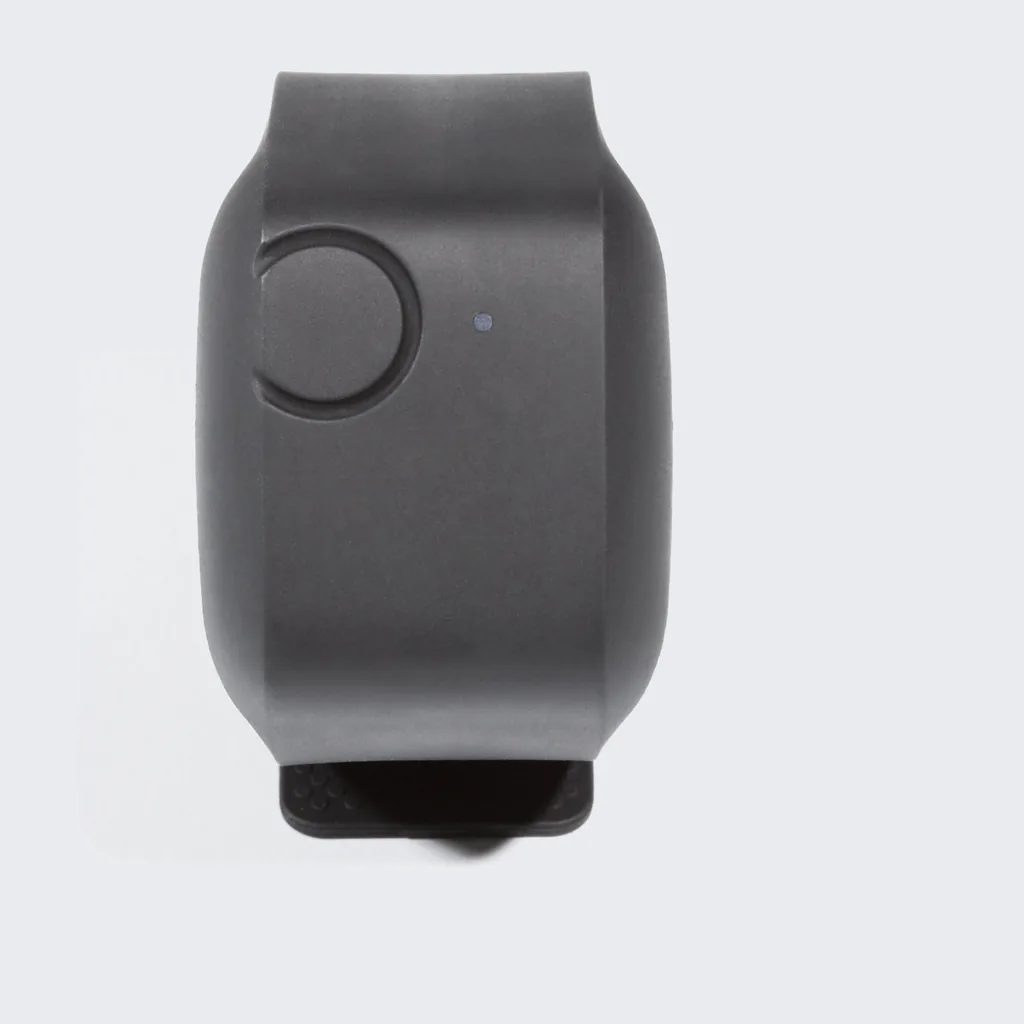
Empatica E4 wristband
License
CC BY 4.0
Protocol

EMA surveys 4 times a day for up to 14 days, plus structured interviews

At a glance
Type
Dataset
Access
Not reported
Subjects
11
PPG sites
Wrist
Setting
In the wild
Wrist
Yes
Raw waveforms
Yes
Updated
Nov 25, 2026

Original description

The Alcohol and Drug Abuse Research Program (ADARP) dataset was collected as a part of a pilot study that aimed to discover how the daily experiences of patients diagnosed with alcohol use disorder (AUD) correspond with physiological biomarkers of stress. Each participant completed three components: 1) a daily diary study using ecological momentary assessment (EMA) of self-reported emotions, cravings, and stress via a web-based survey, prompted 4 times daily for up to 14 days; 2) continuous monitoring of stress with an Empatica E4 wristband that captured, in real-time, continuous physiological markers of stress, including heart rate (HR), skin conductance or electrodermal activity (EDA), skin temperature, and bodily movements; and 3) structured qualitative interviews to assess daily alcohol use, using a timeline follow-back calendar, and to validate self-reported and physiological markers of stress. With the proposed study, we aimed to address three research objectives. Aim 1 examines the fluctuations and associations among the self-reported emotions, alcohol-related cravings, and stress assessed in the EMA component. Analysis for Aim 1 centered on concurrent and lagged associations among negative affect, cravings, and stress. Aim 2 uses the continuous monitoring data acquired via the wearable device to visualize and describe fluctuations among the physiological measures of stress. Analysis for this aim focused on determining the degree of synchrony among the different physiological indicators. Aim 3 combines the EMA and continuous monitoring components in order to determine if self-reported changes in alcohol-related cravings can be predicted from physiological measures of stress.

ADARP dataset was collected from participants suffering from alcohol use disorder (AUD) and receiving treatment at an outpatient treatment agency during 2019 - 2020, at Washington State University (WSU), Pullman, WA, USA. Funding for the original study was provided by the Alcohol and Drug Research Program (ADARP) of Washington State University.  This investigation was supported in part by funds provided for medical and biological research by the State of Washington Initiative Measure No. 171.

The sensor and EMA survey data are made public to facilitate further research into this topic. We have also set up a GitHub repository with code that can be used to process the sensor data and extract meaningful information. Please cite the following papers if you use this dataset in your research.

Ramesh Kumar Sah, Hassan Ghasemzadeh, Assal Habibi, Michael McDonell, Patricia Pendry, and Michael Cleveland. 2020. Poster: Mobile Health for Alcohol Recovery and Relapse Prevention. In 2020 IEEE/ACM International Conference on Connected Health: Applications, Systems and Engineering Technologies (CHASE). IEEE Press, 18–19. https://doi.org/10.1145/3384420.3431779 Alinia P, Sah RK, McDonell M, Pendry P, Parent S, Ghasemzadeh H, Cleveland MJ. Associations Between Physiological Signals Captured Using Wearable Sensors and Self-reported Outcomes Among Adults in Alcohol Use Disorder Recovery: Development and Usability Study. JMIR Form Res. 2021 Jul 21;5(7):e27891. DOI: 10.2196/27891. PMID: 34287205; PMCID: PMC8339978. Ramesh Kumar Sah, Michael McDonell, Patricia Pendry, Sara Parent, Hassan Ghasemzadeh, Michael J Cleveland. ADARP: A Multi Modal Dataset for Stress and Alcohol Relapse Quantification in Real Life Setting. ArXiv, 2022, Jun.

If you have any questions or suggestions, please feel free to reach Ramesh Sah at ramesh.sah@wsu.edu

Verbatim fromZenodo· Licence: cc-by-4.0

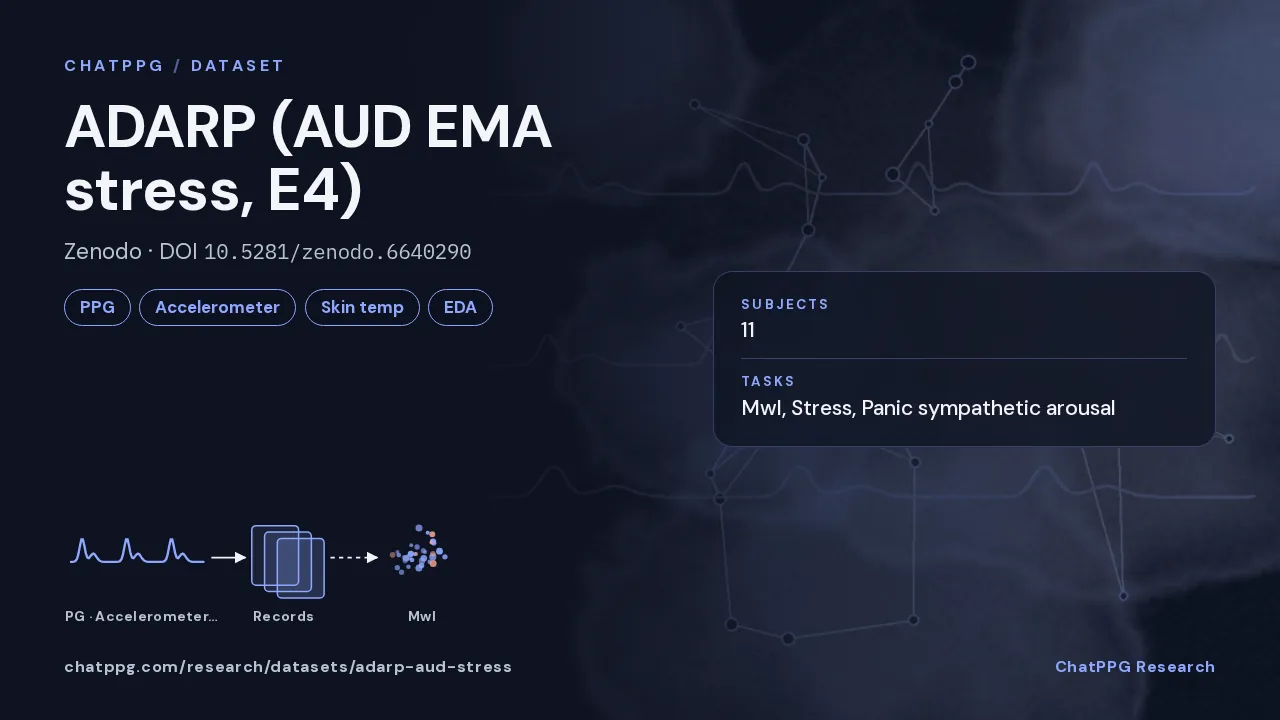
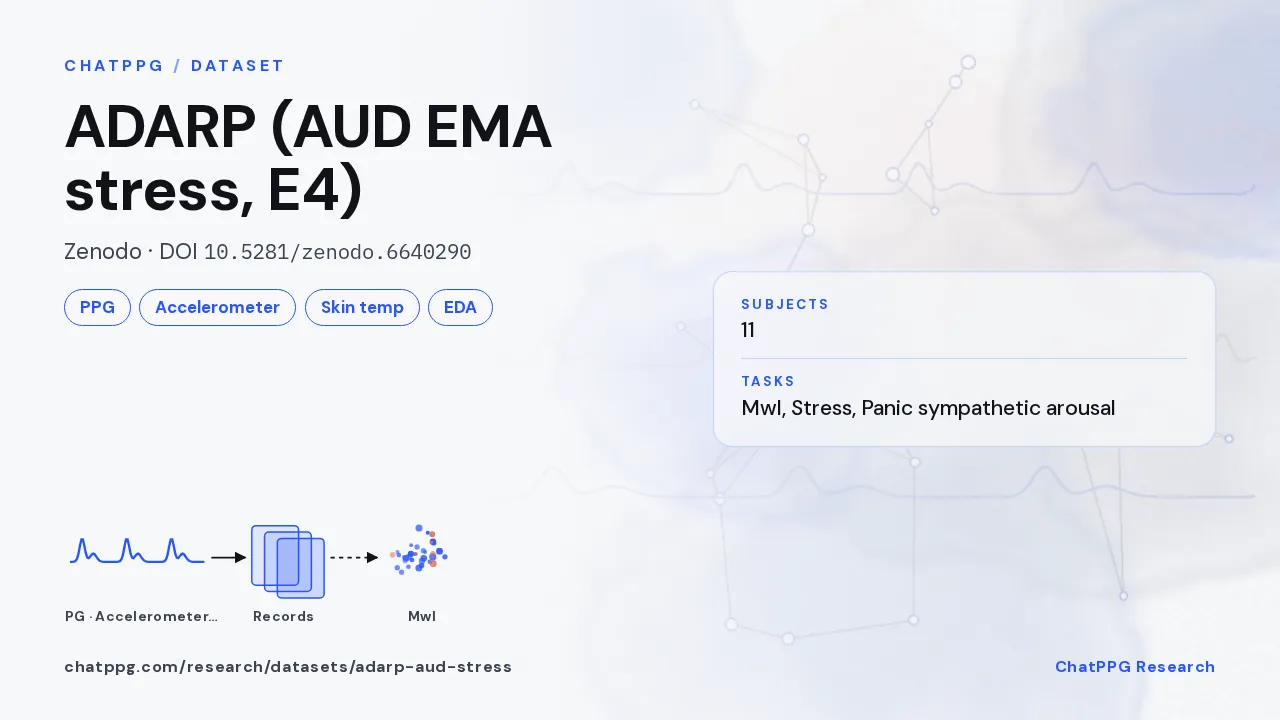
ADARP (AUD EMA stress, E4): ChatPPG research summary card

Key numbers

11
Subjects
2
Reference labels
STRESS, MWL
4Hz
Released sampling rate
BVP 64Hz; ACC 32Hz; EDA/TEMP 4Hz

How it works

How ADARP (AUD EMA stress, E4) works: Devices & body sites → Signals recorded → TasksDevices & body sites: Empatica E4 (Empatica · Wrist). PPG sites: Wrist. Signals recorded: ADARP (AUD EMA stress, E4), 11 subjects · 4Hz, signals PPG, IMU, EDA, Temperature. Tasks: Mental workload; Stress; Panic sympathetic arousal.Devices & body sitesEmpatica E4: Empatica · WristEmpatica E4Empatica · WristPPG sites: WristPPG sitesWristSignals recordedADARP (AUD EMA stress, E4)11 subjects · 4HzPPGxyzIMUEDATemperatureTasksMental workloadMental workloadStressStressPanic sympathetic arousalPanic sympathetic arousal

No model in the hub reports results on this dataset yet.

Sampling
BVP 64Hz; ACC 32Hz; EDA/TEMP 4Hz
Reference labels
stress, mwl
Device roles
Study wearable (IMU)

Devices· 1

Full photo credits, sources and licences are on each device page.

Leaderboard rows· 6

All leaderboards
TaskDatasetMetricValueRank
Emotion recognition (valence/arousal)ADARP (AUD EMA stress, E4)f1_score ↑0.47#1 / 2
Emotion recognition (valence/arousal)ADARP (AUD EMA stress, E4)f1_score ↑0.40#2 / 2
Emotion recognition (valence/arousal)ADARP (AUD EMA stress, E4)f1_score ↑0.80#1 / 2
Emotion recognition (valence/arousal)ADARP (AUD EMA stress, E4)f1_score ↑0.62#2 / 2
Emotion recognition (valence/arousal)ADARP (AUD EMA stress, E4)f1_score ↑0.433#1 / 2
Emotion recognition (valence/arousal)ADARP (AUD EMA stress, E4)f1_score ↑0.354#2 / 2

FAQ

How many subjects are in ADARP?

ADARP has data from 11 subjects, as listed in its research record.

What signals does ADARP include?

ADARP includes PPG, accelerometer, skin temperature and EDA data. Sampling rate as recorded: BVP 64Hz; ACC 32Hz; EDA/TEMP 4Hz. Raw waveforms are included.

What can ADARP be used for?

Research tasks it supports: mental workload assessment and stress detection. Reference labels: stress and mental workload.

How do I get ADARP, and what is its licence?

It is hosted on Zenodo at https://zenodo.org/records/6640290. Licence: CC BY 4.0.

Was ADARP recorded with a wrist-worn device?

Yes. Its record lists wrist-worn recording.

Cite this dataset

Cite this dataset with the fields recorded here. Check it against the publisher before submitting.

ADARP (AUD EMA stress, E4) [Data set]. (n.d.). zenodo. https://doi.org/10.5281/zenodo.6640290
@misc{adarpaudstressadarp,
  title         = {{ADARP (AUD EMA stress, E4)}},
  howpublished  = {zenodo},
  doi           = {10.5281/zenodo.6640290}
}

Cite the ChatPPG record

Cite the dated snapshot 2026-10 for a fixed, reproducible version. Please also cite the original publications listed above.

APA

ChatPPG. (2026). ADARP (AUD EMA stress, E4): dataset record (Version 2026-10) [Data set]. ChatPPG Research Hub. https://chatppg.com/research/datasets/adarp-aud-stress

BibTeX
@misc{chatppg_dataset_adarp_aud_stress,
  author       = {{ChatPPG}},
  title        = {{ADARP (AUD EMA stress, E4): dataset record}},
  year         = {2026},
  month        = nov,
  version      = {2026-10},
  howpublished = {\url{https://chatppg.com/research/datasets/adarp-aud-stress}},
  note         = {ChatPPG Research Hub, Snapshot 2026-10, https://chatppg.com/research/snapshots/2026-10}
}
CITATION.cff
cff-version: 1.2.0
message: "If you use this resource, please cite it as below."
type: dataset
title: "ADARP (AUD EMA stress, E4): dataset record"
authors:
  - name: "ChatPPG"
url: "https://chatppg.com/research/datasets/adarp-aud-stress"
repository-artifact: "https://chatppg.com/research/snapshots/2026-10"
version: "2026-10"
date-released: "2026-11-25"

History

  1. Record updated