WHOOP Calorie Accuracy: How Reliable Is Its Energy Expenditure Tracking?
How accurate is WHOOP calorie tracking? We review the PPG-based energy expenditure model, validation data, and real-world accuracy limits for WHOOP 4.0.
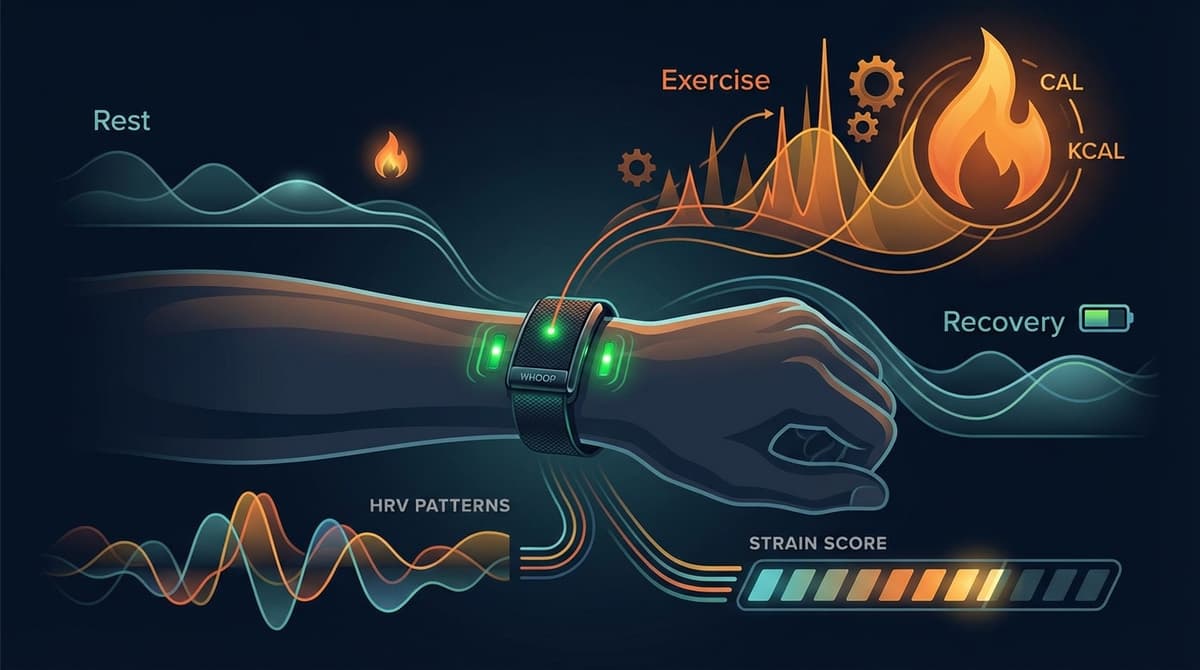
WHOOP calorie accuracy is moderate at best. Like all wrist-worn wearables that estimate energy expenditure from PPG-derived heart rate, WHOOP uses a heart rate-based model that works reasonably well during sustained aerobic exercise but can produce significant errors during strength training, high-intensity intervals, and daily living activities. Published research on wearable energy expenditure shows typical errors of 20 to 40 percent at the individual level, and WHOOP is no exception to these fundamental limitations.
The core issue is not a flaw in WHOOP's hardware or software specifically. It is that heart rate is an imperfect proxy for energy expenditure. Understanding why helps set realistic expectations for what any PPG-based calorie tracker can deliver.
How Does WHOOP Estimate Calories?
WHOOP estimates total daily energy expenditure (TDEE) by combining a basal metabolic rate (BMR) estimate with an activity-based calorie calculation derived from continuous heart rate monitoring. The device uses its green-light PPG sensor to track heart rate 24 hours a day, then applies an algorithm that converts heart rate data into calorie estimates. For a deeper look at how PPG sensors measure heart rate, see our guide to PPG signal basics.
The Heart Rate-to-Calorie Model
The relationship between heart rate and energy expenditure is based on the well-established linear correlation between heart rate and oxygen consumption (VO2) during steady-state aerobic exercise. As exercise intensity increases, both heart rate and oxygen demand rise in a roughly proportional fashion. Since oxygen consumption directly relates to caloric burn (approximately 5 kcal per liter of O2), heart rate can serve as an indirect estimate of energy expenditure.
WHOOP uses a personalized version of this model. During onboarding and ongoing use, the device incorporates user-provided data (age, height, weight, sex) along with resting heart rate and heart rate reserve to calibrate its calorie algorithm. The specifics of WHOOP's proprietary algorithm are not publicly documented, but the general approach follows the Keytel et al. (2005) framework that most HR-based calorie models use:
- For men: kcal/min = (-55.0969 + 0.6309 × HR + 0.1988 × weight_kg + 0.2017 × age) / 4.184
- For women: kcal/min = (-20.4022 + 0.4472 × HR - 0.1263 × weight_kg + 0.074 × age) / 4.184
These equations work best when heart rate elevation genuinely reflects increased metabolic demand from aerobic activity. They break down when heart rate rises for other reasons.
WHOOP 4.0 Hardware Specifics
The WHOOP 4.0 uses a five-LED PPG sensor array (green and infrared LEDs) with four photodiodes, paired with a three-axis accelerometer. The sensor samples at a higher rate than many consumer wearables, and the band's form factor (worn on the wrist, bicep, or with apparel like the WHOOP Body) is designed to maintain consistent skin contact.
The hardware quality matters for calorie accuracy primarily because it affects heart rate accuracy. If the heart rate reading is wrong, the calorie estimate built on top of it will be wrong too. WHOOP's PPG sensor performs well for resting and moderate-intensity heart rate tracking, comparable to other premium wearables. During vigorous exercise with heavy wrist motion, accuracy can degrade, though wearing the sensor on the bicep or using a body-mounted position reduces motion artifact.
What Does the Research Say About Wearable Calorie Accuracy?
There is limited published research specifically validating WHOOP's calorie estimates against gold-standard indirect calorimetry. However, the broader body of research on wearable energy expenditure accuracy provides a clear picture of what to expect.
The Shcherbina et al. 2017 Benchmark Study
The most cited study on wearable energy expenditure accuracy is Shcherbina et al. (2017), published in the Journal of Personalized Medicine (DOI: 10.3390/jpm7020003). The Stanford researchers tested seven wrist-worn devices against indirect calorimetry across walking, running, and cycling in 60 volunteers.
Key findings:
- Heart rate error was relatively small, with the most accurate device achieving a median error rate of 5% and the least accurate at 8.8%.
- Energy expenditure error was much larger, with the most accurate device off by 27.4% and the least accurate by 92.6%.
- No device achieved energy expenditure error below 20% at the individual level.
The large gap between heart rate accuracy and calorie accuracy illustrates a fundamental point: even when the heart rate reading is correct, converting that to calories introduces substantial additional error. The HR-to-calorie model itself is the weak link.
Comparison With Indirect Calorimetry
Indirect calorimetry, which measures oxygen consumption and carbon dioxide production via a metabolic cart, is the gold standard for energy expenditure measurement. All wearable calorie estimates are approximations of what indirect calorimetry would measure.
A systematic review by O'Driscoll et al. (2020, Sports Medicine; DOI: 10.1007/s40279-019-01247-9) analyzed 40 studies comparing wearable energy expenditure to indirect calorimetry. The review found mean absolute percentage errors ranging from 10% to over 50% depending on device, activity type, and population. Wrist-worn optical heart rate devices consistently showed larger errors than chest strap-based systems.
WHOOP-Specific Data
WHOOP has published internal validation data claiming their calorie algorithm is more accurate than competitors, but this data has not been independently peer-reviewed. Independent comparisons suggest that WHOOP's calorie estimates fall in the same range as other premium wearables: reasonable for steady aerobic exercise, less reliable for mixed or strength-based activities. As with other consumer wearables compared to clinical-grade devices, the gap between marketing claims and validated performance is a recurring theme.
Where WHOOP Calorie Tracking Works Well
WHOOP calorie accuracy is highest in scenarios where the HR-to-calorie relationship is most stable:
Sustained aerobic exercise at moderate intensity. Running at a steady pace, cycling at constant effort, rowing, or using an elliptical trainer all produce a strong linear relationship between heart rate and metabolic rate. For a 45-minute steady-state run, WHOOP's calorie estimate is likely within 15 to 25 percent of true expenditure. Not perfect, but directionally useful.
Tracking relative changes over time. Even if the absolute calorie number is off by 20%, consistent day-to-day measurement with the same device can reveal meaningful trends. If your WHOOP-estimated daily burn drops from 3,200 to 2,800 kcal over a period of reduced training, that relative change is informative regardless of whether the absolute numbers are correct.
Resting metabolic rate estimation. WHOOP uses resting heart rate and user biometrics to estimate BMR. While not as accurate as indirect calorimetry, this estimate is based on well-validated equations (Harris-Benedict or Mifflin-St Jeor) and provides a reasonable baseline. Resting metabolic rate typically accounts for 60 to 75 percent of total daily energy expenditure, so getting this component approximately right matters.
Where WHOOP Calorie Tracking Falls Short
Strength Training and Resistance Exercise
This is the biggest weakness of any HR-based calorie system. During resistance training, heart rate responds differently than during aerobic exercise. Isometric contractions and the Valsalva maneuver during heavy lifts cause transient heart rate spikes that do not correspond proportionally to caloric expenditure. Meanwhile, the rest periods between sets drop heart rate back down even though metabolic activity (tissue repair, EPOC) remains elevated.
The result: WHOOP tends to underestimate calories during some strength training sessions and overestimate during others, depending on the exercises, rest periods, and cardiovascular demand. A high-volume circuit workout with short rests will register higher calorie burn than a heavy powerlifting session with long rests, even if actual metabolic cost is similar. For athletes who monitor exercise recovery and train with mixed modalities, this inconsistency is worth understanding.
Non-Exercise Activity Thermogenesis (NEAT)
NEAT, the energy spent on all physical activity that is not structured exercise, accounts for a highly variable portion of daily expenditure (15 to 50 percent depending on occupation and lifestyle). WHOOP attempts to capture NEAT through continuous heart rate and accelerometer data, but low-intensity activities like standing, fidgeting, walking short distances, and housework produce only modest heart rate elevations that are difficult to distinguish from normal resting variation.
Caffeine, Stress, and Temperature Effects
Heart rate is influenced by factors unrelated to physical exertion. Caffeine consumption can raise resting heart rate by 5 to 15 bpm. Psychological stress activates the sympathetic nervous system and elevates heart rate. Ambient heat increases cardiovascular demand for thermoregulation. In each of these cases, WHOOP will register higher calorie burn without any corresponding increase in actual metabolic work.
This is not a software bug. It is a fundamental limitation of using heart rate as a proxy for energy expenditure.
Individual Variation in HR-VO2 Relationship
The linear relationship between heart rate and oxygen consumption varies significantly between individuals. Cardiovascular fitness level, cardiac stroke volume, blood volume, and autonomic characteristics all affect the slope and intercept of an individual's HR-VO2 curve. A generic algorithm calibrated only on age, sex, weight, and resting HR cannot fully account for this variation. Highly trained endurance athletes, for example, deliver more oxygen per heartbeat, so their calorie expenditure at a given heart rate is higher than a less fit person at the same heart rate.
How Does WHOOP Compare to Other Wearables?
Comparative accuracy testing suggests that WHOOP performs similarly to Apple Watch, Garmin, and Fitbit for calorie estimation. No wrist-worn device has demonstrated consistently superior energy expenditure accuracy in independent validation.
| Factor | WHOOP 4.0 | Apple Watch Ultra 2 | Garmin Fenix 8 |
|---|---|---|---|
| HR sensor quality | 5 LEDs, 4 PDs | Multi-LED cluster | Elevate v5, multi-LED |
| Calorie model | HR + biometric | HR + GPS + motion | HR + Firstbeat analytics |
| Strength training | Poor to moderate | Poor to moderate | Poor to moderate |
| Steady cardio | Moderate to good | Moderate to good | Moderate to good |
| 24/7 wear design | Yes, battery-free charging | Must charge daily | Must charge every few days |
The key differentiator for WHOOP is not calorie accuracy per se, but the emphasis on continuous wear and recovery analytics, including HRV-based monitoring that informs strain and recovery scores. The calorie feature is one piece of a broader system.
Practical Tips for Getting the Most Accurate Calorie Data From WHOOP
- Wear it consistently. Gaps in data force the algorithm to interpolate, reducing accuracy. The 24/7 wear model helps here.
- Consider bicep or body placement for workouts. Bicep-worn PPG reduces motion artifact during heavy arm movements, improving heart rate accuracy during strength training and HIIT.
- Keep your profile updated. Changes in body weight meaningfully affect BMR and calorie calculations. Update your weight in the app regularly.
- Use WHOOP calories as a trend indicator, not an absolute number. Track week-over-week and month-over-month patterns rather than fixating on daily totals.
- Cross-reference with nutrition tracking. If you are using WHOOP calories to guide dietary intake, build in a margin. Do not eat back every calorie WHOOP says you burned during exercise.
- Understand your activity mix. If your training is primarily steady-state cardio, WHOOP calorie data will be more reliable than if you do mostly strength training or mixed modality work.
FAQ
How accurate is WHOOP for calorie tracking?
WHOOP calorie tracking is typically within 20 to 30 percent of true energy expenditure during steady aerobic exercise, based on what published research shows for similar HR-based wearable devices. Individual errors can be larger, especially during strength training or mixed activities. No wrist-worn wearable achieves better than about 20 percent individual-level error for energy expenditure.
Does WHOOP overestimate or underestimate calories?
It depends on the activity. During steady-state aerobic exercise, WHOOP may slightly overestimate or underestimate depending on individual physiology. During strength training with long rest periods, it tends to underestimate because heart rate drops between sets while metabolic cost remains elevated. When heart rate is elevated by caffeine, heat, or stress rather than physical work, WHOOP will overestimate.
Is WHOOP more accurate for calories than Apple Watch?
Independent validation studies have not shown a consistent accuracy advantage for either device. Both use PPG-based heart rate and biometric data to estimate calories, and both face the same fundamental limitation: heart rate is an imperfect proxy for metabolic rate. The differences between devices are generally smaller than the overall error of the HR-based approach itself.
Why does WHOOP show different calories than MyFitnessPal or other apps?
Different platforms use different algorithms, different activity databases, and different baseline assumptions. MyFitnessPal typically uses MET-based estimates from activity databases (Ainsworth et al. Compendium of Physical Activities), while WHOOP uses continuous heart rate data. Neither approach is perfectly accurate, but they measure different things: WHOOP estimates what your body actually burned based on physiological data, while MET-based estimates use population averages for a given activity.
Can I use WHOOP calorie data for weight loss?
You can use it as a directional guide, but do not treat the numbers as precise. A common approach is to use WHOOP's calorie estimate as a starting point and then adjust your intake based on actual weight trends over 2 to 4 weeks. If you are losing weight faster or slower than expected, adjust accordingly. The calorie number is a useful input, not a definitive answer.
Does wearing WHOOP on the bicep improve calorie accuracy?
Bicep placement primarily improves heart rate accuracy by reducing motion artifact, which indirectly improves calorie accuracy during activities involving heavy arm movement. For running or cycling where wrist placement already provides good heart rate data, the difference is minimal. For CrossFit, weightlifting, or rowing, bicep placement may offer a modest improvement.
How does WHOOP calculate resting calories?
WHOOP estimates resting metabolic rate using your profile data (age, sex, height, weight) combined with resting heart rate measurements. This follows established BMR estimation equations with a heart rate adjustment. Resting calories typically make up the largest portion of your total daily burn. The resting estimate is generally more accurate than the active calorie estimate because it does not depend on the problematic HR-to-calorie conversion during variable activities.
The Bottom Line
WHOOP calorie accuracy is best understood as a useful approximation rather than a precise measurement. The 20 to 40 percent error range typical of HR-based wearable energy expenditure applies to WHOOP just as it applies to Apple Watch, Garmin, and Fitbit. The physics and physiology of PPG-based heart rate monitoring simply do not allow for precise calorie measurement from the wrist.
That said, consistent daily wear and trend tracking can provide genuinely useful information for managing training load and nutrition. The value lies not in any single day's number, but in patterns that emerge over weeks and months. If you understand the limitations and use the data accordingly, WHOOP's calorie feature is a practical tool within a well-designed recovery and performance platform.