PaperarXiv:2408.05178
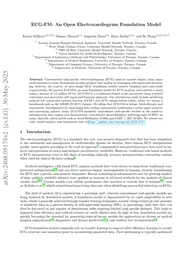
ECG-FM: An Open Electrocardiogram Foundation Model
arXiv preprint
Key results
All results- ECG-FM (Full)Table 3 (source, opens in a new tab)
0.996
AUROC ↑
AFib detection · UHN-ECG
atrial fibrillation label of the ECG interpretation task · pretrained ECG foundation model, fine-tuned
Results as reported by the authors; not independently reproduced. A SOTA star marks the best value among results reported under the same evaluation protocol; ties go to the earlier publication.
TL;DR
ECG-FM is an open-weight foundation model for ECG analysis, studied on a dataset of 1.5 million ECGs. It was tested on predicting reduced left ventricular ejection fraction and ECG interpretation labels, and the authors released a benchmark task on MIMIC-IV-ECG. It clearly beat task-specific models when labelled data were limited, with AUROCs of 0.996 for atrial fibrillation and 0.929 for LVEF of 40% or less.
- Data: 1.5 million ECGs
- Weights: open
- Result: AUROC 0.996 (AF), 0.929 (LVEF <= 40%)
- Benchmark: MIMIC-IV-ECG task released
Abstract
Conventional task-specific electrocardiogram (ECG) analysis models require large annotated datasets to train. Foundation models mitigate this burden by leveraging self-supervised pretraining; however, the scarcity of open-weight ECG foundation models hinders adoption and cross-study comparability. We present ECG-FM, an open foundation model for ECG analysis, and conduct a study using a dataset of 1.5 million ECGs. ECG-FM is a transformer-based model pretrained using a hybrid contrastive and generative self-supervised learning approach. Our downstream tasks include predicting reduced left ventricular ejection fraction (LVEF) and ECG interpretation labels, where we release a benchmark task on the MIMIC-IV-ECG dataset. We affirm that ECG-FM is robust, label-efficient, and functionally discriminative by showcasing data scaling experiments, performing a latent space analysis, and generating saliency maps. ECG-FM markedly outperforms task-specific models in the small-to-medium-scale data regime and demonstrates cross-dataset generalizability, achieving high AUROC on many clinically salient labels such as atrial fibrillation (0.996) and LVEF<=40% (0.929). We release our code, model weights, and benchmark task at https://github.com/bowang-lab/ECG-FM/.
Verbatim from arXiv (opens in a new tab) · arXiv metadata (abstracts are released under CC0)
Results on ChatPPG leaderboards
All leaderboardsNo results from this paper on ChatPPG leaderboards yet. Browse the leaderboards.
Tasks & signals
Tasks
Signals
Keywords
Datasets used
Models
How it works
Cite this paper
McKeen, K., Masood, S., Toma, A., Rubin, B., & Wang, B. (2024). ECG-FM: An Open Electrocardiogram Foundation Model. arXiv preprint. https://arxiv.org/abs/2408.05178
McKeen, Kaden, Sameer Masood, Augustin Toma, Barry Rubin, and Bo Wang. 2024. "ECG-FM: An Open Electrocardiogram Foundation Model." arXiv preprint. https://arxiv.org/abs/2408.05178.
McKeen, K., Masood, S., Toma, A., Rubin, B. and Wang, B. (2024) 'ECG-FM: An Open Electrocardiogram Foundation Model', arXiv preprint. Available at: https://arxiv.org/abs/2408.05178
McKeen, Kaden, et al. "ECG-FM: An Open Electrocardiogram Foundation Model." arXiv preprint, 2024. https://arxiv.org/abs/2408.05178.
K. McKeen, S. Masood, A. Toma, B. Rubin, and B. Wang, "ECG-FM: An Open Electrocardiogram Foundation Model," arXiv preprint, 2024, [Online]. Available: https://arxiv.org/abs/2408.05178.
@misc{mckeen2024ecgfm,
  title         = {{ECG-FM: An Open Electrocardiogram Foundation Model}},
  author        = {McKeen, Kaden and Masood, Sameer and Toma, Augustin and Rubin, Barry and Wang, Bo},
  year          = {2024},
  howpublished  = {arXiv preprint},
  eprint        = {2408.05178},
  archivePrefix = {arXiv}
}Record updated