Activity counts measure attention, not model quality. Missing counts are unknown. Publication status follows the linked source; a listed venue alone does not confirm peer review.
A transformer ECG encoder with a deep shared per-lead convolutional tokenizer (0.5 s patches, 12 × 20 = 240 tokens for a 10 s 12-lead ECG), learnable lead embeddings and 1D sinusoidal time encoding. It is built to transfer to arbitrary lead subsets (Lead I-only is called out as the wearable case). Instead of aligning ECGs only to machine interpretation reports (MERL, D-BETA, MELP), it contrastively aligns each ECG to five clinical text sources: ECG machine reports, cardiologist ECG reads, echo reports, chest X-ray reports and discharge summaries.
Signals
ECG
Form factor
clinical_12lead_to_reduced_lead
Year
2026
Architecture
Transformer ECG encoder with shared per-lead convolutional tokenizer (0.5 s patches), learnable lead embeddings
Pretraining data
MIMIC-IV-ECG train split (720,102 of 800,035 10 s 12-lead ECGs, 500 Hz) contrastively aligned to five report types: ECG machine reports, ECG cardiologist reports, echo reports, chest X-ray reports, discharge summaries
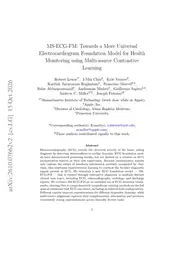
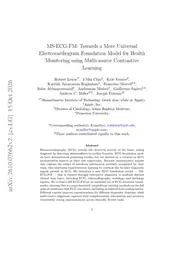
Electrocardiography (ECG) records the electrical activity of the heart, aiding diagnosis by detecting abnormalities in cardiac function. ECG foundation models have demonstrated promising results, but are limited by a reliance on ECG interpretation reports as their sole supervision. Because interpretation reports only capture the subset of waveform information routinely recognized by clinicians, this constrains representation learning to overlook the broader diagnostic signals present in ECG. We introduce a new ECG foundation model — MS-ECG-FM — that is trained through contrastive alignment to multiple distinct clinical note types, including ECG, echocardiography, radiology, and discharge reports. We evaluate MS-ECG-FM on an extended set of ECG detection benchmarks, showing that it comprehensively outperforms existing methods on the full span of conditions that ECG can detect, including in reduced-lead configurations. Different reports improve representations for different diagnostic domains, while multi-source alignment captures their complementary information and produces consistently strong representations across clinically diverse tasks.
Verbatim fromarXiv· arXiv metadata (abstracts are released under CC0)
Cite the publication recorded for this model. Check it against the publisher before submitting.
Lewis, R. A., Chiu, I.-M., Verrier, K., Raghuram, K. J., Marvel, F., Abbaspourazad, S., Mishra, A., Sapiro, G., Miller, A. C., & Futoma, J. (2026). MS-ECG-FM: Towards a More Universal Electrocardiogram Foundation Model for Health Monitoring using Multi-source Contrastive Learning. arXiv preprint. https://arxiv.org/abs/2610.07662
Lewis, Robert A., I-Min Chiu, Kyle Verrier, Karthik Jayaraman Raghuram, Francoise Marvel, Salar Abbaspourazad, Anshuman Mishra, Guillermo Sapiro, Andrew C. Miller, and Joseph Futoma. 2026. "MS-ECG-FM: Towards a More Universal Electrocardiogram Foundation Model for Health Monitoring using Multi-source Contrastive Learning." arXiv preprint. https://arxiv.org/abs/2610.07662.
Lewis, R. A., Chiu, I.-M., Verrier, K., Raghuram, K. J., Marvel, F., Abbaspourazad, S., Mishra, A., Sapiro, G., Miller, A. C. and Futoma, J. (2026) 'MS-ECG-FM: Towards a More Universal Electrocardiogram Foundation Model for Health Monitoring using Multi-source Contrastive Learning', arXiv preprint. Available at: https://arxiv.org/abs/2610.07662
Lewis, Robert A., et al. "MS-ECG-FM: Towards a More Universal Electrocardiogram Foundation Model for Health Monitoring using Multi-source Contrastive Learning." arXiv preprint, 2026. https://arxiv.org/abs/2610.07662.
R. A. Lewis et al., "MS-ECG-FM: Towards a More Universal Electrocardiogram Foundation Model for Health Monitoring using Multi-source Contrastive Learning," arXiv preprint, 2026, [Online]. Available: https://arxiv.org/abs/2610.07662.
@misc{lewis2026msecgfm,
  title         = {{MS-ECG-FM: Towards a More Universal Electrocardiogram Foundation Model for Health Monitoring using Multi-source Contrastive Learning}},
  author        = {Lewis, Robert A. and Chiu, I-Min and Verrier, Kyle and Raghuram, Karthik Jayaraman and Marvel, Francoise and Abbaspourazad, Salar and Mishra, Anshuman and Sapiro, Guillermo and Miller, Andrew C. and Futoma, Joseph},
  year          = {2026},
  howpublished  = {arXiv preprint},
  eprint        = {2610.07662},
  archivePrefix = {arXiv}
}
History
Added to the ChatPPG research hub
Newsletter
Get new PPG datasets, papers and models
Get alerts when MS-ECG-FM is benchmarked on new datasets, plus the weekly digest.
New datasets, papers and models
Practical guides from the hub
Unsubscribe anytime
The waveform is an illustration of a PPG pulse, not a recording.