Activity counts measure attention, not model quality. Missing counts are unknown. Publication status follows the linked source; a listed venue alone does not confirm peer review.
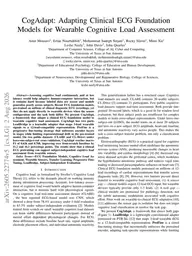
CogAdapt adapts a clinical ECG foundation model to estimate cognitive load from wearable ECG. Its ProFine strategy unfreezes encoder layers in stages to limit drift from the pretrained model. On the CLARE and CL-Drive datasets with leave-one-subject-out testing it reached macro-F1 of 0.626 and 0.768, 11.2 and 16.1 points above models trained from scratch.
Results as reported by the authors; not independently reproduced. A SOTA star marks the best value among results reported under the same evaluation protocol; ties go to the earlier publication.
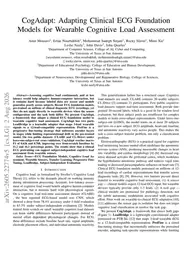
Assessing cognitive load continuously and at low latency would help adaptive human-computer interaction, but it remains hard because labeled data are scarce and models generalize poorly across subjects. Recent ECG foundation models, pre-trained on millions of clinical diagnostic ECG recordings, yet they do not apply directly to wearable devices when the sensor configuration and the task both differ. We present CogAdapt, a framework that adapts a clinical ECG foundation model to wearable cognitive load assessment. CogAdapt has two parts. LeadBridge is a learnable adapter that maps 3-lead wearable signals to a 12-lead-compatible representation. ProFine is a progressive fine-tuning strategy that unfreezes encoder layers in stages while limiting representational drift in the pre-trained model. On two public datasets (CLARE and CL-Drive) under leave-one-subject-out cross-validation, CogAdapt reaches macro-F1 of 0.626 and 0.768, improving over from-scratch baselines by 11.2 and 16.1 percentage points. The results show that a clinical ECG pretraining can support subject-independent cognitive load assessment from wearable sensors.
Verbatim fromarXiv· arXiv metadata (abstracts are released under CC0)
Key numbers
0.626
F1
On the CLARE and CL-Drive datasets with leave-one-subject-out testing it reached macro-F1 of 0.626 and 0.768, 11.2 and 16.1 points above …
How it works
Datasets linked in the hub; pretraining vs evaluation roles follow the paper.
Cite the publication recorded for this model. Check it against the publisher before submitting.
Mousavi, A., Nourbakhsh, E., Sirjani, M. S., Xie, M., Slavin, R., Neely, L., Davis, J., & Quarles, J. (2026). CogAdapt: Adapting Clinical ECG Foundation Models for Wearable Cognitive Load Assessment. arXiv preprint. https://doi.org/10.48550/arXiv.2605.22774
Mousavi, Amir, Erfan Nourbakhsh, Mohammad Sadegh Sirjani, Mimi Xie, Rocky Slavin, Leslie Neely, John Davis, and John Quarles. 2026. "CogAdapt: Adapting Clinical ECG Foundation Models for Wearable Cognitive Load Assessment." arXiv preprint. https://doi.org/10.48550/arXiv.2605.22774.
Mousavi, A., Nourbakhsh, E., Sirjani, M. S., Xie, M., Slavin, R., Neely, L., Davis, J. and Quarles, J. (2026) 'CogAdapt: Adapting Clinical ECG Foundation Models for Wearable Cognitive Load Assessment', arXiv preprint. doi: 10.48550/arXiv.2605.22774.
Mousavi, Amir, et al. "CogAdapt: Adapting Clinical ECG Foundation Models for Wearable Cognitive Load Assessment." arXiv preprint, 2026. https://doi.org/10.48550/arXiv.2605.22774.
A. Mousavi et al., "CogAdapt: Adapting Clinical ECG Foundation Models for Wearable Cognitive Load Assessment," arXiv preprint, 2026, doi: 10.48550/arXiv.2605.22774.
@misc{mousavi2026cogadapt,
  title         = {{CogAdapt: Adapting Clinical ECG Foundation Models for Wearable Cognitive Load Assessment}},
  author        = {Mousavi, Amir and Nourbakhsh, Erfan and Sirjani, Mohammad Sadegh and Xie, Mimi and Slavin, Rocky and Neely, Leslie and Davis, John and Quarles, John},
  year          = {2026},
  howpublished  = {arXiv preprint},
  doi           = {10.48550/arXiv.2605.22774},
  eprint        = {2605.22774},
  archivePrefix = {arXiv}
}
History
Added to the ChatPPG research hub
Newsletter
Get new PPG datasets, papers and models
Get alerts when CogAdapt is benchmarked on new datasets, plus the weekly digest.
New datasets, papers and models
Practical guides from the hub
Unsubscribe anytime
The waveform is an illustration of a PPG pulse, not a recording.