Activity counts measure attention, not model quality. Missing counts are unknown. Publication status follows the linked source; a listed venue alone does not confirm peer review.
ECG-FM is an open-weight foundation model for electrocardiogram analysis from Kaden McKeen, Sameer Masood, Augustin Toma, Barry Rubin and Bo Wang, described in "ECG-FM: An Open Electrocardiogram Foundation Model" (arXiv 2408.05178).
The authors start from a practical gap. Task-specific ECG models need large labeled datasets, and although foundation models reduce that burden through self-supervised pretraining, few ECG foundation models had open weights, which made adoption and cross-study comparison hard. ECG-FM is their answer: a transformer-based model pretrained with a hybrid contrastive and generative self-supervised approach, studied on a dataset of 1.5 million ECGs.
Downstream tasks include predicting reduced left ventricular ejection fraction (LVEF) and ECG interpretation labels, and the team released a benchmark task built on the MIMIC-IV-ECG dataset. The paper backs its claims of label efficiency with data scaling experiments, a latent space analysis and saliency maps. ECG-FM clearly outperforms task-specific models when labeled data is small to medium in size and generalizes across datasets, with AUROC of 0.996 for atrial fibrillation and 0.929 for LVEF at or below 40%.
The code, weights and benchmark task are released. The GitHub repository (bowang-lab/ECG-FM) and the Hugging Face repository (wanglab/ecg-fm) both use the MIT license. The Hugging Face repository hosts weights only; the model cannot be loaded with the transformers library, so you load it as the GitHub instructions describe. Training runs through the fairseq-signals framework, and configuration files are provided for reproducibility.
ECG-FM is ECG only, but it is often used next to PPG models in multimodal cardiac work. Its open MIT weights make it an easy baseline when you need an ECG encoder, for example for synchronized PPG and ECG datasets such as BIDMC, MIMIC PERform or PulseDB.
Signals
ECG
Study dataset
1.5 million ECGs
Year
2024
Paper
ECG-FM: An Open Electrocardiogram Foundation Model (McKeen, Masood, Toma, Rubin, Wang), arXiv 2408.05178
Architecture
transformer, hybrid contrastive and generative self-supervised pretraining
Results
AUROC 0.996 for atrial fibrillation, 0.929 for LVEF at or below 40%
Benchmark task released on MIMIC-IV-ECG
Weights
Hugging Face wanglab/ecg-fm (MIT); code github.com/bowang-lab/ECG-FM (MIT)
atrial fibrillation label of the ECG interpretation task · pretrained ECG foundation model, fine-tuned
Results as reported by the authors; not independently reproduced. A SOTA star marks the best value among results reported under the same evaluation protocol; ties go to the earlier publication.
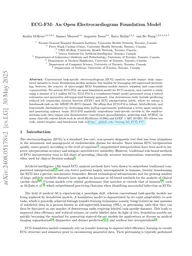
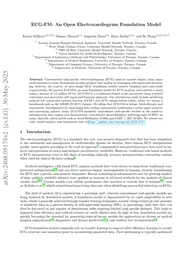
Conventional task-specific electrocardiogram (ECG) analysis models require large annotated datasets to train. Foundation models mitigate this burden by leveraging self-supervised pretraining; however, the scarcity of open-weight ECG foundation models hinders adoption and cross-study comparability. We present ECG-FM, an open foundation model for ECG analysis, and conduct a study using a dataset of 1.5 million ECGs. ECG-FM is a transformer-based model pretrained using a hybrid contrastive and generative self-supervised learning approach. Our downstream tasks include predicting reduced left ventricular ejection fraction (LVEF) and ECG interpretation labels, where we release a benchmark task on the MIMIC-IV-ECG dataset. We affirm that ECG-FM is robust, label-efficient, and functionally discriminative by showcasing data scaling experiments, performing a latent space analysis, and generating saliency maps. ECG-FM markedly outperforms task-specific models in the small-to-medium-scale data regime and demonstrates cross-dataset generalizability, achieving high AUROC on many clinically salient labels such as atrial fibrillation (0.996) and LVEF<=40% (0.929). We release our code, model weights, and benchmark task at https://github.com/bowang-lab/ECG-FM/.
Verbatim fromarXiv· arXiv metadata (abstracts are released under CC0)
ECG-FM is an open-weight transformer foundation model for ECG analysis, pretrained with a hybrid contrastive and generative self-supervised approach and studied on 1.5 million ECGs.
How do I download ECG-FM?
Weights are at https://huggingface.co/wanglab/ecg-fm and code at https://github.com/bowang-lab/ECG-FM, both MIT. Load the weights with the GitHub code, not the transformers library.
ECG-FM vs HuBERT-ECG?
ECG-FM was studied on 1.5 million ECGs and is MIT licensed. HuBERT-ECG was pre-trained on 9.1 million 12-lead ECGs, comes in three sizes and is released under CC BY-NC 4.0.
What are ECG-FM's benchmark results?
ECG-FM reports AUROC of 0.996 for atrial fibrillation and 0.929 for LVEF at or below 40%, and it outperforms task-specific models in the small-to-medium data regime.
Cite this model
Cite the publication recorded for this model. Check it against the publisher before submitting.
McKeen, K., Masood, S., Toma, A., Rubin, B., & Wang, B. (2024). ECG-FM: An Open Electrocardiogram Foundation Model. JAMIA Open 2025. https://doi.org/10.48550/ARXIV.2408.05178
McKeen, Kaden, Sameer Masood, Augustin Toma, Barry Rubin, and Bo Wang. 2024. "ECG-FM: An Open Electrocardiogram Foundation Model." JAMIA Open 2025. https://doi.org/10.48550/ARXIV.2408.05178.
McKeen, K., Masood, S., Toma, A., Rubin, B. and Wang, B. (2024) 'ECG-FM: An Open Electrocardiogram Foundation Model', JAMIA Open 2025. doi: 10.48550/ARXIV.2408.05178.
McKeen, Kaden, et al. "ECG-FM: An Open Electrocardiogram Foundation Model." JAMIA Open 2025, 2024. https://doi.org/10.48550/ARXIV.2408.05178.
K. McKeen, S. Masood, A. Toma, B. Rubin, and B. Wang, "ECG-FM: An Open Electrocardiogram Foundation Model," JAMIA Open 2025, 2024, doi: 10.48550/ARXIV.2408.05178.
@misc{mckeen2024ecgfm,
  title         = {{ECG-FM: An Open Electrocardiogram Foundation Model}},
  author        = {McKeen, Kaden and Masood, Sameer and Toma, Augustin and Rubin, Barry and Wang, Bo},
  year          = {2024},
  howpublished  = {JAMIA Open 2025},
  publisher     = {arXiv},
  doi           = {10.48550/ARXIV.2408.05178},
  eprint        = {2408.05178},
  archivePrefix = {arXiv}
}
History
Record updated
Added to the ChatPPG research hub
Newsletter
Get new PPG datasets, papers and models
Get alerts when ECG-FM is benchmarked on new datasets, plus the weekly digest.
New datasets, papers and models
Practical guides from the hub
Unsubscribe anytime
The waveform is an illustration of a PPG pulse, not a recording.