PaperarXiv:2610.35378
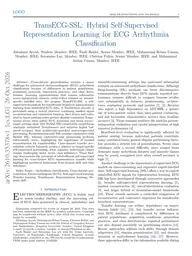
TransECG-SSL: hybrid self-supervised representation learning for ECG arrhythmia classification
arXiv 2610.35378v1 (cs.LG, 26 Oct 2026); submitted to IEEE
Open codeLicence: arXiv.org perpetual non-exclusive licence (arXiv default; not an open-content licence)
TL;DR
TransECG-SSL pretrains a Transformer heartbeat encoder with a hybrid masked-reconstruction and contrastive objective, then evaluates patient-disjoint within- and cross-dataset arrhythmia classification on MIT-BIH, INCART, and SVDB. Hybrid self-supervision beat contrastive-only transfer on most cross-dataset routes, while absolute balanced accuracy remains modest for minority classes. Code is promised after publication; the named GitHub repository was not available when this entry was prepared.
- Form factor: other (Holter/clinical ECG databases)
Abstract
Cross-dataset generalisation remains a major challenge for automated electrocardiogram (ECG) arrhythmia classification because of differences in patient populations, acquisition protocols, annotation practices, and class distributions. Learning representations that remain informative across independent datasets could reduce reliance on dataset-specific labelled data. We propose TransECG-SSL, a self-supervised framework for transferable heartbeat representation learning from unlabelled ECG data. A Transformer encoder is pretrained using a hybrid objective combining masked signal reconstruction and contrastive learning, then frozen and evaluated by linear probing under patient-disjoint evaluation. Experiments across three public ECG databases and seven source–target settings show that Hybrid SSL consistently outperforms randomly initialised Transformers and achieves higher balanced accuracy than architecture-matched source-supervised pretraining. Reconstruction-only SSL remains competitive with Hybrid SSL, whereas contrastive-only pretraining performs substantially worse, highlighting the importance of masked reconstruction for transferability. Cross-dataset transfer nevertheless reduces balanced accuracy relative to target-specific self-supervised pretraining, while minority arrhythmia classes remain challenging under severe class imbalance. These findings demonstrate the potential of label-efficient self-supervised learning for cross-dataset ECG representation transfer while highlighting persistent limitations from domain shift and class imbalance.
Verbatim from arXiv (opens in a new tab) · arXiv metadata (abstracts are released under CC0)
Results on ChatPPG leaderboards
All leaderboardsNo results from this paper on ChatPPG leaderboards yet. Browse the leaderboards.
Tasks & signals
Tasks
Signals
Keywords
Datasets
How it works
Cite this paper
APA
Ayyub, A., Haider, F., Usman, M. R., Luz, S., Politis, C., & Usman., M. A. (2026). TransECG-SSL: hybrid self-supervised representation learning for ECG arrhythmia classification. arXiv 2610.35378v1. https://arxiv.org/abs/2610.35378
BibTeX
@misc{ayyub2026transecgssl,
  title         = {{TransECG-SSL: hybrid self-supervised representation learning for ECG arrhythmia classification}},
  author        = {Ayyub, Ahtisham and Haider, Fasih and Usman, Muhammad Rehan and Luz, Saturnino and Politis, Christos and Usman., Muhammad Arslan},
  year          = {2026},
  howpublished  = {arXiv 2610.35378v1},
  eprint        = {2610.35378},
  archivePrefix = {arXiv}
}
Built from the hub record. Check it against the publisher before submitting.
Added to the ChatPPG research hub