PaperarXiv:2610.05649
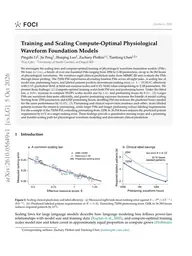
Training and Scaling Compute-Optimal Physiological Waveform Foundation Models
arXiv preprint
 (opens in a new tab)
Li, Pingzhi et al., "Training and Scaling Compute-Optimal Physiological Waveform Foundation Models", arXiv:2610.05649, CC BY 4.0
TL;DR
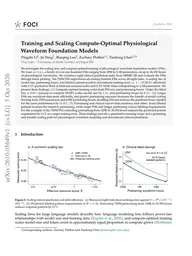
This paper studies scaling laws and compute-optimal training for physiological waveform foundation models. The authors trained Aether, more than 100 models from 20M to 2.1B parameters, on up to 36.3M hours of waveforms and tested them on eight clinical tasks built from MIMIC-III. The 720M model beat all existing baseline foundation models on all eight tasks.
- Models: 100+ from 20M to 2.1B parameters
- Pretraining: up to 36.3M hours of waveforms
- Result: 720M model beats all baselines on 8 clinical tasks
- Result: scaling law predicts downstream error with 0.5% MAE
Abstract
We investigate the scaling laws and compute-optimal training of physiological waveform foundation models (FMs). We train Aether, a family of over one hundred FMs ranging from 20M to 2.1B parameters, on up to 36.3M hours of physiological waveforms. We construct eight clinical prediction tasks from MIMIC-III and evaluate the FMs through linear probing. The 720M FM outperforms all existing baseline FMs across all eight tasks. A scaling law of model size, pretraining hours, and labeled patients predicts downstream ranking error, i.e. 1-AUROC, effectively with 0.5% prediction MAE at held-out resource scales and 0.9% MAE when extrapolating to 2.1B parameters. We present three findings: (1) Compute-optimal training scales both FM size and pretraining hours. Under the fitted law, a 10.0× increase in compute FLOPs scales model size by 1.2× and pretraining hours by 8.2×. (2) Larger FMs use waveform data more efficiently, and greater pretraining exposure increases the benefit of model scaling. Starting from 25M parameters and 4.8M pretraining hours, doubling FM size reduces the predicted hours needed for the same performance by 51.8%. (3) Pretraining and clinical supervision reinforce each other: more labeled patients increase the return to pretraining, while larger FMs and longer pretraining reduce labeling requirements. For the example of the 720M FM, extending pretraining from 120K to 36.3M hours reduces the predicted patient requirement by 61% at a target ranking error. These findings provide a quantitative training recipe and a promising and durable scaling path for physiological waveform modeling and downstream clinical prediction.
Verbatim from arXiv (opens in a new tab) · arXiv metadata (abstracts are released under CC0)
Results on ChatPPG leaderboards
All leaderboardsNo results from this paper on ChatPPG leaderboards yet. Browse the leaderboards.
Tasks & signals
Signals
Keywords
Datasets used
Models
How it works
Cite this paper
Li, P., Peng, J., Luo, S., Plotkin, Z., & Chen, T. (2026). Training and Scaling Compute-Optimal Physiological Waveform Foundation Models. arXiv preprint. https://arxiv.org/abs/2610.05649
Li, Pingzhi, Jie Peng, Shuqing Luo, Zachary Plotkin, and Tianlong Chen. 2026. "Training and Scaling Compute-Optimal Physiological Waveform Foundation Models." arXiv preprint. https://arxiv.org/abs/2610.05649.
Li, P., Peng, J., Luo, S., Plotkin, Z. and Chen, T. (2026) 'Training and Scaling Compute-Optimal Physiological Waveform Foundation Models', arXiv preprint. Available at: https://arxiv.org/abs/2610.05649
Li, Pingzhi, et al. "Training and Scaling Compute-Optimal Physiological Waveform Foundation Models." arXiv preprint, 2026. https://arxiv.org/abs/2610.05649.
P. Li, J. Peng, S. Luo, Z. Plotkin, and T. Chen, "Training and Scaling Compute-Optimal Physiological Waveform Foundation Models," arXiv preprint, 2026, [Online]. Available: https://arxiv.org/abs/2610.05649.
@misc{li2026training,
  title         = {{Training and Scaling Compute-Optimal Physiological Waveform Foundation Models}},
  author        = {Li, Pingzhi and Peng, Jie and Luo, Shuqing and Plotkin, Zachary and Chen, Tianlong},
  year          = {2026},
  howpublished  = {arXiv preprint},
  eprint        = {2610.05649},
  archivePrefix = {arXiv}
}Added to the ChatPPG research hub