Activity counts measure attention, not model quality. Missing counts are unknown. Publication status follows the linked source; a listed venue alone does not confirm peer review.
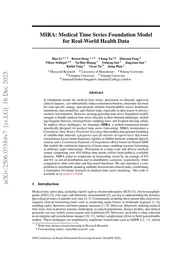
MIRA is a foundation model for medical time series forecasting from Hao Li, Bowen Deng, Chang Xu and colleagues, with code from Microsoft. The paper, "MIRA: Medical Time Series Foundation Model for Real-World Health Data" (arXiv 2506.07584), was accepted to the NeurIPS 2025 main conference.
General time series foundation models struggle with medical data because of irregular intervals, heterogeneous sampling rates and frequent missing values. MIRA is built for exactly those problems. It has three main parts. Continuous-Time Rotary Positional Encoding (CT-RoPE) models variable time intervals directly. A frequency-specific mixture-of-experts layer routes computation across latent frequency regimes so different experts specialize. A Continuous Dynamics Extrapolation Block based on Neural ODEs models the continuous trajectory of latent states, which lets the model forecast at arbitrary target timestamps.
MIRA was pretrained on over 454 billion time points from publicly available medical datasets. The README describes the corpus as ICU physiological signals plus hospital EHR time series, with sampling frequencies ranging from minute-level vitals and hourly labs to waveform segments and multi-day clinical indicators. Sources listed include MIMIC and the WAVES Pediatric Waveform Database.
On results, the README says MIRA achieves state-of-the-art zero-shot forecasting across clinical benchmarks and obtains the best results in 4 of 5 out-of-distribution evaluation settings against existing foundation models. The authors also introduce a benchmark that spans several downstream clinical tasks. Different versions of the arXiv abstract give different average error reductions, so check the version you cite.
The code is on GitHub at microsoft/MIRA under the MIT license, with scripts for training on CPU or GPU and for loading a checkpoint with from_pretrained. MIRA is a forecasting model, not a PPG encoder, but it is one of the few foundation models designed for irregular clinical vitals. It is a good fit for forecasting heart rate or SpO2 trends from ICU records, which is where PPG-derived numbers usually end up.
Signals
PPG, ECG, EEG, EHR, medical time series
Code
github.com/microsoft/MIRA (MIT)
Year
2025
Paper
MIRA: Medical Time Series Foundation Model for Real-World Health Data (Li et al.), arXiv 2506.07584, NeurIPS 2025
Pretraining
over 454 billion time points from public medical datasets
Components
CT-RoPE, frequency-specific mixture of experts, Neural ODE extrapolation block
Best results in 4 of 5 out-of-distribution settings (README)
A unified foundation model for medical time series – pretrained on open access and ethics board-approved medical corpora – offers the potential to reduce annotation burdens, minimize model customization, and enable robust transfer across clinical institutions, modalities, and tasks, particularly in data-scarce or privacy-constrained environments. However, existing generalist time series foundation models struggle to handle medical time series data due to their inherent challenges, including irregular intervals, heterogeneous sampling rates, and frequent missing values. To address these challenges, we introduce MIRA, a unified foundation model specifically designed for medical time series forecasting. MIRA incorporates a Continuous-Time Rotary Positional Encoding that enables fine-grained modeling of variable time intervals, a frequency-specific mixture-of-experts layer that routes computation across latent frequency regimes to further promote temporal specialization, and a Continuous Dynamics Extrapolation Block based on Neural ODE that models the continuous trajectory of latent states, enabling accurate forecasting at arbitrary target timestamps. Pretrained on a large-scale and diverse medical corpus comprising over 454 billion time points collect from publicly available datasets, MIRA achieves reductions in forecasting errors by an average of 10% and 7% in out-of-distribution and in-distribution scenarios, respectively, when compared to other zero-shot and fine-tuned baselines. We also introduce a comprehensive benchmark spanning multiple downstream clinical tasks, establishing a foundation for future research in medical time series modeling.
Verbatim fromarXiv· arXiv metadata (abstracts are released under CC0)
How it works
Datasets linked in the hub; pretraining vs evaluation roles follow the paper.
MIRA is a medical time series forecasting foundation model, accepted to NeurIPS 2025, pretrained on over 454 billion time points from public medical datasets and designed for irregular sampling and missing values.
How do I get MIRA?
The code is at https://github.com/microsoft/MIRA under the MIT license.
MIRA vs general time series foundation models?
MIRA adds continuous-time positional encoding, a frequency-specific mixture of experts and a Neural ODE block to handle irregular intervals, mixed sampling rates and missing values in medical data.
What are MIRA's benchmark results?
The README reports state-of-the-art zero-shot forecasting and the best results in 4 of 5 out-of-distribution settings compared with existing foundation models.
Cite this model
Cite the publication recorded for this model. Check it against the publisher before submitting.
Li, H., Deng, B., Xu, C., Feng, Z., Schlegel, V., Huang, Y.-H., Sun, Y., Sun, J., Yang, K., Yu, Y., & Bian, J. (2025). MIRA: Medical Time Series Foundation Model for Real-World Health Data. NeurIPS 2025. https://doi.org/10.48550/ARXIV.2506.07584
Li, Hao, Bowen Deng, Chang Xu, Zhiyuan Feng, Viktor Schlegel, Yu-Hao Huang, and Yizheng Sun, et al. 2025. "MIRA: Medical Time Series Foundation Model for Real-World Health Data." NeurIPS 2025. https://doi.org/10.48550/ARXIV.2506.07584.
Li, H., Deng, B., Xu, C., Feng, Z., Schlegel, V., Huang, Y.-H. and Sun, Y. et al. (2025) 'MIRA: Medical Time Series Foundation Model for Real-World Health Data', NeurIPS 2025. doi: 10.48550/ARXIV.2506.07584.
Li, Hao, et al. "MIRA: Medical Time Series Foundation Model for Real-World Health Data." NeurIPS 2025, 2025. https://doi.org/10.48550/ARXIV.2506.07584.
H. Li et al., "MIRA: Medical Time Series Foundation Model for Real-World Health Data," NeurIPS 2025, 2025, doi: 10.48550/ARXIV.2506.07584.
@misc{li2025mira,
  title         = {{MIRA: Medical Time Series Foundation Model for Real-World Health Data}},
  author        = {Li, Hao and Deng, Bowen and Xu, Chang and Feng, Zhiyuan and Schlegel, Viktor and Huang, Yu-Hao and Sun, Yizheng and Sun, Jingyuan and Yang, Kailai and Yu, Yiyao and Bian, Jiang},
  year          = {2025},
  howpublished  = {NeurIPS 2025},
  publisher     = {arXiv},
  doi           = {10.48550/ARXIV.2506.07584},
  eprint        = {2506.07584},
  archivePrefix = {arXiv}
}
History
Record updated
Added to the ChatPPG research hub
Newsletter
Get new PPG datasets, papers and models
Get alerts when MIRA is benchmarked on new datasets, plus the weekly digest.
New datasets, papers and models
Practical guides from the hub
Unsubscribe anytime
The waveform is an illustration of a PPG pulse, not a recording.