Dataset

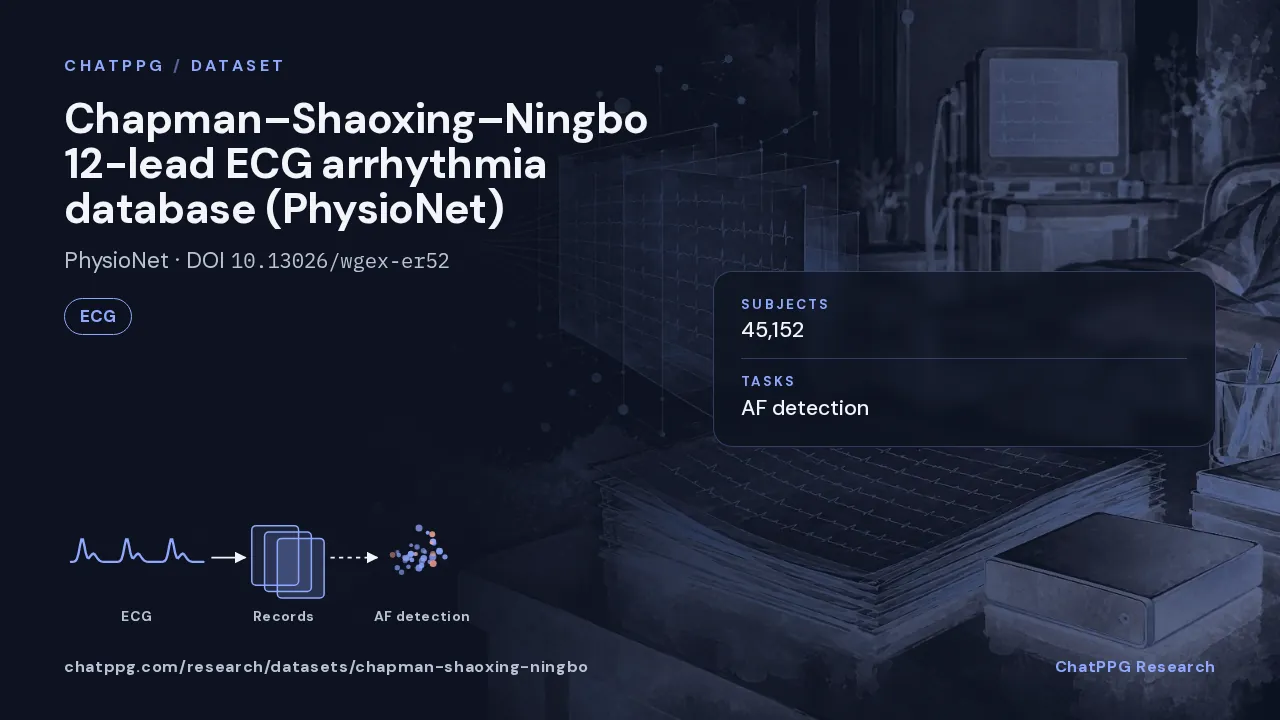
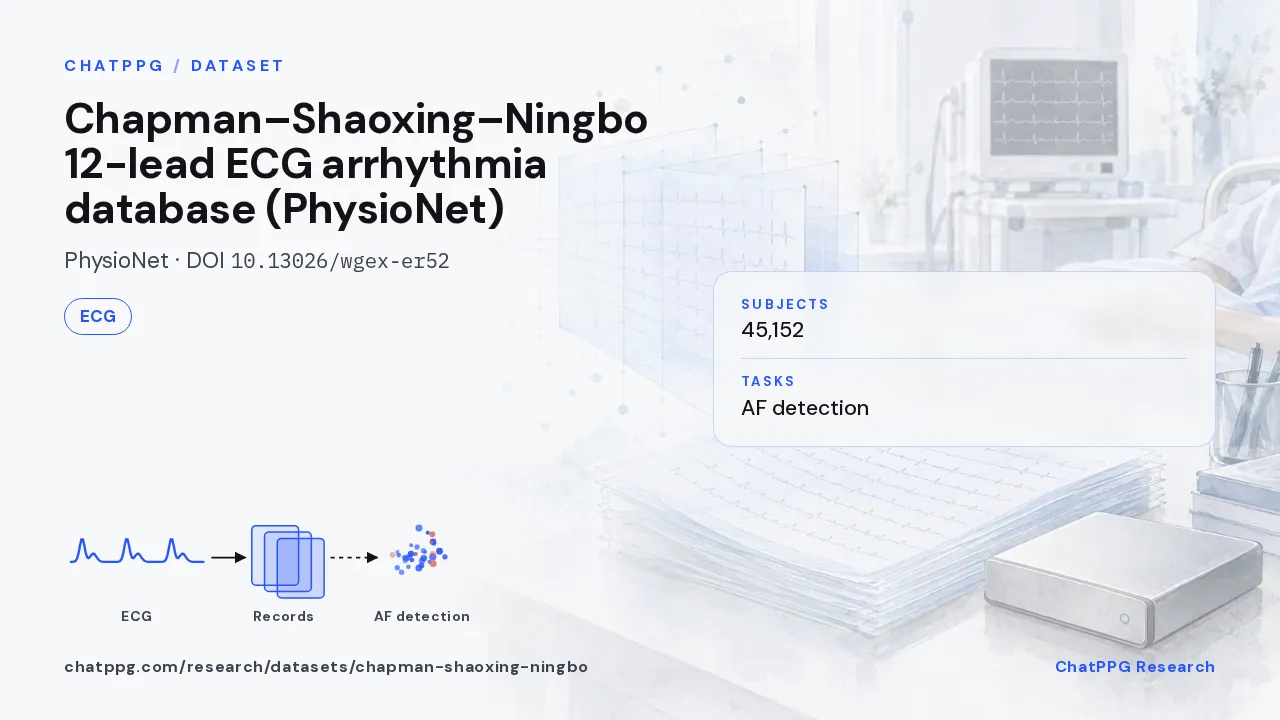
Chapman–Shaoxing–Ningbo 12-lead ECG arrhythmia database (PhysioNet)

10-s resting 12-lead ECGs from 45,152 patients (Chapman University, Shaoxing People's Hospital, Ningbo First Hospital), GE MUSE; rhythm labels (incl. AFIB) and conditions (PVC, RBBB, LBBB, APB) by two physicians, SNOMED-CT coded. Earlier 10,646-patient subset on figshare (10.6084/m9.figshare.c.4560497.v2).

License

Creative Commons Attribution 4.0 International (CC BY 4.0)

Original description

This newly inaugurated research database for 12-lead electrocardiogram (ECG) signals was created under the auspices of Chapman University, Shaoxing People’s Hospital (Shaoxing Hospital Zhejiang University School of Medicine), and Ningbo First Hospital. It aims to enable the scientific community in conducting new studies on arrhythmia and other cardiovascular conditions. Certain types of arrhythmias, such as atrial fibrillation, have a pronounced negative impact on public health, quality of life, and medical expenditures. As a non-invasive test, ECG is a major and vital diagnostic tool for detecting these conditions. This practice, however, generates large amounts of data, the analysis of which requires considerable time and effort by human experts. Modern machine learning and statistical tools can be trained on high quality, large data to achieve exceptional levels of automated diagnostic accuracy. Thus, we collected and disseminated this novel database that contains 12-lead ECGs of 45,152 patients with a 500 Hz sampling rate that features multiple common rhythms and additional cardiovascular conditions, all labeled by professional experts. The dataset can be used to design, compare, and fine-tune new and classical statistical and machine learning techniques in studies focused on arrhythmia and other cardiovascular conditions.

Verbatim fromPhysioNet· Licence: Creative Commons Attribution 4.0 International Public License

Chapman–Shaoxing–Ningbo 12-lead ECG arrhythmia database (PhysioNet): overview

This PhysioNet database from Chapman University, Shaoxing People's Hospital and Ningbo First Hospital contains 45,152 resting 12-lead ECGs, each 10 seconds long at 500 Hz. A licensed physician labelled each ECG's rhythm and other conditions, a second physician validated the labels, and a senior physician settled disagreements. Labels, age and sex are stored in the WFDB headers as SNOMED CT codes. There is no PPG, but it is a large, openly licensed source of AF and other rhythm labels for ECG pretraining or teacher models. An earlier 10,646-patient version was published on figshare (Scientific Data 2020).

What's inside

ECGs
45,152 patients, one 10 s resting 12-lead ECG each
Sampling
500 Hz, amplitude in microvolts (4.88 µV per bit)
Labels
Rhythm (including AFIB) and other conditions such as PVC, RBBB, LBBB and APB, applied to the whole recording
Coding
SNOMED CT codes in each header; ConditionNames_SNOMED-CT.xlsx maps them to names
Formats
WFDB (.hea + .mat) in WFDBRecords/<46 folders>/<10 subfolders>
Size
5.1 GB uncompressed, 2.3 GB zip

How to access it

Host: PhysioNet

  1. Open access: no account needed.
  2. Download the 2.3 GB zip, use wget, or stream single records with wfdb.
  3. Map the Dx codes in each header with ConditionNames_SNOMED-CT.xlsx.

Licence: Creative Commons Attribution 4.0 International (CC BY 4.0)

What it allows: Any use, including commercial, with attribution.

Load Chapman–Shaoxing–Ningbo 12-lead ECG arrhythmia database (PhysioNet) in Python

Testedpip install wfdb
import wfdb

rec = wfdb.rdrecord("JS00001", pn_dir="ecg-arrhythmia/1.0.0/WFDBRecords/01/010")
print(rec.fs, rec.sig_name, rec.p_signal.shape)   # 500 Hz, 12 leads, (5000, 12)
print(rec.comments)                                # Age, Sex, Dx (SNOMED CT codes)

Run on 21 Oct 2026: JS00001 loads as 12 leads × 5,000 samples at 500 Hz; comments hold Age, Sex and three Dx codes.

Caveats

  • ECG only: there is no PPG, so use it for rhythm pretraining, teacher labels or ECG baselines, not to train a PPG model directly.
  • Labels describe the whole 10-second recording, not individual beats or episodes.
  • Resting in-hospital ECGs: no motion and no ambulatory conditions.
  • The figshare release covers 10,646 of the same patients; do not combine the two as separate datasets.

Similar datasets

DatasetSubjectsSignalsLicence
PTB-XL18,869ecgCC BY 4.0
CODE-15%: large annotated 12-lead ECG dataset (Telehealth Network of Minas Gerais)n/aecgCC BY 4.0
PhysioNet/CinC Challenge 2017: AF classification from a short single-lead ECG (AliveCor)n/aecgOpen Data Commons Attribution License v1.0 (ODC-By)
MIT-BIH Arrhythmia Database (PhysioNet)25ecgOpen Data Commons Attribution License v1.0 (ODC-By)

Sources: PhysioNet project page · Zheng et al. 2020 · Updated 2026-10-21

Chapman–Shaoxing–Ningbo 12-lead ECG arrhythmia database (PhysioNet): ChatPPG research summary card

Key numbers

45,152
Subjects
1
Reference labels
AFIB
500 Hz
Released sampling rate
500 Hz

How it works

How Chapman–Shaoxing–Ningbo 12-lead ECG arrhythmia database (PhysioNet) works: Devices & body sites → Signals recorded → TasksDevices & body sites: None (PPG site). Signals recorded: Chapman–Shaoxing–Ningbo 12-lead ECG arrhythmia database (PhysioNet), 45,152 subjects · 500 Hz, signals ECG. Tasks: AF / rhythm.Devices & body sitesNone: PPG siteNonePPG siteSignals recordedChapman–Shaoxing–Ningbo…45,152 subjects · 500 HzECGTasksAF / rhythmAF / rhythm
Sampling
500 Hz
Reference labels
afib

Papers and models using this dataset· 14

Papers

Models

#16 of 186 most-used datasets by published papers and models · #10 of 78 ECG

Browse these 9 papers in the research explorer (filtered to Chapman–Shaoxing–Ningbo 12-lead ECG arrhythmia database (PhysioNet))

FAQ

How many ECGs are in the Chapman–Shaoxing–Ningbo database?

45,152 patients, each with a 10-second 12-lead ECG at 500 Hz.

Does the Chapman dataset include atrial fibrillation labels?

Yes. Rhythm labels include AFIB, along with other rhythms and conditions, coded in SNOMED CT.

What licence is the Chapman–Shaoxing–Ningbo ECG database under?

The PhysioNet release is CC BY 4.0.

Does it contain PPG?

No. It is 12-lead ECG only.

Cite this dataset

Cite this dataset with the fields recorded here. Check it against the publisher before submitting.

Chapman–Shaoxing–Ningbo 12-lead ECG arrhythmia database (PhysioNet) [Data set]. (n.d.). physionet. https://doi.org/10.13026/wgex-er52
@misc{chapmanshaoxingnchapmanshaoxingningbo,
  title         = {{Chapman–Shaoxing–Ningbo 12-lead ECG arrhythmia database (PhysioNet)}},
  howpublished  = {physionet},
  doi           = {10.13026/wgex-er52}
}

Cite the ChatPPG record

Cite the dated snapshot 2026-10 for a fixed, reproducible version. Please also cite the original publications listed above.

APA

ChatPPG. (2026). Chapman–Shaoxing–Ningbo 12-lead ECG arrhythmia database (PhysioNet): dataset record (Version 2026-10) [Data set]. ChatPPG Research Hub. https://chatppg.com/research/datasets/chapman-shaoxing-ningbo

BibTeX
@misc{chatppg_dataset_chapman_shaoxing_ningbo,
  author       = {{ChatPPG}},
  title        = {{Chapman–Shaoxing–Ningbo 12-lead ECG arrhythmia database (PhysioNet): dataset record}},
  year         = {2026},
  month        = nov,
  version      = {2026-10},
  howpublished = {\url{https://chatppg.com/research/datasets/chapman-shaoxing-ningbo}},
  note         = {ChatPPG Research Hub, Snapshot 2026-10, https://chatppg.com/research/snapshots/2026-10}
}
CITATION.cff
cff-version: 1.2.0
message: "If you use this resource, please cite it as below."
type: dataset
title: "Chapman–Shaoxing–Ningbo 12-lead ECG arrhythmia database (PhysioNet): dataset record"
authors:
  - name: "ChatPPG"
url: "https://chatppg.com/research/datasets/chapman-shaoxing-ningbo"
repository-artifact: "https://chatppg.com/research/snapshots/2026-10"
version: "2026-10"
date-released: "2026-11-24"

History

  1. Record updated