Paperdoi:10.1109/ACCESS.2026.3756286
ECG Characterization via Autocorrelation and Embedded Machine Learning for Classification of Sinus Rhythm and Atrial Fibrillation
IEEE Access, 2026
TL;DR
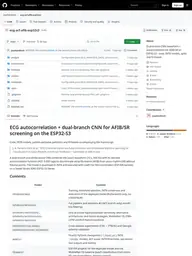
A dual-branch 1D-CNN classifies atrial fibrillation versus sinus rhythm from a raw 10-second single-lead ECG plus its autocorrelation function, without R-peak detection. Trained on PTB-XL and Chapman-Shaoxing-Ningbo with patient-exclusive splits and quantized to INT8 on an ESP32-S3, it reached AUC 0.9972 on 4,025 recordings from unseen patients and AUC 0.9560 (sensitivity 0.7823) on an external cohort of 2,069 recordings, using 519.7 ms, 188.97 KB and 169.4 mJ per window. Code is on GitHub under MIT.
- Form factor: single-lead ECG, 10 s windows, ESP32-S3 microcontroller
Abstract
Atrial fibrillation (AFIB) is the most prevalent sustained cardiac arrhythmia, and its growing burden calls for low-cost, autonomous screening devices. Existing detectors typically depend on fiducial points, such as R-peak locations and R-R intervals, or on models too large for wearable microcontrollers, and few report end-to-end latency or energy consumption on the target hardware. This study investigates whether a dual-branch one-dimensional convolutional neural network that combines the electrocardiogram (ECG) waveform with its discrete autocorrelation function (ACF) can discriminate AFIB from sinus rhythm in 10-second single-lead windows, without fiducial points, on a microcontroller. The model was trained on the PTB-XL and Chapman-Shaoxing-Ningbo databases with patient-exclusive partitions and 10-fold cross-validation, quantized to 8-bit integers, and executed on an ESP32-S3 microcontroller. On 4,025 test recordings from patients unseen during training, the INT8 model achieved an area under the receiver operating characteristic curve (AUC) of 0.9972, sensitivity of 0.9618, specificity of 0.9879, and F1-score of 0.9369. On an external cohort from a third institution (2,069 recordings), the AUC was 0.9560, but sensitivity fell to 0.7823 at the transferred threshold, reflecting both the threshold transfer and lower discrimination across corpora. Each window was processed in 519.7 ms by a 188.97 KB model, consuming 169.4 mJ. Removing smoothing and non-local means denoising caused no detectable loss of discrimination and reduced latency 7.74-fold. The model outperformed lightweight convolutional, recurrent, and R-R-feature baselines. These results show that AFIB screening support can run entirely on a microcontroller from short single-lead recordings, without fiducial-point detection or cloud offloading.
Verbatim from OpenAlex (opens in a new tab) · Abstract via OpenAlex (publisher-deposited); © the authors/publisher
Results on ChatPPG leaderboards
All leaderboardsNo results from this paper on ChatPPG leaderboards yet. Browse the leaderboards.
Tasks & signals
Tasks
Signals
Keywords
Datasets used
How it works
Cite this paper
Filho, J. A. F., Gomes, O. D. S. M., Rovai, M. J., Bernardi, A., Carmo, R. M. D., & Zennaro, M. (2026). ECG Characterization via Autocorrelation and Embedded Machine Learning for Classification of Sinus Rhythm and Atrial Fibrillation. IEEE Access, 2026. https://doi.org/10.1109/ACCESS.2026.3756286
Filho, José Alberto Ferreira, Otávio de Souza Martins Gomes, Marcelo José Rovai, André Bernardi, Ricardo Magno do Carmo, and Marco Zennaro. 2026. "ECG Characterization via Autocorrelation and Embedded Machine Learning for Classification of Sinus Rhythm and Atrial Fibrillation." IEEE Access, 2026. https://doi.org/10.1109/ACCESS.2026.3756286.
Filho, J. A. F., Gomes, O. D. S. M., Rovai, M. J., Bernardi, A., Carmo, R. M. D. and Zennaro, M. (2026) 'ECG Characterization via Autocorrelation and Embedded Machine Learning for Classification of Sinus Rhythm and Atrial Fibrillation', IEEE Access, 2026. doi: 10.1109/ACCESS.2026.3756286.
Filho, José Alberto Ferreira, et al. "ECG Characterization via Autocorrelation and Embedded Machine Learning for Classification of Sinus Rhythm and Atrial Fibrillation." IEEE Access, 2026, 2026. https://doi.org/10.1109/ACCESS.2026.3756286.
J. A. F. Filho, O. D. S. M. Gomes, M. J. Rovai, A. Bernardi, R. M. D. Carmo, and M. Zennaro, "ECG Characterization via Autocorrelation and Embedded Machine Learning for Classification of Sinus Rhythm and Atrial Fibrillation," IEEE Access, 2026, 2026, doi: 10.1109/ACCESS.2026.3756286.
@article{filho2026characterization,
  title         = {{ECG Characterization via Autocorrelation and Embedded Machine Learning for Classification of Sinus Rhythm and Atrial Fibrillation}},
  author        = {Filho, José Alberto Ferreira and Gomes, Otávio de Souza Martins and Rovai, Marcelo José and Bernardi, André and Carmo, Ricardo Magno do and Zennaro, Marco},
  year          = {2026},
  journal       = {IEEE Access, 2026},
  doi           = {10.1109/ACCESS.2026.3756286}
}Added to the ChatPPG research hub