Model

ECG+ACF dual-branch 1D-CNN for AF vs sinus rhythm on ESP32-S3 (ecg-acf-afib-esp32s3)

Form factor
Clinical ECG single lead
Cite
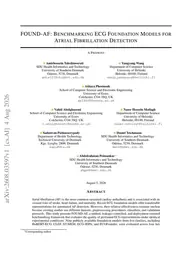
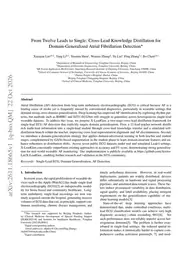
Figure or first page from the ECG+ACF dual-branch 1D-CNN for AF vs sinus rhythm on ESP32-S3 (ecg-acf-afib-esp32s3) source
UnconfirmedCatalog paper date: Not reportedAdded to atlas: Nov 23, 2026

Activity counts measure attention, not model quality. Missing counts are unknown. Publication status follows the linked source; a listed venue alone does not confirm peer review.

Dual-branch 1D-CNN that classifies atrial fibrillation versus sinus rhythm from a raw 10-second single-lead ECG plus its autocorrelation function, quantized to INT8 for an ESP32-S3 microcontroller. Trained on PTB-XL and Chapman-Shaoxing-Ningbo with patient-exclusive splits, it reached AUC 0.9972 on unseen patients and 0.9560 on an external cohort (Ferreira Filho et al., IEEE Access 2026). INT8 TFLite and float32 checkpoints are on GitHub under MIT.

Signals
ECG
Form factor
clinical_ecg_single_lead
Architecture

Dual-branch 1-D CNN: raw 10 s single-lead ECG + its discrete autocorrelation function; INT8 TFLite for ESP32-S3 (188.97 KB deployed model per paper)

At a glance
Type
Task model
Modalities
ECG
Form factor
Clinical ECG single lead
Parameters
Not reported
Architecture
Dual-branch 1-D CNN: raw 10 s single-lead ECG + its discrete autocorrelation function; INT8 TFLite for ESP32-S3 (188.97 KB deployed model per paper)
Venue
Not reported
Year
Not reported
arXiv
Not reported
DOI
Not reported
Code
Open
Weights
Open
Licence
Not reported
Caveats
Not reported
Added
Nov 23, 2026
Updated
Nov 23, 2026

Key results

0.9972
AUC
Trained on PTB-XL and Chapman-Shaoxing-Ningbo with patient-exclusive splits, it reached AUC 0.9972 on unseen patients and 0.9560 on an ex…

How it works

How ECG+ACF dual-branch 1D-CNN for AF vs sinus rhythm on ESP32-S3 (ecg-acf-afib-esp32s3) works: Input signals → Model → Downstream tasksInput signals: ECG (Electrocardiogram). Datasets: PTB-XL, Chapman–Shaoxing–Ningbo 12-lead ECG arrhythmia database (PhysioNet), PhysioNet/CinC Challenge 2021: Will Two Do? (12-lead ECG). Model: ECG+ACF dual-branch 1D-CNN for AF vs sinus rhythm on ESP32-S3 (ecg-acf-afib-esp32s3) (Convolutional network). Downstream tasks: AF / rhythm.Input signalsECG: ElectrocardiogramECGElectrocardiogramDatasets: PTB-XL, Chapman–Shaoxing–Ningbo 12-lead ECG arrhythmia database (PhysioNet), PhysioNet/CinC Challenge 2021: Will Two Do? (12-lead ECG)DatasetsPTB-XL, Chapman–Shaoxing–Ningbo 12-lead…ModelECG+ACF dual-branch 1D-CNN…Convolutional networkDownstream tasksAF / rhythmAF / rhythm

Datasets linked in the hub; pretraining vs evaluation roles follow the paper.

Architecture
Dual-branch 1-D CNN: raw 10 s single-lead ECG + its discrete autocorrelation function; INT8 TFLite for ESP32-S3 (188.97 KB deployed model per paper)
Inputs
ECG
Approach
AF · ECG · TinyML · INT8 · ESP32 S3 · autocorrelation

Datasets used· 2

Cite this model

Cite the publication recorded for this model. Check it against the publisher before submitting.

ECG+ACF dual-branch 1D-CNN for AF vs sinus rhythm on ESP32-S3 (ecg-acf-afib-esp32s3). (n.d.).
@misc{ecgacfafibesp32secgacf,
  title         = {{ECG+ACF dual-branch 1D-CNN for AF vs sinus rhythm on ESP32-S3 (ecg-acf-afib-esp32s3)}}
}
Record updated Nov 23, 2026

History

  1. Added to the ChatPPG research hub