

Model

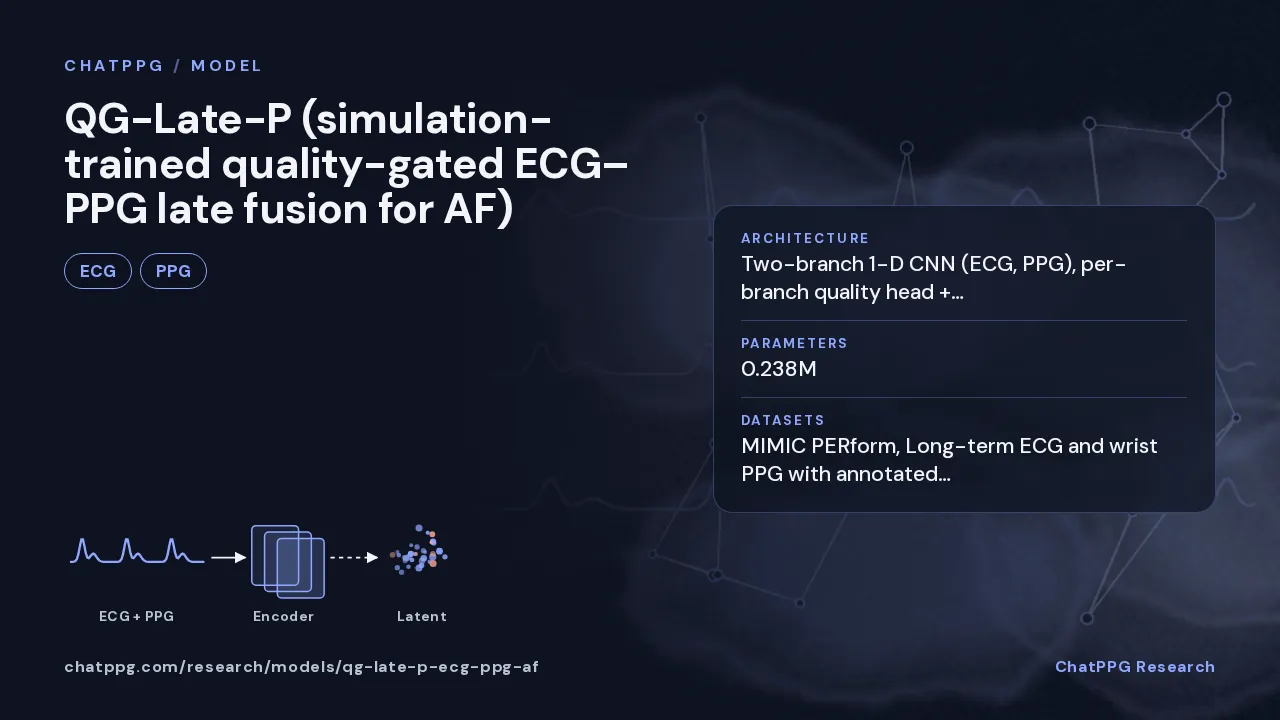
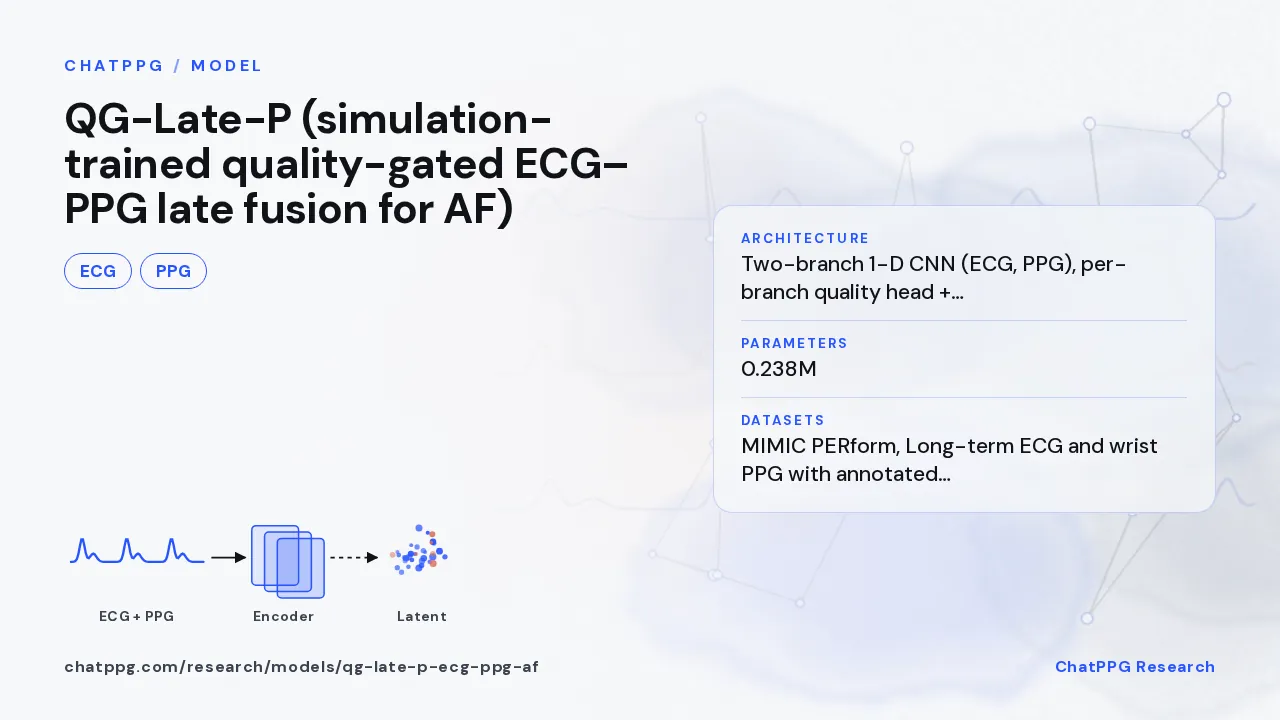
QG-Late-P (simulation-trained quality-gated ECG–PPG late fusion for AF)

Cite
UnconfirmedCatalog paper date: Not reportedAdded to atlas: Nov 20, 2026

Activity counts measure attention, not model quality. Missing counts are unknown. Publication status follows the linked source; a listed venue alone does not confirm peer review.

QG-Late-P is a small open model (about 238,000 parameters) for atrial fibrillation that fuses ECG and PPG with two 1-D CNN branches, each with a quality head, weighted by estimated signal usability. It was trained only on simulated paired ECG and PPG and tested zero-shot: subject-level AUROC 0.970 on ICU MIMIC PERform AF, and 0.887 for fusion on ambulatory wrist PPG plus ECG, where ECG alone reached 0.931 and wrist PPG alone 0.673. The learned quality gate did not beat equal weighting.

Parameters
0.238M
Signals
PPG, ECG
Form factor
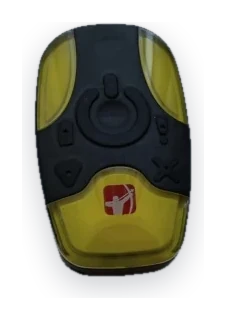
clinical_finger
Architecture

Two-branch 1-D CNN (ECG, PPG), per-branch quality head + quality-weighted attention pooling, softmax(τ·log usability) late fusion
At a glance
Type
Task model
Modalities
PPGECG
Form factor
Clinical finger
Parameters
0.238M
Architecture
Two-branch 1-D CNN (ECG, PPG), per-branch quality head + quality-weighted attention pooling, softmax(τ·log usability) late fusion
Venue
Not reported
Year
Not reported
arXiv
Not reported
DOI
Not reported
Code
Open
Weights
Open
Licence
Not reported
Caveats
Not reported
Added
Nov 20, 2026
Updated
Nov 20, 2026
QG-Late-P (simulation-trained quality-gated ECG–PPG late fusion for AF): ChatPPG research summary card

Key results

0.970
AUROC
It was trained only on simulated paired ECG and PPG and tested zero-shot: subject-level AUROC 0.970 on ICU MIMIC PERform AF, and 0.887 fo…

How it works

How QG-Late-P (simulation-trained quality-gated ECG–PPG late fusion for AF) works: Input signals → Model → Downstream tasksInput signals: PPG (Photoplethysmogram); ECG (Electrocardiogram). Datasets: MIMIC PERform, Long-term ECG and wrist PPG with annotated AF episodes (AFPPGECG). Model: QG-Late-P (simulation-trained quality-gated ECG–PPG late fusion for AF), 0.238M parameters (Transformer · Convolutional network). Downstream tasks: AF / rhythm; Signal quality.Input signalsPPG: PhotoplethysmogramPPGPhotoplethysmogramECG: ElectrocardiogramECGElectrocardiogramDatasets: MIMIC PERform, Long-term ECG and wrist PPG with annotated AF episodes (AFPPGECG)DatasetsMIMIC PERform, Long-term ECG and wrist PPG…Model×NQG-Late-P (simulation-trained…0.238M parametersTransformer · Convolutional networkDownstream tasksAF / rhythmAF / rhythmSignal qualitySignal quality

Datasets linked in the hub; pretraining vs evaluation roles follow the paper.

Architecture
Two-branch 1-D CNN (ECG, PPG), per-branch quality head + quality-weighted attention pooling, softmax(τ·log usability) late fusion
Inputs
PPG, ECG
Approach
AF · ECG PPG fusion · quality gating · simulation trained · open weights · tiny model

Devices· 1

Full photo credits, sources and licences are on each device page.

Datasets used· 2

Cite this model

Cite the publication recorded for this model. Check it against the publisher before submitting.

QG-Late-P (simulation-trained quality-gated ECG–PPG late fusion for AF). (n.d.).
@misc{qglatepecgppgafqglatep,
  title         = {{QG-Late-P (simulation-trained quality-gated ECG–PPG late fusion for AF)}}
}

Record updated Nov 20, 2026

History

  1. Added to the ChatPPG research hub