PaperarXiv:2411.15240
A Foundation Model for Wearable Movement Data in Mental Health Research (PAT)
IEEE J Biomed Health Inform
 (opens in a new tab)
Ruan, Franklin Y. et al., "A Foundation Model for Wearable Movement Data in Mental Health Research", arXiv:2411.15240, CC BY 4.0
Key results
All results- PAT-L (Pretrained Actigraphy Transformer)Table VI (source, opens in a new tab)
0.767
AUROC ↑
Mental health from wearables · NHANES actigraphy
benzodiazepine use (binary) · pretrained masked autoencoder, fine-tuned; AUC averaged over training-set sizes (500, 1,000, 2,500, full)
Results as reported by the authors; not independently reproduced. A SOTA star marks the best value among results reported under the same evaluation protocol; ties go to the earlier publication.
TL;DR
PAT is a masked-autoencoder transformer over one week of minute-level actigraphy (10,080 minutes per participant), pretrained on 21,538 NHANES participants and evaluated on five mental-health labels. It is the first open-source foundation model for wearable movement data aimed at psychiatric outcomes, and the clearest published demonstration that long-context behavioural structure — not short-window signal fidelity — is where movement data pays off for mental health.
Abstract
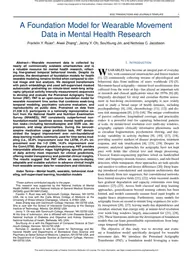
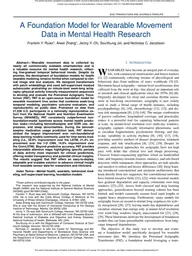
Wearable movement data is collected by nearly all commercially available smartwatches and is a valuable resource for mental health research, reflecting fine-grained temporal behavioral trends. Despite its promise, the development of foundation models for health wearable modeling remains limited when compared to clinical image and text analysis. We designed transformers with patch embeddings and used self-supervised masked autoencoder pretraining on minute-level week-long actigraphy (physical activity intensity measurement) sequences to develop and evaluate the Pretrained Actigraphy Transformer (PAT). PAT is an open-source foundation model for wearable movement time series that combines week-long temporal modeling, psychiatric outcome evaluation, and reproducibility on public data. Pretrained on data from 21,538 U.S. participants in a nationally representative cohort from the National Health and Nutrition Examination Survey (NHANES), PAT consistently outperformed non-foundation-model baselines across mental health prediction tasks-including benzodiazepine and SSRI use, depression, and sleep abnormalities. During the benzodiazepine medication usage prediction task, PAT demonstrated the largest improvement over non-foundational deep learning models commonly used for time-series modeling (i.e., 55.6% improvement over the LSTM, 21.4% improvement over the 1-D CNN, 14.8% improvement over the ConvLSTM). Beyond predictive accuracy, PAT provides interpretable attention maps highlighting specific periods of daily activity most important for clinical predictions, offering model transparency and potential clinical insights. The results suggest that PAT offers an easy-to-deploy, adaptable and scalable solution to advance clinical insight from wearable sensor data for researchers and clinicians. GitHub: https://github.com/njacobsonlab/Pretrained-Actigraphy-Transformer/
Verbatim from arXiv (opens in a new tab) · arXiv metadata (abstracts are released under CC0)
Results on ChatPPG leaderboards
All leaderboardsNo results from this paper on ChatPPG leaderboards yet. Browse the leaderboards.
Tasks & signals
Signals
Keywords
Models
How it works
Cite this paper
Ruan, F. Y., Zhang, A., Oh, J. Y., Jin, S., & Jacobson, N. C. (2026). A Foundation Model for Wearable Movement Data in Mental Health Research (PAT). IEEE J Biomed Health Inform. https://doi.org/10.1109/JBHI.2026.3694809
Ruan, F Y, A Zhang, J Y Oh, S Jin, and N C Jacobson. 2026. "A Foundation Model for Wearable Movement Data in Mental Health Research (PAT)." IEEE J Biomed Health Inform. https://doi.org/10.1109/JBHI.2026.3694809.
Ruan, F. Y., Zhang, A., Oh, J. Y., Jin, S. and Jacobson, N. C. (2026) 'A Foundation Model for Wearable Movement Data in Mental Health Research (PAT)', IEEE J Biomed Health Inform. doi: 10.1109/JBHI.2026.3694809.
Ruan, F Y, et al. "A Foundation Model for Wearable Movement Data in Mental Health Research (PAT)." IEEE J Biomed Health Inform, 2026. https://doi.org/10.1109/JBHI.2026.3694809.
F. Y. Ruan, A. Zhang, J. Y. Oh, S. Jin, and N. C. Jacobson, "A Foundation Model for Wearable Movement Data in Mental Health Research (PAT)," IEEE J Biomed Health Inform, 2026, doi: 10.1109/JBHI.2026.3694809.
@article{ruan2026foundation,
  title         = {{A Foundation Model for Wearable Movement Data in Mental Health Research (PAT)}},
  author        = {Ruan, F. Y. and Zhang, A. and Oh, J. Y. and Jin, S. and Jacobson, N. C.},
  year          = {2026},
  journal       = {IEEE J Biomed Health Inform},
  doi           = {10.1109/JBHI.2026.3694809},
  eprint        = {2411.15240},
  archivePrefix = {arXiv}
}Record updated