MorphologyFM: A Foundation Model for Morphology-Aware Representation Learning from ECG and Pulse Oximetry Waveforms
Activity counts measure attention, not model quality. Missing counts are unknown. Publication status follows the linked source; a listed venue alone does not confirm peer review.
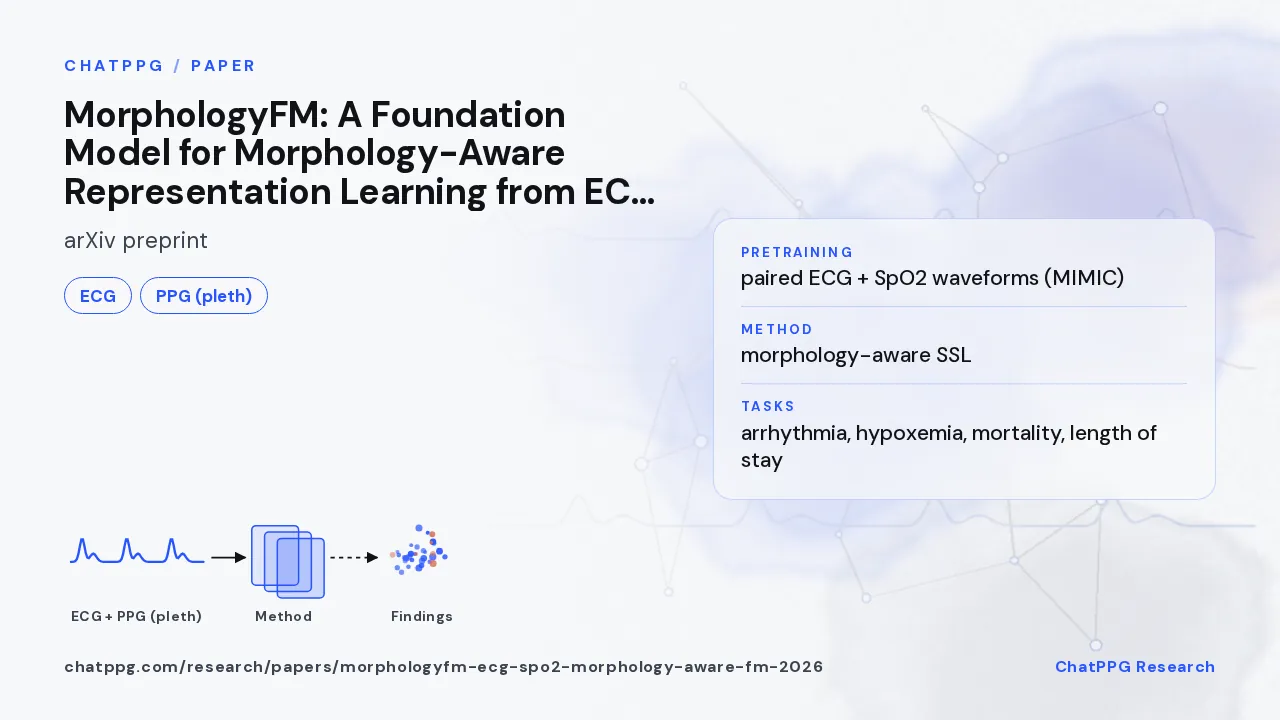
MorphologyFM is a foundation model pretrained on paired ECG and SpO2 waveforms from the MIMIC critical care database with an objective that preserves clinically meaningful waveform shape. It beat masked autoencoders, contrastive learning, Barlow Twins and JEPA on arrhythmia classification, hypoxemia prediction, mortality and length of stay.
- Pretraining: paired ECG + SpO2 waveforms (MIMIC)
- Tasks: arrhythmia, hypoxemia, mortality, length of stay
- Venue
- arXiv preprint
- Published
- 2026
- DOI
- Not reported
- PMID
- Not reported
- Licence
- Not reported
- Form factor
- Not reported
- Datasets
- Subjects
- Not reported
- Code
- Not reported
- Added
- Oct 11, 2026
Abstract
Foundation models have recently emerged as a powerful paradigm for learning transferable representations from large scale biomedical data, yet existing approaches for physiological waveforms primarily optimize reconstruction or forecasting objectives that do not explicitly preserve clinically meaningful waveform morphology. Electrocardiograms (ECGs) and pulse oximetry (SpO2) waveforms encode rich cardiovascular and hemodynamic information through their morphological structure. In this work, we introduce MorphologyFM, a multimodal foundation model pretrained on paired ECG and SpO2 waveforms from the MIMIC critical care database using a morphology aware self supervised learning objective. MorphologyFM combines morphology guided masking, cross modal representation learning, and contrastive latent alignment to learn representations that capture clinically relevant physiological structure without requiring manual annotations. We evaluate MorphologyFM across multiple downstream prediction tasks, including arrhythmia classification, hypoxemia prediction, mortality prediction, and length of stay estimation, demonstrating consistent improvements over representative self supervised learning methods, including Masked Autoencoders (MAE), contrastive learning, Barlow Twins, and Joint Embedding Predictive Architectures (JEPA). Furthermore, we show that jointly modeling ECG and SpO2 waveforms produces more transferable representations than single modality pretraining. Our results establish waveform morphology as a powerful inductive bias for self supervised physiological representation learning and introduce MorphologyFM as a general purpose foundation model for continuous physiological monitoring.
Verbatim fromarXiv· arXiv metadata (abstracts are released under CC0)
How it works
- Method
- morphology-aware SSL
Datasets used· 1
Cite
@article{morphologyfmecgspo2morph2026,
  title = {{MorphologyFM: A Foundation Model for Morphology-Aware Representation Learning from ECG and Pulse Oximetry Waveforms}},
  author = {Saiyang Feng and Yuanyun Zhang and Shi Li},
  year = {2026},
  journal = {arXiv preprint},
  eprint = {2607.09749}
}History
Added to the ChatPPG research hub
More on ChatPPG
- A meta-learning method with reduced data requirements for training and updating deep learning models on wearable devices
This paper proposes a meta-learning method that cuts how much labelled data a new wearable needs bef
- Agentic AI-enabled discovery across large-scale sleep physiology (AI Sleep Co-Scientist)
AI Sleep Co-Scientist is a setup in which human scientists direct specialist AI agents for hypothesi
- AnyECG-Echo: Wearable Single-Lead ECG Detects Fine-Grained Structural Heart Disease Through Echo-Report Supervision
AnyECG-Echo uses contrastive pretraining between single-lead ECGs and echocardiography reports to sc