Paperdoi:10.1038/s43856-025-01234-6
Wearable devices for anxiety assessment: a systematic review (Elgendi, Markov, Liu, De Vos … Menon; Commun Med 2026)
Communications Medicine 6:20 (2026)
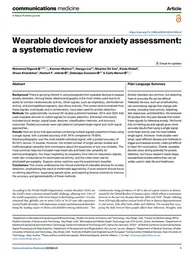 (opens in a new tab)
Mohamed Elgendi et al., "Wearable devices for anxiety assessment: a systematic review", doi:10.1038/s43856-025-01234-6, CC BY 4.0
TL;DR
Systematic review of 26 studies (2014-2024) using wearables for anxiety detection. Multi-signal approaches pooled 81.94% accuracy vs 76.85% for single signals; ECG was the most reliable single signal (80.34% across 12 studies). Few single-sensor studies and heterogeneous methods limit modality conclusions.
- Form factor: review
Abstract
Background
There is growing interest in using biosignals from wearable devices to assess anxiety disorders. Among these, electrocardiography is the most widely used due to its ability to monitor cardiovascular activity. Other signals, such as respiratory, electrodermal activity, and photoplethysmography, also show promise. This review aims to evaluate how these signals, individually and in combination, have been used for anxiety detection.
Methods
We systematically reviewed 26 studies published between 2014 and 2024 that used wearable devices to collect signals for anxiety detection. Extracted information included study design, signal types, features, classification methods, and accuracy outcomes. Pooled accuracies were calculated to compare single-signal and multi-signal approaches.
Results
Here we show that approaches combining multiple signals outperform those using a single signal, with a pooled accuracy of 81.94% compared to 76.85%. Electrocardiography was the most reliable individual signal, with a pooled accuracy of 80.34% across 12 studies. However, the limited number of single-sensor studies and methodological variability limit conclusions about the superiority of any one modality. The most common features included mean heart rate and heart rate variability for electrocardiography, the mean inspiratory-to-expiratory time ratio for respiratory signals, mean skin conductance for electrodermal activity, and the mean heart rate for photoplethysmography. Support vector machine was the predominant classifier.
Conclusions
This review underscores the clinical potential of wearable devices for anxiety detection, emphasizing the value of multimodal approaches. Future research should focus on refining algorithms, expanding sample sizes, and exploring diverse contexts to improve the accuracy and generalizability of these methods.
Verbatim from the publisher's DOI record (opens in a new tab) · Publisher licence: https://creativecommons.org/licenses/by/4.0
Results on ChatPPG leaderboards
All leaderboardsNo results from this paper on ChatPPG leaderboards yet. Browse the leaderboards.
Tasks & signals
Signals
Keywords
How it works
Cite this paper
Wearable devices for anxiety assessment: a systematic review (Elgendi, Markov, Liu, De Vos … Menon; Commun Med 2026). (2026). Communications Medicine, 6, 20. https://doi.org/10.1038/s43856-025-01234-6
@article{elgendiwearablea2026wearable,
  title         = {{Wearable devices for anxiety assessment: a systematic review (Elgendi, Markov, Liu, De Vos … Menon; Commun Med 2026)}},
  year          = {2026},
  journal       = {Communications Medicine},
  volume        = {6},
  pages         = {20},
  doi           = {10.1038/s43856-025-01234-6}
}Added to the ChatPPG research hub