Activity counts measure attention, not model quality. Missing counts are unknown. Publication status follows the linked source; a listed venue alone does not confirm peer review.
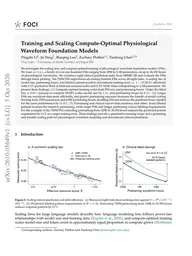
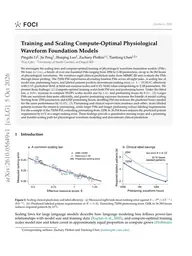
Aether is a family of more than 100 physiological waveform foundation models, from 20M to 2.1B parameters, trained on up to 36.3M hours of waveforms to study scaling laws. The authors built eight clinical prediction tasks from MIMIC-III and tested the models with linear probes. The 720M model beat all existing baseline foundation models on all eight tasks, and the fitted scaling law predicted downstream error to within 0.5% MAE.
Published
arXiv preprint, 2026
Signals
PPG, ECG, BP, Resp
Parameters
20M to 2.1B (over 100 models)
Pretraining
up to 36.3M hours of physiological waveforms (MIMIC-III)
We investigate the scaling laws and compute-optimal training of physiological waveform foundation models (FMs). We train Aether, a family of over one hundred FMs ranging from 20M to 2.1B parameters, on up to 36.3M hours of physiological waveforms. We construct eight clinical prediction tasks from MIMIC-III and evaluate the FMs through linear probing. The 720M FM outperforms all existing baseline FMs across all eight tasks. A scaling law of model size, pretraining hours, and labeled patients predicts downstream ranking error, i.e. 1-AUROC, effectively with 0.5% prediction MAE at held-out resource scales and 0.9% MAE when extrapolating to 2.1B parameters. We present three findings: (1) Compute-optimal training scales both FM size and pretraining hours. Under the fitted law, a 10.0× increase in compute FLOPs scales model size by 1.2× and pretraining hours by 8.2×. (2) Larger FMs use waveform data more efficiently, and greater pretraining exposure increases the benefit of model scaling. Starting from 25M parameters and 4.8M pretraining hours, doubling FM size reduces the predicted hours needed for the same performance by 51.8%. (3) Pretraining and clinical supervision reinforce each other: more labeled patients increase the return to pretraining, while larger FMs and longer pretraining reduce labeling requirements. For the example of the 720M FM, extending pretraining from 120K to 36.3M hours reduces the predicted patient requirement by 61% at a target ranking error. These findings provide a quantitative training recipe and a promising and durable scaling path for physiological waveform modeling and downstream clinical prediction.
Verbatim fromarXiv· arXiv metadata (abstracts are released under CC0)
How it works
Datasets linked in the hub; pretraining vs evaluation roles follow the paper.
Pretraining data
MIMIC-III Waveform Database Matched Subset (bedside ECG, ABP, pleth/PPG, respiration; 125 Hz, up to 62 channels); exposure scaled to 36.3M waveform-hours via repeats
Cite the publication recorded for this model. Check it against the publisher before submitting.
Li, P., Peng, J., Luo, S., Plotkin, Z., & Chen, T. (2026). Training and Scaling Compute-Optimal Physiological Waveform Foundation Models. arXiv preprint. https://arxiv.org/abs/2610.05649
Li, Pingzhi, Jie Peng, Shuqing Luo, Zachary Plotkin, and Tianlong Chen. 2026. "Training and Scaling Compute-Optimal Physiological Waveform Foundation Models." arXiv preprint. https://arxiv.org/abs/2610.05649.
Li, P., Peng, J., Luo, S., Plotkin, Z. and Chen, T. (2026) 'Training and Scaling Compute-Optimal Physiological Waveform Foundation Models', arXiv preprint. Available at: https://arxiv.org/abs/2610.05649
Li, Pingzhi, et al. "Training and Scaling Compute-Optimal Physiological Waveform Foundation Models." arXiv preprint, 2026. https://arxiv.org/abs/2610.05649.
P. Li, J. Peng, S. Luo, Z. Plotkin, and T. Chen, "Training and Scaling Compute-Optimal Physiological Waveform Foundation Models," arXiv preprint, 2026, [Online]. Available: https://arxiv.org/abs/2610.05649.
@misc{li2026training,
  title         = {{Training and Scaling Compute-Optimal Physiological Waveform Foundation Models}},
  author        = {Li, Pingzhi and Peng, Jie and Luo, Shuqing and Plotkin, Zachary and Chen, Tianlong},
  year          = {2026},
  howpublished  = {arXiv preprint},
  eprint        = {2610.05649},
  archivePrefix = {arXiv}
}
History
Added to the ChatPPG research hub
Newsletter
Get new PPG datasets, papers and models
Get alerts when Aether is benchmarked on new datasets, plus the weekly digest.
New datasets, papers and models
Practical guides from the hub
Unsubscribe anytime
The waveform is an illustration of a PPG pulse, not a recording.