PaperarXiv:2605.30865
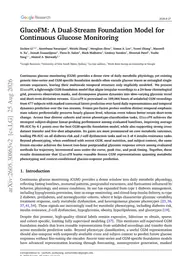
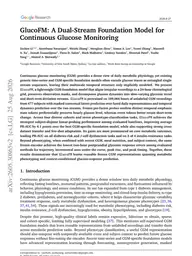
GlucoFM: A Dual-Stream Foundation Model for Continuous Glucose Monitoring
arXiv preprint
TL;DR
GlucoFM is a lightweight foundation model for continuous glucose monitoring. It aligns readings to a 24-hour grid, splits glucose into slow trend and short-term deviation streams, and was pretrained on 109,066 hours of CGM data from 477 people. It gave the best linear-probe results across four cohorts and seven tasks, with the biggest gains on diabetes risk and beta-cell dysfunction.
- Result: Across four diverse cohorts and seven phenotype-classification tasks, GlucoFM achieves the strongest subject-disjoint linear-probing performance among evaluated baselines, improving average PR-AUC by 4.1 points over the best CGM-specific foundation model,…
- Result: Its gains are most pronounced on core metabolic outcomes, leading PR-AUC on all diabetes-risk and $β$-cell dysfunction tasks and on 3 of 4 insulin-resistance tasks.
Abstract
Continuous glucose monitoring (CGM) provides a dense view of daily metabolic physiology, yet existing generic time-series and CGM-specific foundation models often encode glucose traces as entangled single-stream sequences, leaving their multiscale temporal structure only implicitly modeled. We present GlucoFM, a lightweight CGM foundation model that aligns irregular recordings to a 24-hour chronological grid, preserves observation masks, and decomposes glucose dynamics into slow-varying glycemic trend and short-term deviation streams. GlucoFM is pretrained on 109,066 hours of unlabeled CGM recordings from 477 subjects with masked contextual latent prediction over fused daily representations and temporal dynamics prediction over the two streams. Frozen pre-fusion probes confirm distinct temporal emphasis: state tokens preferentially preserve hourly glucose level, whereas event tokens better retain short-term change. Across four diverse cohorts and seven phenotype-classification tasks, GlucoFM achieves the strongest subject-disjoint linear-probing performance among evaluated baselines, improving average PR-AUC by 4.1 points over the best CGM-specific foundation model, while also supporting strong cross-dataset transfer and few-shot adaptation. Its gains are most pronounced on core metabolic outcomes, leading PR-AUC on all diabetes-risk and -cell dysfunction tasks and on 3 of 4 insulin-resistance tasks. Beyond phenotyping, when combined with recent CGM, meal nutrition, and subject context, the same frozen encoder achieves the lowest two-hour postprandial glycemic response errors among evaluated methods for trajectory, incremental area under the curve, peak rise, and peak timing. Together, these results demonstrate that GlucoFM learns reusable frozen CGM representations spanning metabolic phenotyping and context-conditioned glucose-response prediction.
Verbatim from arXiv (opens in a new tab) · arXiv metadata (abstracts are released under CC0)
Results on ChatPPG leaderboards
All leaderboardsNo results from this paper on ChatPPG leaderboards yet. Browse the leaderboards.
Tasks & signals
Tasks
Signals
Keywords
Models
How it works
- Cohort
- 477 subjects
Cite this paper
Li, Z., Natarajan, K., Zhang, W., Zhou, M., Lee, S. A., Zhang, Y., Xu, M. A., Esmaeilpour, Z., Salim, F. D., Malhotra, M., Sunden, L., Patel, S., et al. (2026). GlucoFM: A Dual-Stream Foundation Model for Continuous Glucose Monitoring. arXiv preprint. https://arxiv.org/abs/2605.30865
Li, Zechen, Keerthana Natarajan, Weizhi Zhang, Menglian Zhou, Simon A. Lee, Yuwei Zhang, and Maxwell A. Xu, et al. 2026. "GlucoFM: A Dual-Stream Foundation Model for Continuous Glucose Monitoring." arXiv preprint. https://arxiv.org/abs/2605.30865.
Li, Z., Natarajan, K., Zhang, W., Zhou, M., Lee, S. A., Zhang, Y. and Xu, M. A. et al. (2026) 'GlucoFM: A Dual-Stream Foundation Model for Continuous Glucose Monitoring', arXiv preprint. Available at: https://arxiv.org/abs/2605.30865
Li, Zechen, et al. "GlucoFM: A Dual-Stream Foundation Model for Continuous Glucose Monitoring." arXiv preprint, 2026. https://arxiv.org/abs/2605.30865.
Z. Li et al., "GlucoFM: A Dual-Stream Foundation Model for Continuous Glucose Monitoring," arXiv preprint, 2026, [Online]. Available: https://arxiv.org/abs/2605.30865.
@misc{li2026glucofm,
  title         = {{GlucoFM: A Dual-Stream Foundation Model for Continuous Glucose Monitoring}},
  author        = {Li, Zechen and Natarajan, Keerthana and Zhang, Weizhi and Zhou, Menglian and Lee, Simon A. and Zhang, Yuwei and Xu, Maxwell A. and Esmaeilpour, Zeinab and Salim, Flora D. and Malhotra, Mark and Sunden, Lindsey and Patel, Shwetak and others},
  year          = {2026},
  howpublished  = {arXiv preprint},
  eprint        = {2605.30865},
  archivePrefix = {arXiv}
}Record updated