Cite this dataset
ZU-PWD '25 [Data set]. (n.d.). ieee-dataport. https://doi.org/10.21227/2tth-wj12
@misc{zupwd25zupwd,
  title         = {{ZU-PWD '25}},
  howpublished  = {ieee-dataport},
  doi           = {10.21227/2tth-wj12}
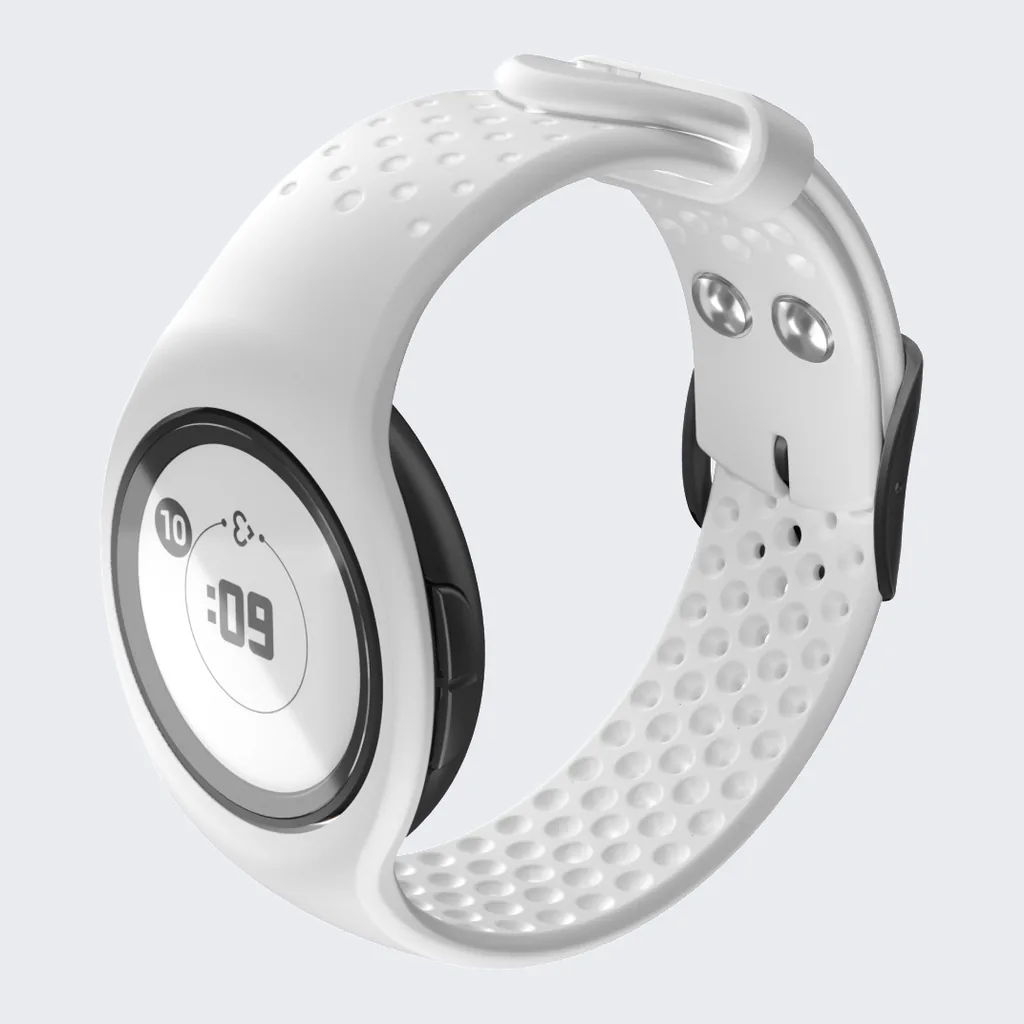
}ZU-PWD ’25 (DOI 10.21227/2tth-wj12) releases synchronized minute-level physiology/behavior from Empatica Embrace Plus with a companion self-report set (ZU-PWD-SR ’25). Authors: Evangelista / Nazir / Bukhari / Dahmani / Tbaishat / Sharma (Zayed University et al.). Created 2025-09-16 on IEEE DataPort; last updated 2025-09-24.
"Background: Wearable devices have become essential tools for capturing continuous physiological and behavioral signals in real-world environments. However, publicly available datasets that combine multimodal, high-resolution physiological signals with behavioral measures in adults remain scarce, limiting opportunities for reproducible and ecologically valid research.Objective: This study introduces a longitudinal, dataset collected using Empatica Embrace Plus wrist-worn devices, designed to support research in digital health, behavioral science, and machine learning based sensor fusion.Methods: Data were collected from 28 participants over a period of up to 30 consecutive days each, capturing synchronized measures of heart rate, heart rate variability (RMSSD), electrodermal activity, peripheral skin temperature, respiratory rate, tri-axial acceleration, posture classification, step count, metabolic equivalent of task (MET), and sleep stages. The technical validation assessed data completeness, physiological plausibility, and cross-sensor consistency through missing values analysis, range checks, circadian pattern evaluation, and correlation profiling.Results: The technical validation confirmed that physiological signals fell within expected biological ranges for adults, behavioral measures reflected realistic daily activity rhythms, and cross-sensor associations were consistent with established physiological relationships. The missing values varied by modality; activity and metadata fields had higher coverage, while respiration had larger gaps. These results establish the reliability of dataset for diverse applications.Potential Applications: The dataset enables research in digital phenotyping, behavioral health monitoring, physical activity recognition, sleep and circadian rhythm analysis, chronic disease risk modeling, and machine learning driven multimodal data fusion. Its ecological validity and temporal depth make it suitable for both laboratory benchmarking and deployment-oriented modeling.Conclusions: By releasing this dataset with full documentation and validation, we intend to advance open, collaborative, and reproducible research at the intersection of wearable sensing, health analytics, and human behavior modeling."
Verbatim fromDataCite· Licence: https://creativecommons.org/licenses/by/4.0/legalcode
No model in the hub reports results on this dataset yet.
Full photo credits, sources and licences are on each device page.
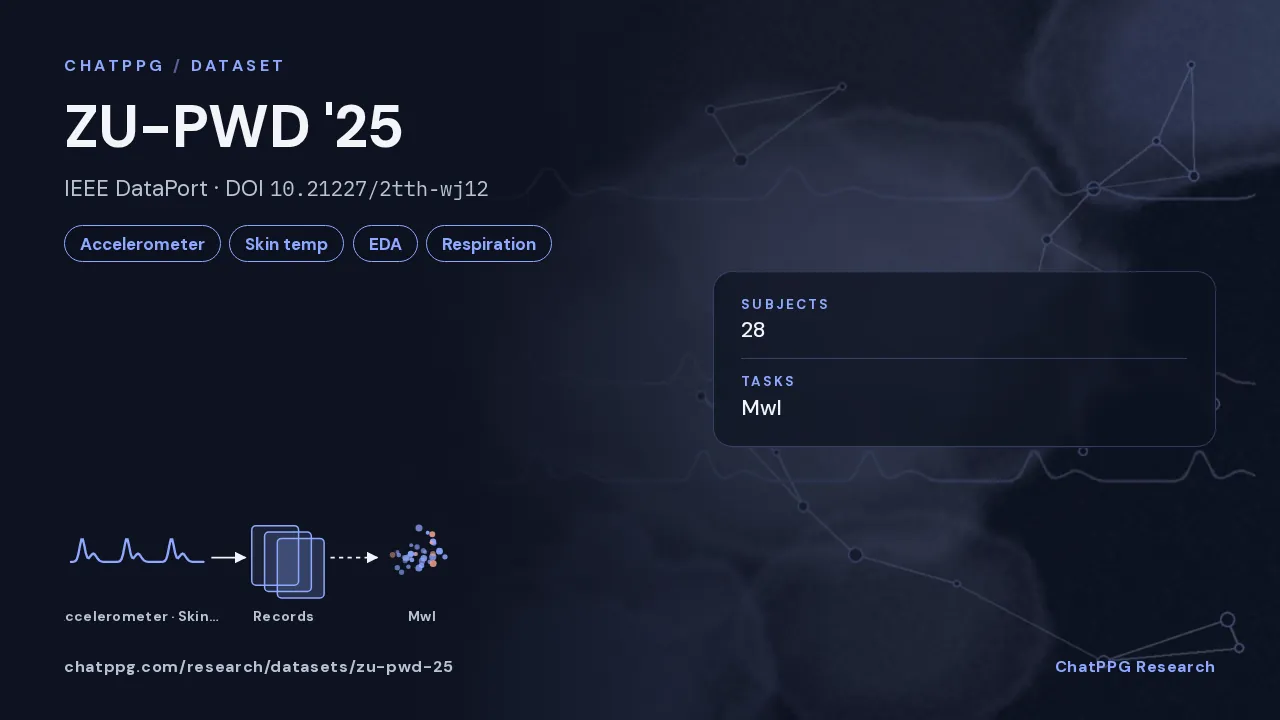
ZU-PWD '25 has data from 28 subjects, as listed in its research record.
ZU-PWD '25 includes accelerometer, skin temperature, EDA, respiration, heart rate and HRV data.
Research tasks it supports: mental workload assessment and stress detection. Reference labels: sleep staging, stress, resp rate and mental workload.
It is hosted on IEEE DataPort at https://ieee-dataport.org/documents/zayed-university-physiological-wellness-dataset-2025-zu-pwd-25. No licence is recorded for it here, so check the terms on the source page before you use it.
Yes. Its record lists wrist-worn recording.
ZU-PWD '25 [Data set]. (n.d.). ieee-dataport. https://doi.org/10.21227/2tth-wj12
@misc{zupwd25zupwd,
title = {{ZU-PWD '25}},
howpublished = {ieee-dataport},
doi = {10.21227/2tth-wj12}
}Cite the dated snapshot 2026-10 for a fixed, reproducible version. Please also cite the original publications listed above.
ChatPPG. (2026). ZU-PWD '25: dataset record (Version 2026-10) [Data set]. ChatPPG Research Hub. https://chatppg.com/research/datasets/zu-pwd-25
@misc{chatppg_dataset_zu_pwd_25,
  author       = {{ChatPPG}},
  title        = {{ZU-PWD '25: dataset record}},
  year         = {2026},
  month        = nov,
  version      = {2026-10},
  howpublished = {\url{https://chatppg.com/research/datasets/zu-pwd-25}},
  note         = {ChatPPG Research Hub, Snapshot 2026-10, https://chatppg.com/research/snapshots/2026-10}
}cff-version: 1.2.0 message: "If you use this resource, please cite it as below." type: dataset title: "ZU-PWD '25: dataset record" authors: - name: "ChatPPG" url: "https://chatppg.com/research/datasets/zu-pwd-25" repository-artifact: "https://chatppg.com/research/snapshots/2026-10" version: "2026-10" date-released: "2026-11-13"
Record updated
 Before a Wearable May Claim Cognitive Stress: A Three-Quantity Measurement ChecklistSame task: StressCambridge Open Engage preprint · 2026
 Cross-Modal Correlation Fusion for End-to-End ECG–PPG Stress ClassificationSame task: StressFrontiers in Artificial Intelligence and A · 2026
 CLASSame task: StressCognitive Load, Affect and Stress (Shimmer ECG/PPG/EDA)62 subjects · PPG · ECG · IMU
 MOODSSame task: StressMobile Open Observation of Daily Stressors (Fossil Sport WearOS watch, 100-day field study; private)122 subjects · PPG · IMU