Dataset

Regulation of Brain Cognitive States through Auditory, Gustatory, and Olfactory Stimulation with Wearable Monitoring

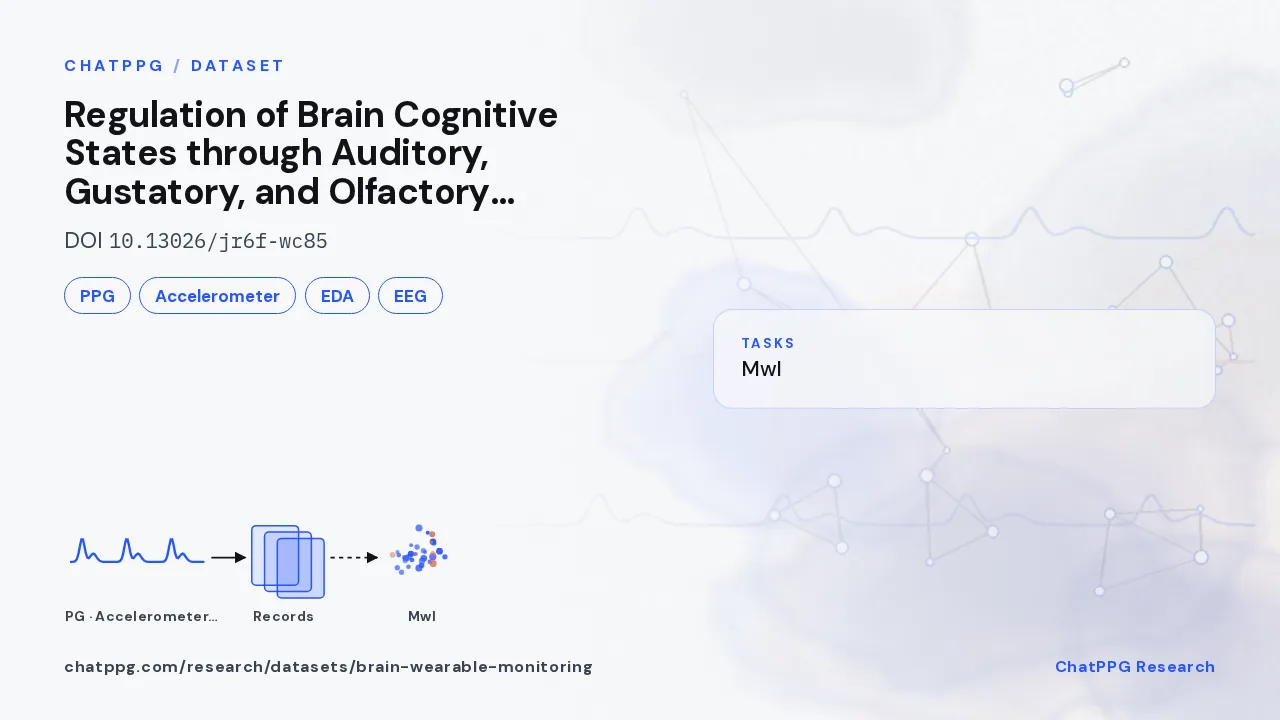
This PhysioNet dataset comes from experiments that tried to shift people's cognitive arousal and performance with safe sensory interventions. In one experiment participants listened to different genres of music; in the other they drank coffee and smelled perfume. Physiological data were recorded with two Empatica wristbands and a Muse EEG headband.

Published
PhysioNet, 2023
Interventions
music (experiment 1); coffee and perfume (experiment 2)
At a glance
Type
Dataset
Host
Not reported
Licence
Not reported
Access
Not reported
Subjects
Not reported
PPG sites
Wrist
Setting
Lab
Wrist
Yes
Raw waveforms
Yes
Updated
Nov 13, 2026

Original description

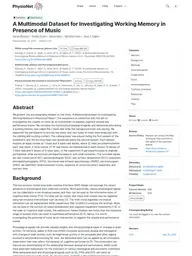
Inspired by advances in wearable technologies, we design and perform human-subject experiments to investigate the impacts of applying safe actuation (i.e., auditory, gustatory, and olfactory) for the purpose of regulating the cognitive arousal state and enhancing the performance state. In two separate experiments, participants are instructed to engage in a working memory task known as the n-back task. To modulate their brain state, we introduce various interventions, including listening to different genres of music in the first experiment, and consuming coffee and smelling perfume in the second experiment. Employing only wearable devices for human monitoring and using safe actuation intervention are the key components of the performed experiments. This dataset contains subjects' correct/incorrect responses along with their reaction times. In these experiments, we employed two Empatica wristbands and one muse headband to collect their physiological data. The data from Empatica contains participants' electrodermal activity (EDA), heart rate (HR), blood volume pulses (BVP), skin surface temperature, Photoplethysmography (PPG), and 3-axis accelerometer data. Using a muse headband, we also collected Electroencephalography (EEG) signals from four sensors. By creating a dataset that addresses the current lack of publicly available data for utilizing wearable devices and safe everyday stimuli to manage internal brain states, our research enables further investigations into machine learning and system identification. It eventually paves the way for smarter work environments in the future. The ultimate goal is to develop practical and automated personalized closed-loop systems that can effectively regulate internal brain states and enhance the overall quality of life.
Verbatim fromPhysioNet· Licence: Open Data Commons Attribution License v1.0

Regulation of Brain Cognitive States through Auditory, Gustatory, and Olfactory Stimulation with Wearable Monitoring: ChatPPG research summary card

Key numbers

1
Reference labels
MWL

How it works

How Regulation of Brain Cognitive States through Auditory, Gustatory, and Olfactory Stimulation with Wearable Monitoring works: Devices & body sites → Signals recorded → TasksDevices & body sites: Empatica E4 (Empatica · Wrist); Muse S EEG headband (Interaxon · Head). PPG sites: Wrist. Signals recorded: Regulation of Brain Cognitive States through Auditory, Gustatory, and Olfactory Stimulation with Wearable Monitoring, signals PPG, IMU, EDA, EEG. Tasks: Mental workload.Devices & body sitesEmpatica E4: Empatica · WristEmpatica E4Empatica · WristMuse S EEG headband: Interaxon · HeadMuse S EEG headbandInteraxon · HeadPPG sites: WristPPG sitesWristSignals recordedRegulation of Brain Cognitive…PPGxyzIMUEDAEEGTasksMental workloadMental workload

No model in the hub reports results on this dataset yet.

Reference labels
mwl
Device roles
Study wearable (IMU)

Devices· 2

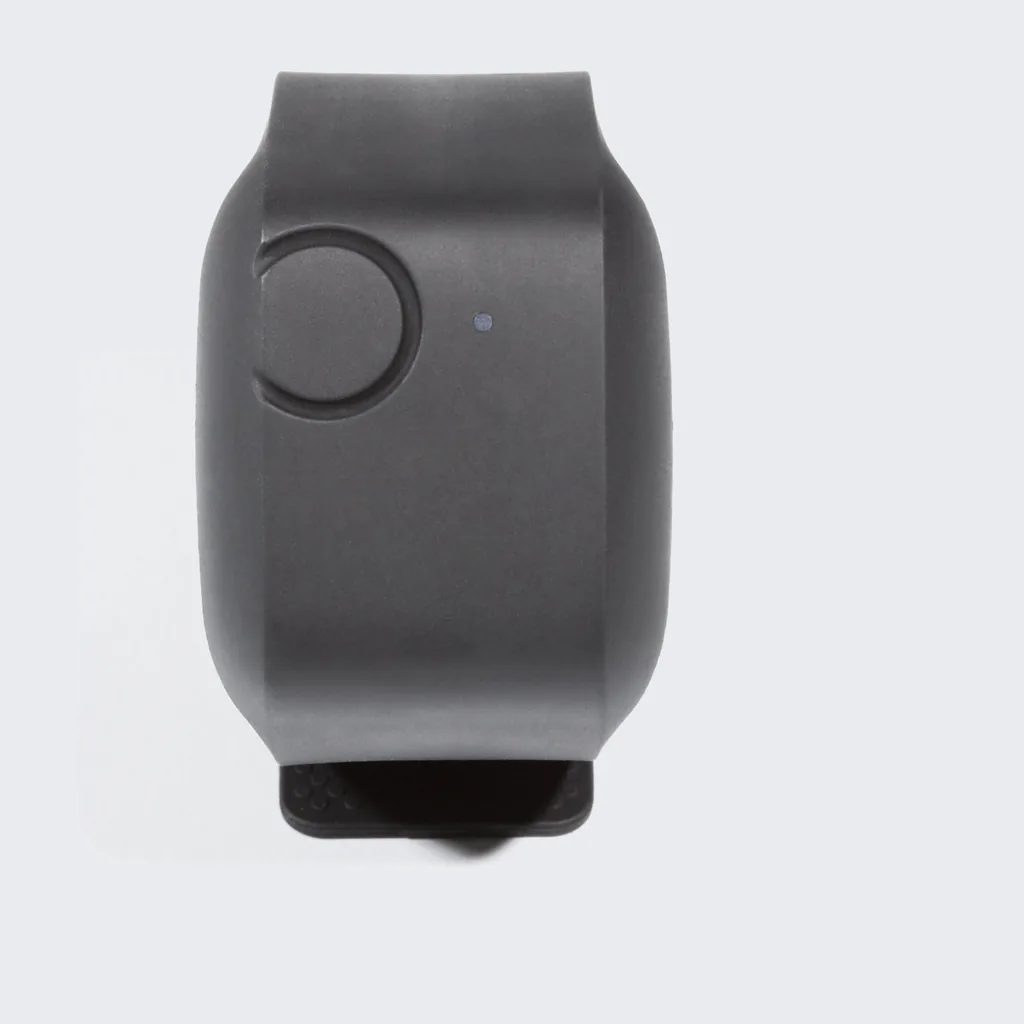
Full photo credits and licences are on each device page. An icon means we have no openly licensed or manufacturer-cleared photo of that exact device yet.

FAQ

What signals does Regulation of Brain Cognitive States through Auditory, Gustatory, and Olfactory Stimulation with Wearable Monitoring include?

Regulation of Brain Cognitive States through Auditory, Gustatory, and Olfactory Stimulation with Wearable Monitoring includes PPG, accelerometer, EDA and EEG data. Raw waveforms are included.

What can Regulation of Brain Cognitive States through Auditory, Gustatory, and Olfactory Stimulation with Wearable Monitoring be used for?

Research tasks it supports: mental workload assessment. Reference labels: mental workload.

How do I get Regulation of Brain Cognitive States through Auditory, Gustatory, and Olfactory Stimulation with Wearable Monitoring, and what is its licence?

It is available from https://physionet.org/content/brain-wearable-monitoring/1.0.0/. No licence is recorded for it here, so check the terms on the source page before you use it.

Was Regulation of Brain Cognitive States through Auditory, Gustatory, and Olfactory Stimulation with Wearable Monitoring recorded with a wrist-worn device?

Yes. Its record lists wrist-worn recording.

Cite this dataset

Cite this dataset with the fields recorded here. Check it against the publisher before submitting.

Regulation of Brain Cognitive States through Auditory, Gustatory, and Olfactory Stimulation with Wearable Monitoring [Data set]. (n.d.). https://doi.org/10.13026/jr6f-wc85
@misc{brainwearablemonregulation,
  title         = {{Regulation of Brain Cognitive States through Auditory, Gustatory, and Olfactory Stimulation with Wearable Monitoring}},
  doi           = {10.13026/jr6f-wc85}
}

Cite the ChatPPG record

Cite the dated snapshot 2026-10 for a fixed, reproducible version. Please also cite the original publications listed above.

APA

ChatPPG. (2026). Regulation of Brain Cognitive States through Auditory, Gustatory, and Olfactory Stimulation with Wearable Monitoring: dataset record (Version 2026-10) [Data set]. ChatPPG Research Hub. https://chatppg.com/research/datasets/brain-wearable-monitoring

BibTeX
@misc{chatppg_dataset_brain_wearable_monitoring,
  author       = {{ChatPPG}},
  title        = {{Regulation of Brain Cognitive States through Auditory, Gustatory, and Olfactory Stimulation with Wearable Monitoring: dataset record}},
  year         = {2026},
  month        = nov,
  version      = {2026-10},
  howpublished = {\url{https://chatppg.com/research/datasets/brain-wearable-monitoring}},
  note         = {ChatPPG Research Hub, Snapshot 2026-10, https://chatppg.com/research/snapshots/2026-10}
}
CITATION.cff
cff-version: 1.2.0
message: "If you use this resource, please cite it as below."
type: dataset
title: "Regulation of Brain Cognitive States through Auditory, Gustatory, and Olfactory Stimulation with Wearable Monitoring: dataset record"
authors:
  - name: "ChatPPG"
url: "https://chatppg.com/research/datasets/brain-wearable-monitoring"
repository-artifact: "https://chatppg.com/research/snapshots/2026-10"
version: "2026-10"
date-released: "2026-11-13"

History

  1. Record updated