PaperarXiv:2610.29320
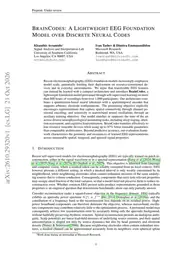
BrainCodes: A Lightweight EEG Foundation Model over Discrete Neural Codes
arXiv 2610.29320v1 (cs.LG, cs.NE), submitted 2026-10-21; comment: preprint, under review
TL;DR
Self-supervised pretraining on >800 h of EEG from >1,000 participants. Quantization-based neural tokenizer + spatiotemporal encoder that accepts arbitrary electrode configurations (channel positional encoding); auxiliary objective for narrowband oscillation sensitivity. Evaluated on sleep staging, attention assessment and cognitive-load estimation; transfers to low-resource wearable devices with up to 97 % fewer trainable parameters than comparable models.
- Form factor: other
Abstract
Recent electroencephalography (EEG) foundation models increasingly emphasize model scale, potentially limiting their deployment on resource-constrained devices and in everyday environments. We argue that transferable EEG features can instead be learned with a compact architecture and introduce BrainCodes, a lightweight foundation model pretrained through self-supervised learning on more than 800 hours of recordings from over 1,000 participants. Our architecture combines a quantization-based neural tokenizer with a spatiotemporal encoder that supports arbitrary electrode configurations. The pretraining objective explicitly encourages representations that capture spatial connectivity through channel positional encoding, and sensitivity to narrowband neural oscillations through an auxiliary training objective. Our model matches or surpasses the state of the art across diverse neurophysiological monitoring tasks, including sleep staging, attention assessment, and cognitive load estimation. BrainCodes transfers effectively to low-resource wearable devices while using up to 97% fewer trainable parameters than comparable architectures. Beyond predictive accuracy, our evaluation framework characterizes the geometry and invariances of learned EEG representations across measurable spatial, temporal, and spectral signal properties.
Verbatim from arXiv (opens in a new tab) · arXiv metadata (abstracts are released under CC0)
Results on ChatPPG leaderboards
All leaderboardsNo results from this paper on ChatPPG leaderboards yet. Browse the leaderboards.
Tasks & signals
Tasks
Signals
Keywords
Models

How it works
Cite this paper
APA
Avramidis, K., Tashev, I., & Emmanouilidou, D. (2026). BrainCodes: A Lightweight EEG Foundation Model over Discrete Neural Codes. arXiv 2610.29320v1 , submitted 2026-10-21. https://arxiv.org/abs/2610.29320
BibTeX
@misc{avramidis2026braincodes,
  title         = {{BrainCodes: A Lightweight EEG Foundation Model over Discrete Neural Codes}},
  author        = {Avramidis, Kleanthis and Tashev, Ivan and Emmanouilidou, Dimitra},
  year          = {2026},
  howpublished  = {arXiv 2610.29320v1 , submitted 2026-10-21},
  eprint        = {2610.29320},
  archivePrefix = {arXiv}
}
Built from the hub record. Check it against the publisher before submitting.
Added to the ChatPPG research hub